
Stress Management for Internal Auditors: A Step by Step Guide
TLDR: Internal audit will always come with deadlines, detail work and stakeholder pressure, but your stress does not have to spiral into burnout. By understanding how stress works in your brain and body, and using a few small, realistic tools inside real audit cycles, you can protect your health without sacrificing performance.
If you’re an internal auditor, you and I have something in common; you love the phrase “it depends.” But sometimes, especially when it comes to stress and burnout, you just want a clear answer - so this guide is as straightforward as it can be while still acknowledging the specific needs of your work.
Internal audit can be exhausting, even when you care about the work and are good at it. The constant shift between deep technical review, tense stakeholder conversations and reporting deadlines is hard on your brain and your body. In this guide I will walk you through a practical, science-backed way to understand your stress, spot early warning signs and use specific tools that fit your actual audit schedule. Think of this as an operating manual for your nervous system during audit season!
Why stress hits internal auditors so hard (and why this guide is different)
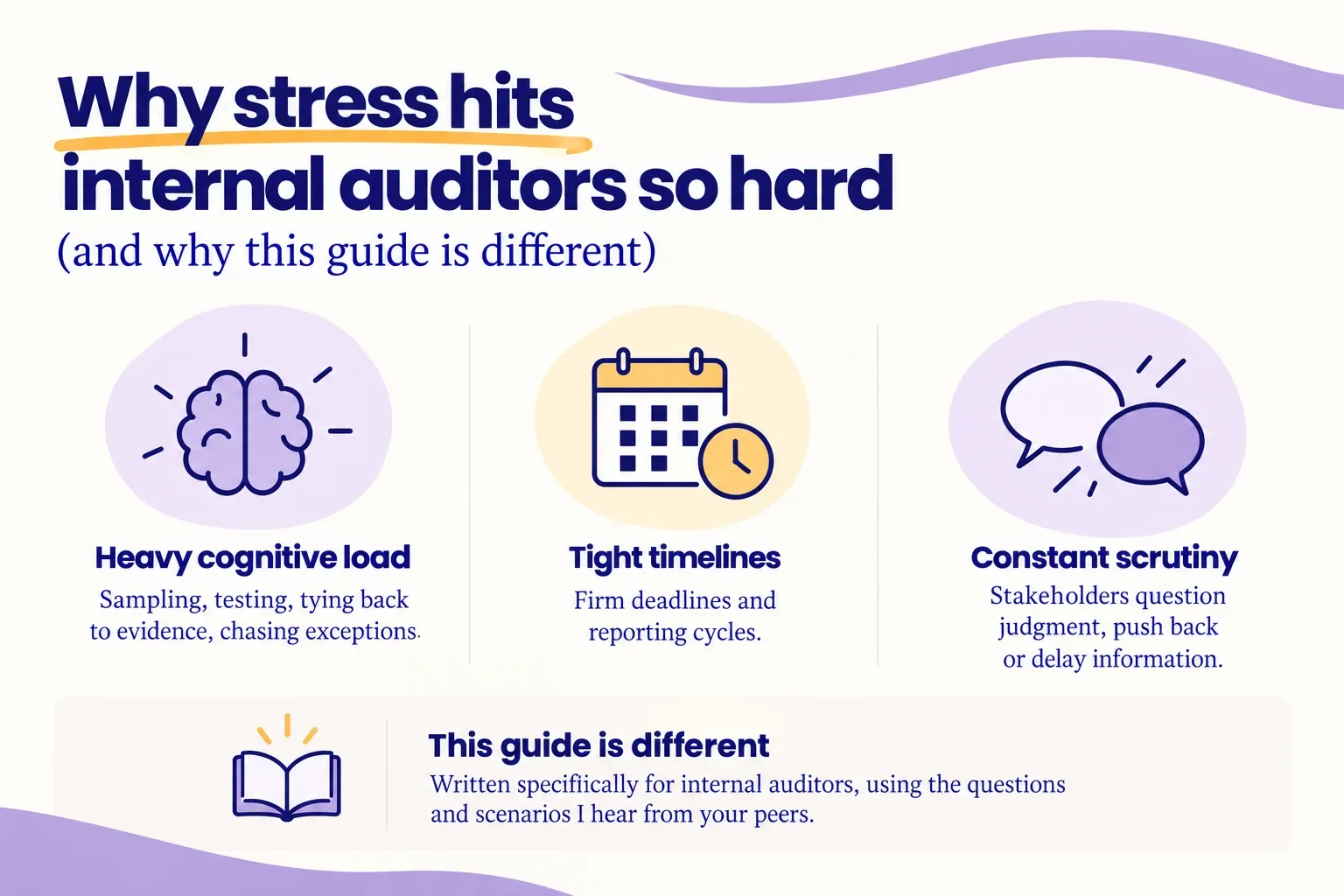
Stress hits internal auditors hard because your job combines three tough ingredients: heavy cognitive load, tight timelines and constant scrutiny. All of these are intense and that mix creates distinctive stress patterns.
Your days are full of sustained concentration: sampling, testing, tying back to evidence, chasing exceptions. That level of focus uses a lot of mental energy and makes your brain more sensitive to interruptions and context switching. On top of that, you work against firm deadlines and reporting cycles that you do not control, while stakeholders question your judgment, push back on findings or delay the information you need.
From a neuroscience perspective, this means your “threat detection” systems in the brain fire not only when something is objectively risky, but also when you anticipate conflict, last-minute scope creep or errors in complex spreadsheets. Over time, your stress response can start to trigger even when you open your inbox or a new working paper.
This guide is different because it is written specifically for internal auditors, whom I’ve had the pleasure of speaking to several times, using the questions and scenarios I heard from your peers.
A little about me before we dive it: I am a Burnout & Corporate Stress Management Speaker, neuroscientist, TEDx speaker and a PhD candidate with a Bachelor's in Neuroscience and Master's in Management. My TEDx Talk "How to Relieve Stress When You're Overwhelmed" was selected as an Editor's Pick.
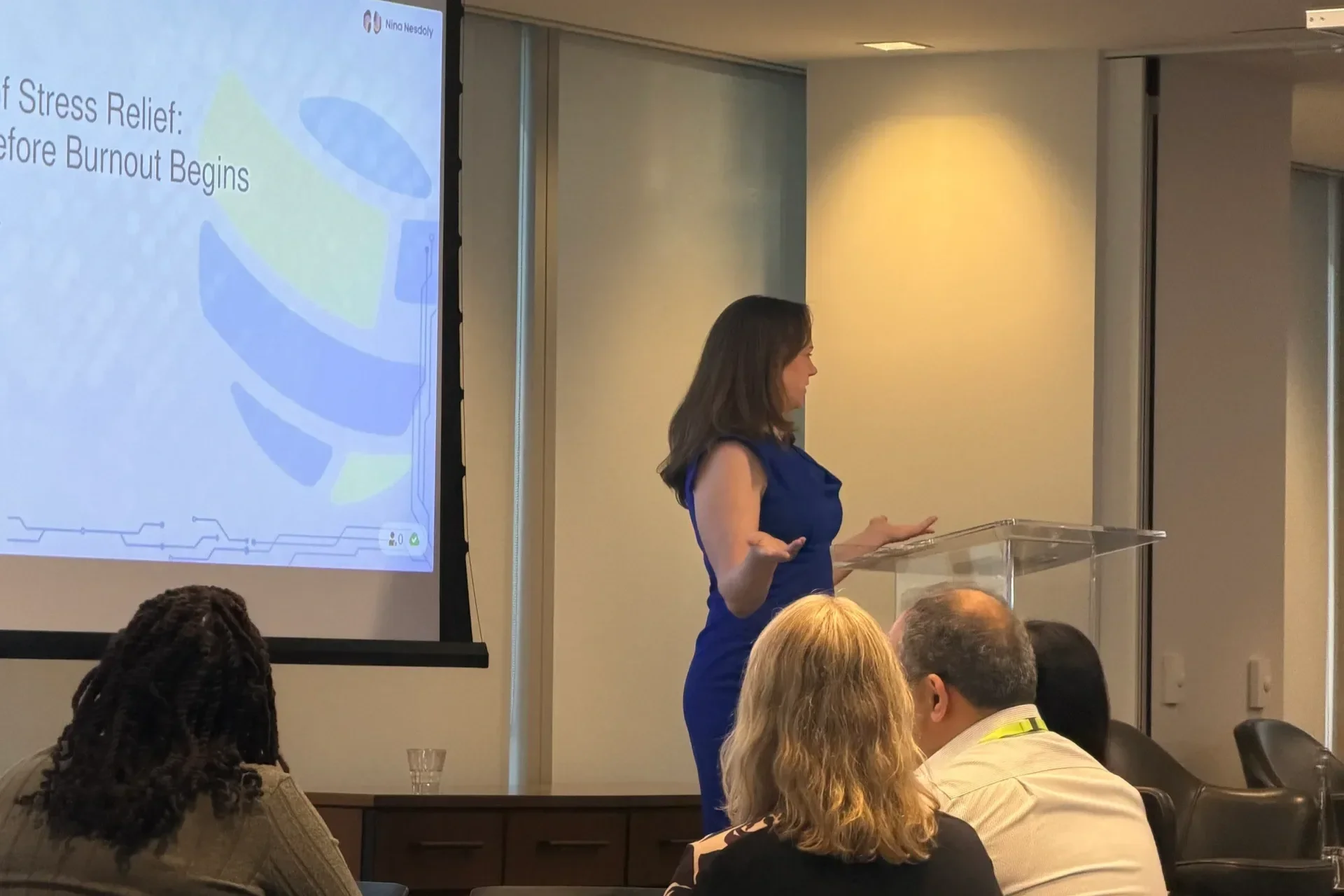
I have given keynotes to the Institute of Internal Auditors Ottawa Chapter (May 2025) and Institute of Internal Auditors Toronto Chapter (May 2026). Those sessions were such fun, thoughtful groups. Real questions from your peers (that I frantically typed into my notes app afterwards so I wouldn’t forget them) were used to great this role-specific guide.
“That was amazing! People are raving about your session!” - Perla Habschi, IIA Ottawa Chapter Chair of Academic Relations
Step 1: Know the types of stress (acute, episodic and chronic)
The first step in stress management is to understand what kind of stress you are dealing with: acute, episodic or chronic. Each type shows up differently in internal audit work and needs a different response.
Acute stress is short term and tied to a specific event. For you, that might be a last-minute request from the audit committee, a tense closing meeting, or realizing you mis-sorted a data extract and need to fix it before tomorrow’s status call. Your heart rate spikes, you feel alert and focused, and once the moment passes, your body can return to baseline. Acute stress can actually sharpen performance in the short term.
Episodic stress is acute stress that happens repeatedly in patterns. In internal audit, that can look like every quarter-end review, every time a particular executive is on the client list, or every time you are assigned to a specific high-pressure process. You notice that certain weeks or projects always come with headaches, irritability or poor sleep. The key with episodic stress is to spot the pattern so you can prepare and build in recovery before and after those predictable spikes.
Chronic stress is the one that quietly wears you down. This is when the demands of your role exceed your capacity for weeks or months: back-to-back audits with no downtime, ongoing staff shortages, constant political tension with one business unit, or a culture where people praise all-nighters. With chronic stress, your nervous system stops returning fully to baseline. You might feel emotionally flat, exhausted even after weekends, more forgetful or cynical, and you may start to question whether you can keep doing this work long term.
Internal audit has clear busy seasons and repeated audit cycles, which makes it much easier to see episodic and chronic patterns when you know what to look for. Take a moment to mentally map your year: when do you reliably feel your worst, and when do you recover? That awareness is what lets you intervene earlier, instead of waiting until you are on the edge of burnout. If you want to go deeper on how chronic stress contributes to burnout, you can read more about chronic stress and its role in burnout.
Step 2: Map your stress in your body and mind
Once you know the type of stress, the next step is to map how it shows up in your body and your mind. This helps you choose tools that match what you are actually feeling, instead of throwing generic advice at a very specific problem.
Audit work loads the “mind” side of stress heavily. You spend hours concentrating on details, holding complex process flows in your working memory and making judgment calls about risk and control design. Mental stress cues for internal auditors often look like:
Brain fog when you stare at a test sheet and nothing sticks
Racing thoughts about stakeholder reactions to your draft report
Rumination after a harsh comment, replaying the conversation instead of sleeping
Difficulty switching off after work, even if you are not physically tired
That mental load then spills into physical symptoms. Physical stress cues can include:
Tension in your neck, shoulders or jaw after hours of spreadsheet review
Headaches that reliably show up during long fieldwork days
Shallow breathing while you type responses to pointed emails
A tight chest or stomach “drop” before contentious meetings
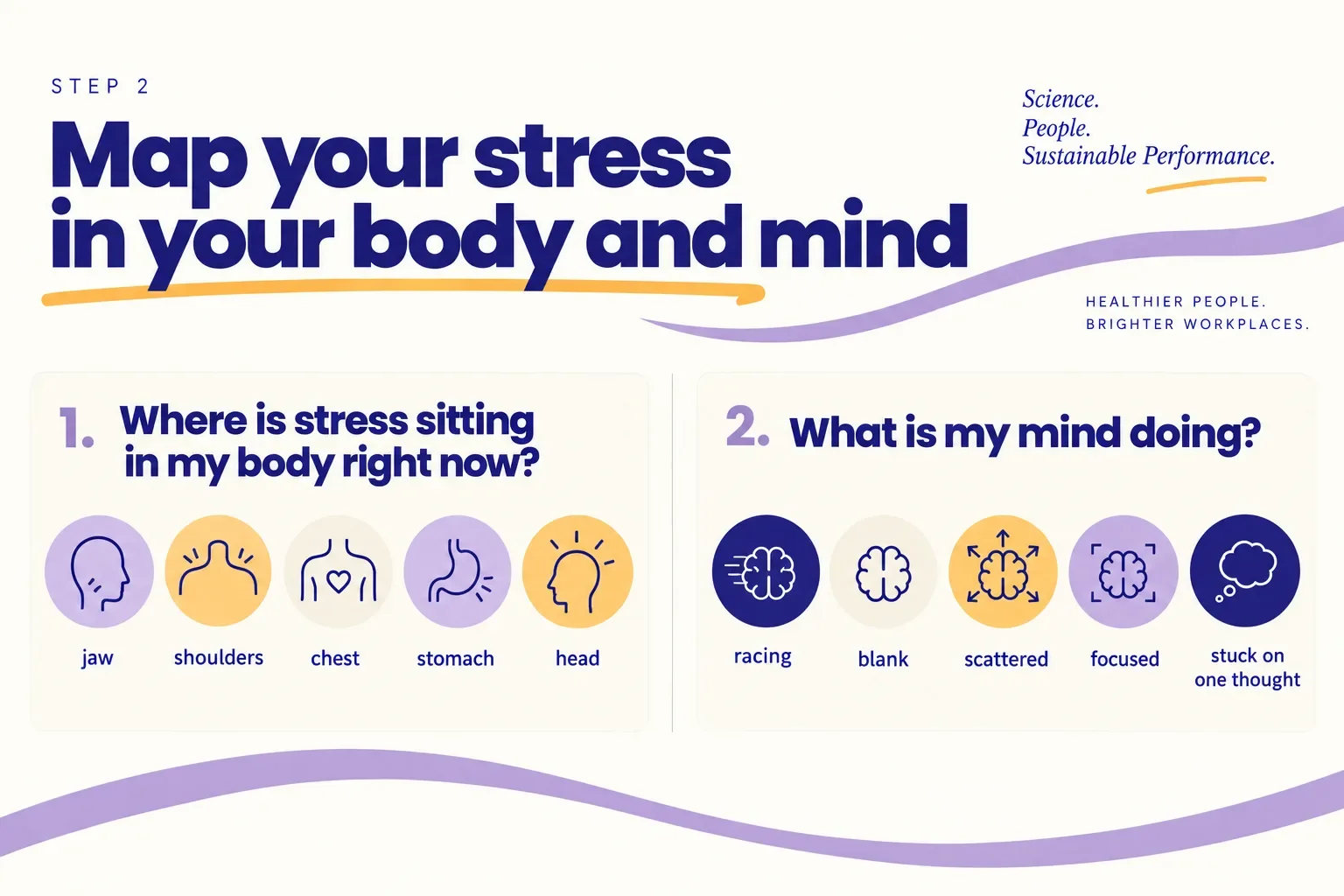
Use simple check-ins during your day. For example, after finishing a testing section or a meeting, ask yourself two questions:
“Where is stress sitting in my body right now?” (jaw, shoulders, chest, stomach, head)
“What is my mind doing?” (racing, blank, scattered, focused, stuck on one thought)
If your stress feels mostly mental (racing thoughts, overthinking), tools that calm the thinking brain are useful: structured journaling, a quick brain dump of worries before you start testing, or clear task chunking for your workpapers.
If your stress feels mostly physical (tight muscles, headache, restless energy), physical tools work better: standing up, stretching, walking to fill your water, or even a few slow, deeper breaths that lengthen your exhale.
Over time, you will notice patterns. Maybe quarterly reviews give you tension headaches, while stakeholder meetings lead to ruminating thoughts. That map lets you quickly match the tool to the symptom, instead of trying random strategies and feeling like nothing works.
Step 3: My 3 keys to stress relief during audit work
When you are overwhelmed, you do not have the bandwidth to overthink stress management. This is where my 3 keys to stress relief framework comes in as a simple way to relieve stress during busy periods.
As a Burnout & Corporate Stress Management Speaker, neuroscientist, I developed this framework to help people quickly choose relief actions that actually shift their nervous system.
Here is how you can apply the 3 keys directly to audit work:
Key 1: Let Tension Out
Choose activities that involve letting something out of the body; sweat or energy when you move your body, words when you talk to a friend, ideas or or drawings on a page. When you release something, tension goes with it.
Key 2: Limit Information In
When you take in information, that becomes your brain’s focus. Your brain can only focus on one thing at a time, so allow stress relief to be the focus for at least a few minutes.
Key 3: Lower the Barrier to Entry
The best way to relieve stress is whatever you will actually do; don’t have time for a long bike ride? Stand up and shake it out at your desk.
If you want a deeper walkthrough of these 3 keys and why they work in your nervous system, I explain them in detail in my TEDx Talk on YouTube.
Step 4: Make small, realistic breaks part of the audit cycle
To make stress management sustainable during audit season, you need breaks that actually fit your schedule. Short, intentional micro-breaks can improve accuracy, focus and decision-making, even when timelines feel tight.
When you are under pressure, it is easy to tell yourself you do not have time to step away. But from a neuroscience perspective, your brain’s attention is like a muscle. After a certain period of intense focus, error rates climb and judgment slips, especially in detail-heavy work like testing or walkthrough documentation. A 2–5 minute reset can protect quality more than another 20 minutes of exhausted pushing.
The key is to tie micro-breaks to natural pauses in your audit workflow:
After you finish documenting one control, stand up, stretch and look away from your screen
When you send a batch of queries to the client, walk to refill your water before opening your inbox again
After a status meeting, take three slow breaths and relax your shoulders before jumping back into fieldwork
When you switch from testing to report drafting, give yourself a short physical reset to help your brain shift gears
These are not long, idealized breaks that do not fit real life. They are tiny habits woven into what you already do. Even 40–60 seconds of standing, moving and looking at a distant point can interrupt the build-up of physical tension and mental fatigue.
If you manage or lead part of the audit function, you can normalize this by acknowledging micro-breaks as part of good audit practice. Protecting your team’s cognitive capacity is directly tied to audit quality. For a broader perspective on why prevention matters, you might be interested in why burnout is becoming such a serious issue across workplaces, which I discuss in why burnout is getting worse.
Your questions from the Institute of Internal Auditors Ottawa and Toronto chapters
When I spoke virtually with the IIA Ottawa Chapter in spring 2025 and then in person with the IIA Toronto Chapter in May 2026, internal auditors asked thoughtful, candid questions about stress, burnout and performance. I love working with internal auditors, and the questions from those sessions directly shaped this guide.
Below are some of the most common questions you and your peers asked, with answers that blend neuroscience with concrete internal audit examples.
1. “How do I know if it’s my circumstances or if I need to build more tolerance?”
This is a powerful question and you are not alone in asking it. People in. every field, not just internal auditors, frequently wonder whether they should just “toughen up” or whether their workload and environment are genuinely unsustainable.
From a neuroscience point of view, both matter. Your nervous system has a certain capacity for stress. You can build skills to work with that system more skillfully (what people often call “tolerance”). At the same time, if demands are consistently too high, no amount of personal resilience will fix a structural problem.
Clues that point toward circumstances:
You are working long hours most weeks, not just in occasional peaks
Your team is understaffed for the number or complexity of audits
You regularly cancel breaks, lunch or time off to meet audit deadlines
There is a culture of criticism or blame when findings emerge, instead of curiosity and improvement
Even on days you use good tools (micro-breaks, boundaries, movement) you still feel depleted
These suggest that organizational workload, staffing or culture need to change. That might mean raising capacity concerns with your manager, documenting the impact of rushed audits on error rates, or advocating for more realistic timelines.
Clues that point toward building skills:
Your workload is heavy but comparable to peers, yet you feel much more overwhelmed
You replay tough conversations for days, long after the stakeholders have moved on
You say yes to every request, even when your plan is already full
You do not use the small recovery windows that do exist in your day
Here, personal strategies can make a real difference: learning to say “I can do that, but here’s what will move,” using the 3 keys to stress relief in real time, and practicing switching off mental rumination after work.
In practice, it is rarely 100% one or the other. Start by using the tools in this guide to support your nervous system, and in parallel, notice and, where possible, address any structural issues like workload, role clarity or psychological safety in your audit function. You deserve both reasonable circumstances and skills.
2. “Stress in the mind versus body – how do I tell which is which and what to do?”
You experience stress in your brain and body at the same time; these are not different things. Stress is a psychological and physiological but many of us are really good at overriding the sensations. If your mind is racing, it’s also in your body.
What you’ll notice psychologically. Examples from audit life:
Lying awake imagining how management will react to your high-risk finding
Writing and rewriting the same email to a senior stakeholder
Fixating on a single error you missed, even though the overall audit was strong
What you’ll notice physiologically in audit life:
Tight chest and shallow breathing before a close-out meeting, even if you feel prepared
Hands shaking slightly while you type during a conflict-heavy discussion
A heavy, exhausted feeling in your limbs after a long testing day, even if your mind still feels busy
Use the 3 keys to stress relief. You can choose how to relieve stress based on what is most noticeable. For example, if your mind is racing journalling may be the best way to relieve stress. If you feel very tense, physically, you mind find going for a run more satisfying.
3. “Why is exercise stress relief if it feels stressful?”
This is an insightful question; why is something that feels effortful stress relief?
Your stress response is designed for physical action. When your brain perceives a threat, it releases stress hormones to prepare your body to move: fight, flight or freeze. In modern work, the “threats” are emails, meetings and spreadsheets, but your body still gets primed as if you need to run.
Exercise, even gentle movement, gives your body a chance to “use up” that stress energy and signal to your brain that the cycle is complete. Over time, regular movement helps your baseline stress response become more flexible: it ramps up when needed and returns to calm more easily.
Exercise also helps you to meet your nervous at the level of the stressor you encountered; stress relief is not passive, it’s an active process in your nervous system.
That does not mean you have to start intense workouts after 10-hour audit days. For sedentary, deadline-driven roles like internal audit, realistic movement might look like:
Walking a few laps of the floor between meetings instead of scrolling your phone
Taking a 10-minute walk outside after shutting your laptop, to create an “end of work” signal for your brain
Stretching your hips, back and shoulders for a few minutes before bed on heavy desk days
On less intense weeks, scheduling one or two longer movement sessions you actually enjoy
The goal is not to exhaust yourself more. It is to give your nervous system regular, manageable outlets so stress does not build up unprocessed. That is why exercise can be a powerful long-term stress relief tool, even if it feels effortful in the moment.
4. “How much journaling is needed to relieve stress?”
You do not need to become an avid diarist for journaling to help with stress. What matters is using it intentionally and consistently enough that your brain learns, “This is where we sort things out.”
For internal auditors, structured, brief journaling often works best. For example:
At the end of a tough audit day, spend 5 minutes answering three prompts: “What went well, what was hard, what I will handle tomorrow”
Before a high-stakes meeting, write down your top three worries, then beside each, one concrete action or piece of evidence you have
During episodic busy seasons, do a weekly “audit debrief” page: what is draining you, what is helping, what boundary you want to set next week
In terms of “how much,” even 3–5 minutes a few times per week can start to shift things. You are externalizing the stress so your mind does not have to keep holding everything in working memory.
If journaling feels like another task on your to-do list, scale it back. One sticky note with “Today’s hard thing / Today’s win” counts. The goal is not volume of words; it is giving your brain a safe container to process what is swirling around from your audits.
5. “What’s the difference between getting validation and physical stress relief?”
I loved this question about the difference between talking to someone about stress and actually feeling calmer in their bodies. Both are important, but they do different things in your nervous system.
Emotional validation happens when someone really hears and understands your experience. For example, after a contentious meeting where a process owner questioned your competence, a teammate might say, “That was rough. Your questions were fair and you stayed professional.” This reduces shame and self-doubt. Your brain’s social centers register, “I am not alone, and I am not crazy.” That is powerful.
Physical stress relief directly targets your body’s stress response. After that same meeting, physical tools might be walking the hallway, dropping your shoulders and unclenching your jaw, or taking a few slow breaths before your next task. These actions tell your nervous system, “We are safe enough now, you can come down from high alert.”
If you get validation without physical relief, you might feel seen but still wired. If you use physical tools without any emotional support, you might calm your body but still feel isolated or self-critical.
The most effective approach is to intentionally use both, especially after tough audit moments. Talk to a trusted colleague or mentor to process the emotions and get perspective, then take a small physical action to help your body actually exit that stress state. Over time, this combination can reduce how long difficult interactions stick with you.
6. “Will journalling bring things up that I do not want to deal with?”
This is a very human concern, especially when you are already close to burnout. You might worry that putting things on paper will unleash a flood you do not have capacity for.
You can keep your journaling focused on specific, work-related situations rather than your entire life story. For example, you might limit yourself to prompts like:
“What from today’s audit work is still looping in my head?”
“What do I need from my manager or team this week?”
“What is one boundary I want to try tomorrow?”
If you notice bigger themes emerging that feel heavy or connected to old experiences, that can be useful information that additional support might help with, such as talking to a mental health professional. It does not mean you have to resolve everything through journaling alone.
You can also build in a “containment” step. After writing, close the notebook, put it in a drawer and do a short grounding activity, like stretching or washing your face. This signals to your brain that you have parked the thoughts for now. You acknowledged them; you are not required to solve them all tonight.
The bottom line: you get to set the boundaries around journaling. Used gently and with clear limits, it can be a helpful tool for internal auditors to offload specific work stress without opening more than you feel ready to handle.
When to seek extra support for stress and burnout as an internal auditor
Sometimes, despite trying multiple tools, your stress still feels unmanageable. That is not a personal failing; it is a sign your nervous system needs more support.
It might be time to seek extra support if you notice:
Persistent exhaustion that does not improve with weekends or vacations
Growing cynicism or detachment about your audits, colleagues or stakeholders
Frequent mistakes in tasks you used to handle easily
Physical symptoms like chronic headaches, stomach issues or insomnia that your doctor cannot explain with other causes
Feeling numb, hopeless or stuck, even when circumstances change
These are classic signs that chronic stress may be moving toward burnout. At that point, self-directed strategies like micro-breaks, journaling and movement are still helpful, but not always sufficient on their own.
Additional support can take several forms:
Talking with a mental health professional who understands work-related stress
Having transparent conversations with your manager about workload, staffing or role design
Exploring whether there are cultural or leadership changes needed in your audit function, for example through leadership development or training
Working with your organization to create healthier practices, like realistic scoping, clearer priorities and permission for true recovery time after intense audit cycles
Stress relief is not meant to be a solo project, especially in roles like internal audit where organizational systems strongly shape your day-to-day reality. If you are interested in working on this as a team, you can explore my team burnout workshops, where I partner with organizations to help teams work in a healthier, more sustainable way.
You do important work, and you deserve to do it in a way that does not cost you your health. If you want support bringing these tools to your whole audit team, you can book a Team Workshop with me here: Book a Team Workshop.
This article is educational and is not medical advice.