
How long does burnout recovery take?

TLDR: There is no single burnout recovery timeline, but most people will not be “fixed” by a vacation or a long weekend. Emotional exhaustion can ease within weeks with rest and early interventions, yet full recovery, can take months. Severe, clinical burnout can take years. Full recovery depends on work-related changes, not just individual changes.
How long does it really take to recover from burnout? Every few months, I see terrifying posts on Tik Toks circulating misinformation on this topic, claiming that burnout recovery takes 3-5 years. I am a stress and burnout researcher, and I have never been able to track down a source for this claim, but the good news is the repeated circulating of this scary number made me curious about what the data does say.
In this article, I will walk you through what the research says about burnout recovery, what I see in practice with teams, what typically happens at work over time, and how you as an HR or people leader can support a faster, more sustainable recovery.
Burnout recovery isn’t a quick fix
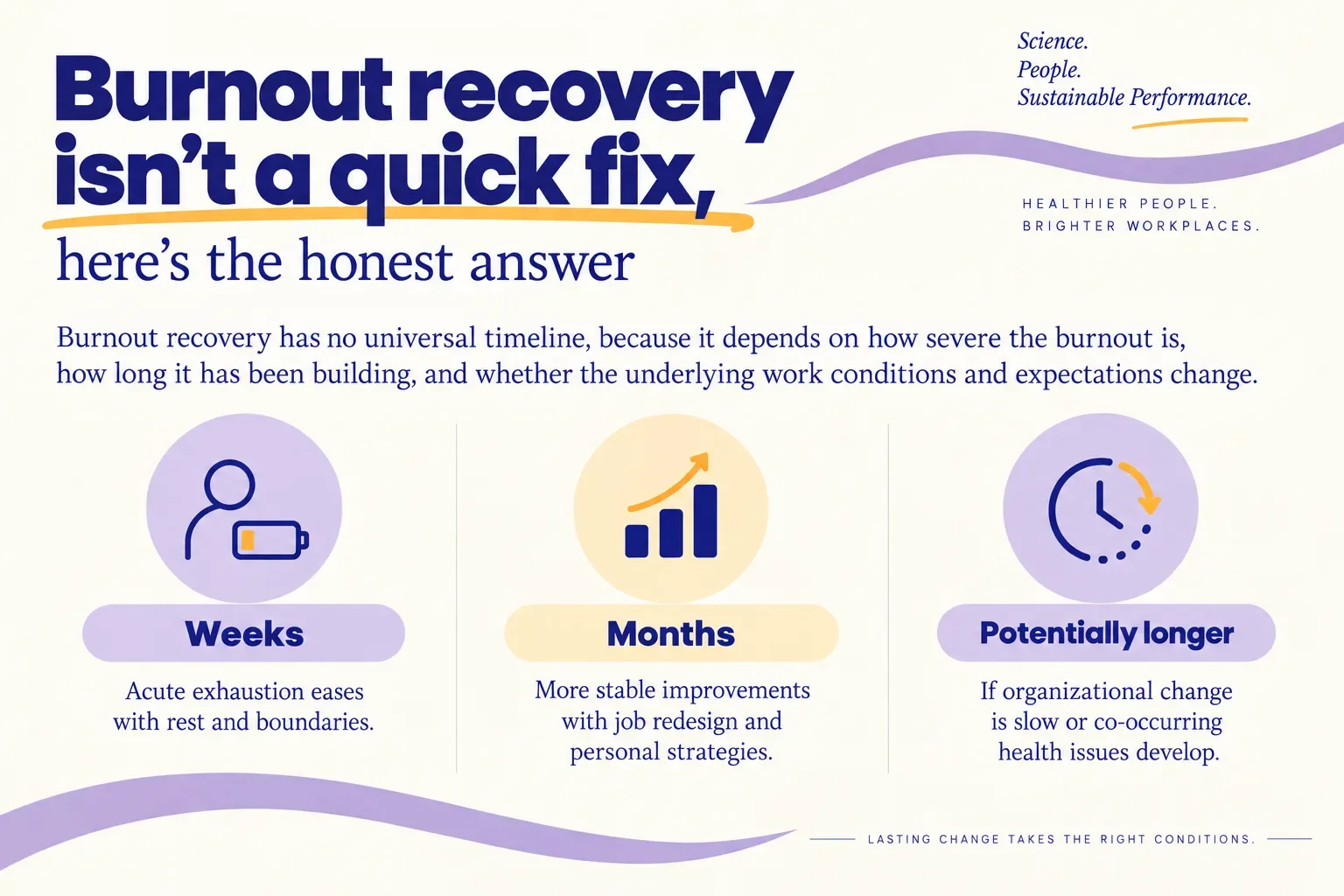
Burnout recovery has no universal timeline, because it depends on how severe the burnout is, how long it has been building, and whether the underlying work conditions and expectations actually change.
I get that may be frustrating, but it’s a more accurate (and less scary) reality than the fear-mongering that circulates online.
Emotional exhaustion often eases quickly with rest, but it usually returns if underlying work conditions and expectations do not change. This is why people come back from vacation feeling briefly better, then crash a few weeks into the same overflowing inbox, headcount shortages or late-night emails.
Burnout according to the World Health Organization’s occupational dimensions (emotional exhaustion, cynicism and reduced professional efficacy) can often improve much faster than severe, clinical-level burnout. If someone is still functioning at work but clearly drained, detached and feeling less effective, there is a good chance that early, targeted interventions at both the personal and workplace level can create meaningful improvement within a few months.
In my experience working with organizations, and in the teams I work with, signs of emotional exhaustion can often be relieved within a couple of weeks with rest and early interventions, especially when burnout is caught before becoming severe. This is not full recovery, but you can see noticeable changes in irritability, sleep and energy.
Even when someone meets all three dimensions of occupational burnout to some degree, early, targeted interventions can mean they do not necessarily need years to recover; in many cases, a few months of combined personal and workplace changes can lead to substantial improvement. Those months are often where you see reduced sick days, better engagement in meetings, and fewer breakdowns over relatively small issues.
At the more extreme end, full recovery from clinical-level burnout can take years, particularly when the person has been burned out for a long time or when workplace changes are slow. In those situations, people may be off work for extended medical leaves, need structured rehabilitation and move gradually back into reduced duties.
I suspect the widely circulated claim that burnout recovery always takes three years likely comes from the most severe clinical burnout cases (including hospitalization), but that does not describe what most workers with occupational burnout will experience. For a typical employee or leader showing significant exhaustion, cynicism and reduced performance, but still working, a realistic pattern tends to look more like:
weeks for acute exhaustion to ease with rest and boundaries
months for more stable improvements when paired with job redesign and personal strategies
potentially longer if organizational change is slow or if co-occurring health issues develop
Recovery tends to take longer the longer burnout goes unaddressed. That is one of the big reasons HR and leaders cannot simply wait it out or keep “pushing through” themselves.
Rest is important but only part of the solution; personal well-being strategies tend to help most with emotional exhaustion, while cynicism and reduced professional efficacy specifically require work-related changes and a combination of both personal and organizational strategies for successful return to work. This is why telling people to “use their vacation days” without adjusting workload is so frustrating for everyone involved.
As a people leader, your planning horizon should usually be: “What can we do in the next 2–4 weeks to stabilize energy, and what are we changing over the next 3–6 months to support deeper recovery?”
If you want a science-backed refresher on why chronic workload and stressors have such big effects, you may find this article helpful on chronic stress and its role in burnout.
The main factors that change how long burnout recovery takes
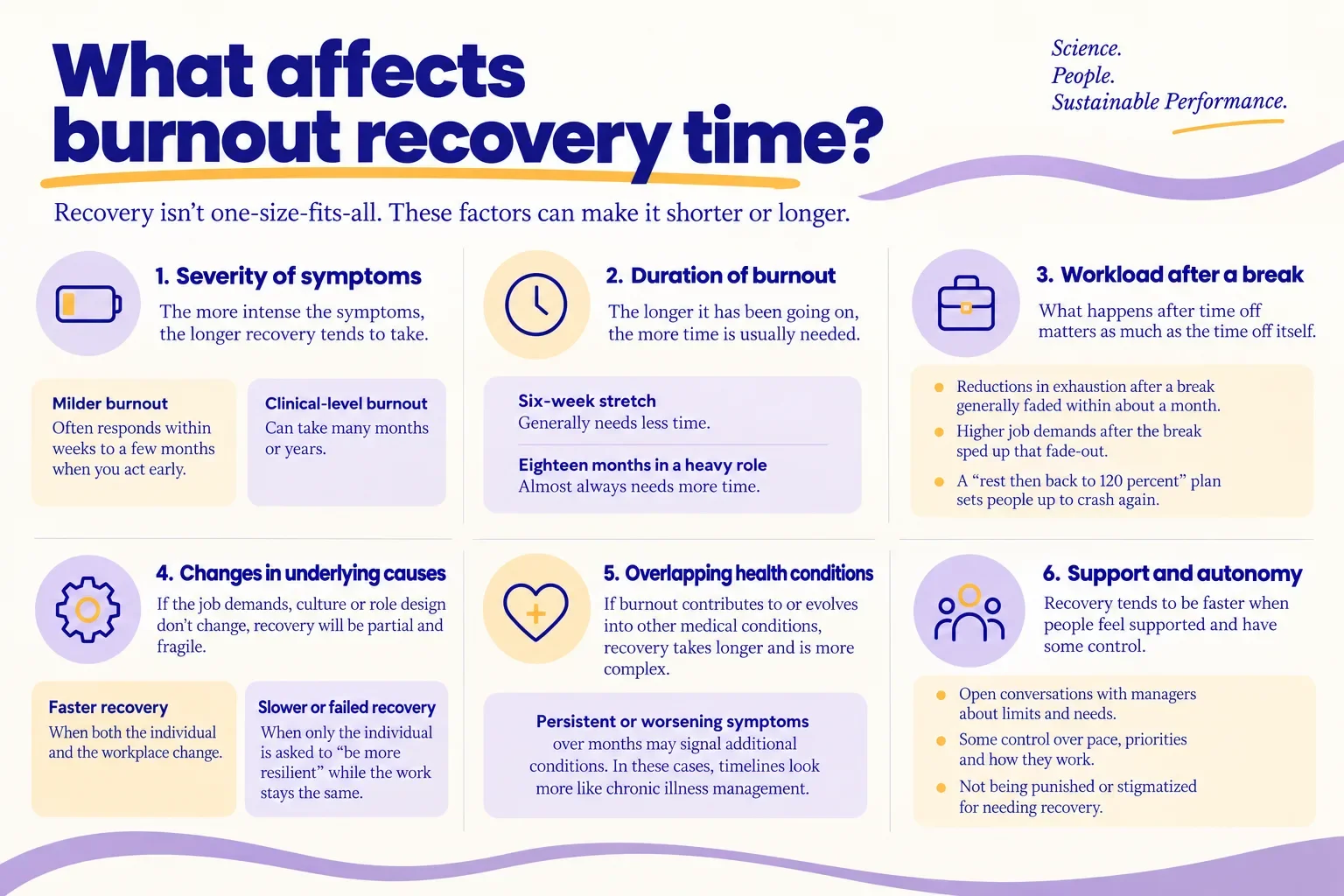
The big reason there is no single answer to “how long does burnout recovery take” is that several variables pull the timeline in different directions.
Severity and duration of burnout
Severity is the strongest driver of the recovery timeline.
If someone has been running hot for months, noticing more irritability and some sleep issues, but they still feel connected to their work, you are likely seeing earlier-stage occupational burnout. Here, recovery may look like:
days to reduce the worst exhaustion with actual rest
weeks to stabilize energy and focus with clear boundaries and workload tweaks
a few months to meaningfully shift cynicism and a sense of effectiveness, with both personal strategies and job changes
On the other hand, when someone has severe symptoms, cannot get through a workday, or is already on leave, the path is longer.
For you as HR, this means you should be cautious about applying “clinical burnout” timelines to everyone who reports feeling burned out at work.
Workload and job demands after a break
How the work looks when someone returns from a break has a huge impact on how long their recovery actually lasts.
In teachers, reductions in exhaustion after a break generally faded within about a month, and higher job demands after the break sped up that fade-out, based on Kühnel and Sonnentag (2011). This fits with what many HR leaders see: everyone is a bit more cheerful coming back from summer, then the same old overload hits and the benefits vanish.
Similarly, a meta-analysis found that vacations have only a small positive effect on burnout that quickly fades once regular work resumes. Time away from work is valuable, but unless job demands change when employees return, the underlying burnout process simply restarts.
For your planning:
If an exhausted employee comes back to the same workload, do not expect lasting recovery from that break.
If you intentionally moderate demands, pace projects and support boundaries in the weeks after, recovery is more likely to stick and shorten the overall timeline.
Personal coping strategies and support
Even in a stressful environment, individuals differ in the tools they have.
Person-directed interventions outperformed purely organizational interventions for reducing emotional exhaustion, although organizational changes remain crucial for sustainable recovery. This means that skills like setting boundaries, managing rumination, improving sleep or reframing unhelpful thoughts can reduce how intensely someone feels exhausted, even before the organization fully catches up on workload or staffing.
However, the other two burnout dimensions, cynicism and reduced professional efficacy, are much more sensitive to the actual work. You can teach someone to breathe through their frustration, but if their role remains chronically understaffed with conflicting priorities, their attitude toward work and sense of impact will still suffer.
If you are curious about structured personal tools, my TEDx Talk "How to Relieve Stress When You're Overwhelmed" selected as an Editor's Pick walks through practical strategies people can start using right away. Watch it on YouTube.
Organizational willingness and speed of change
Finally, the speed of burnout recovery is heavily influenced by how responsive the organization is.
If leaders validate burnout, adjust expectations, reset priorities and address common causes of workplace burnout, recovery usually moves on the shorter end of the spectrum for that level of severity.
If the message is “we care” but nothing visible changes about workload, decision-making or psychological safety, recovery stalls. People may temporarily feel heard, but their nervous system is still dealing with the same chronic stress pattern every day.
For an HR or a people leader, one useful question is: “Are we acting such that people can actually feel the difference in their day-to-day week by week?”
Typical phases of burnout recovery (and what they look like at work)
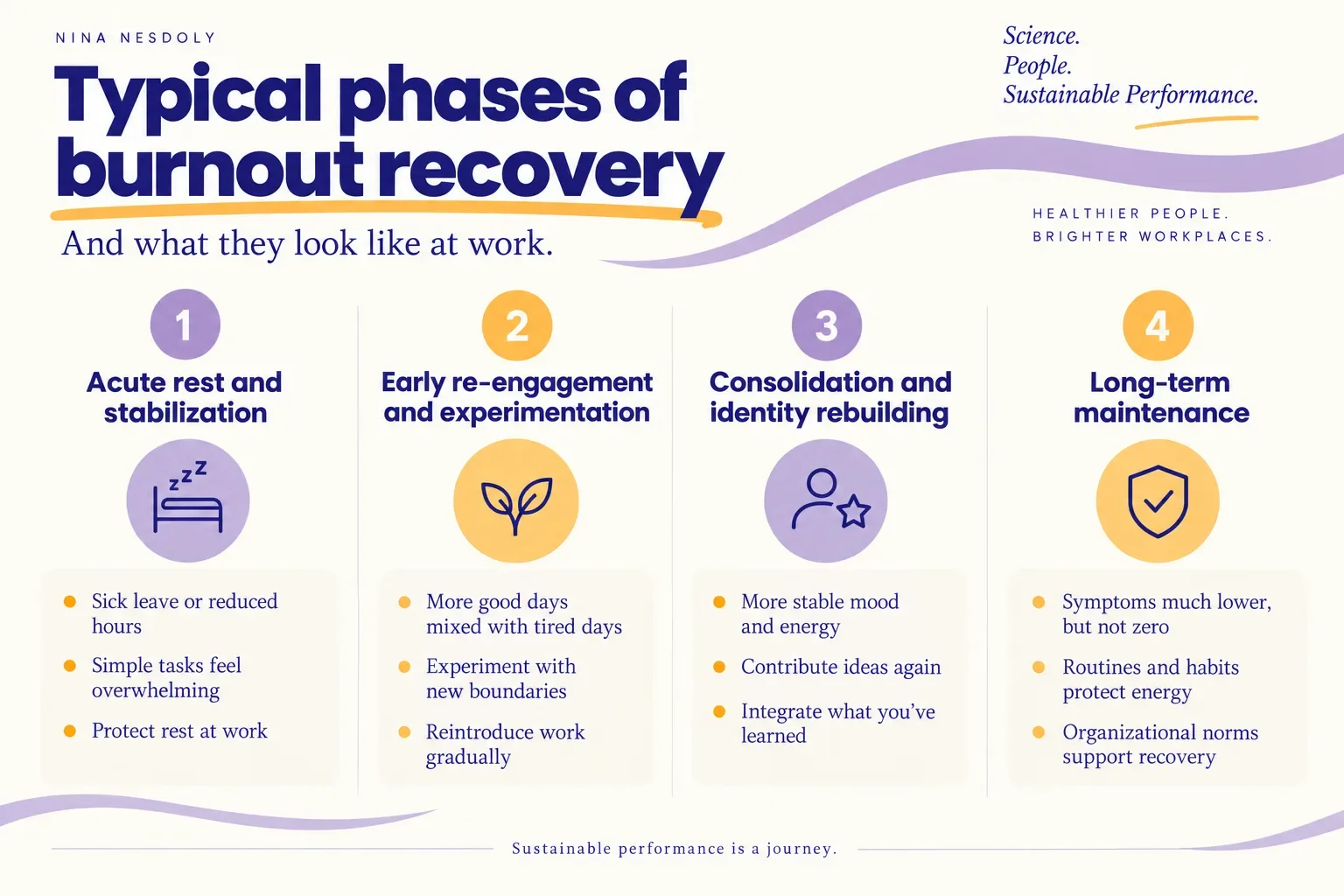
Recovery does not move in a straight line, but there are recognizable phases. Understanding these can help you know what to expect from yourself and your team at each stage.
Acute rest and stabilization
Recovery often begins with an acute rest and stabilization phase, where capacity is very low and rest is the primary intervention.
You might see:
an employee going on sick leave or reducing hours
you, as a leader, realizing you cannot sustain your current schedule
simple tasks feeling overwhelming
more sleep, or sometimes initial difficulty sleeping because the stress system is still “on”
At work, this phase can look like:
temporary reassignment of projects
postponing nonessential initiatives
explicit permission to step away from certain meetings or on-call rotations
Your job in this phase is to protect rest. Well-meaning managers sometimes try to use this window to “catch up” with the person on big-picture planning. For someone in acute burnout, those conversations are often draining, not energizing.
Signs this phase is progressing:
some improvement in baseline energy
slightly better concentration
fewer emotional outbursts or tears over small triggers
“Nina’s teachings really resonated with our leadership team and inspired us to re-evaluate our work-life balance.” Feedback like this often comes from teams who have allowed rest to be real, not performative, in this phase.

A relaxed outdoor portrait in a city setting.
Early re-engagement and experimentation
Once the sheer exhaustion starts to lift, people move into an early re-engagement phase. They are not “back to normal,” but capacity is higher than in the acute period.
You may notice:
more good days mixed in with tired days
cautious optimism about certain tasks
employees experimenting with new boundaries (for example, no emails after a certain time)
At work, this is the phase to:
reintroduce work gradually, prioritizing high-meaning or high-skill tasks over busywork
adjust expectations about speed and volume
normalize that energy will fluctuate and that relapses do not mean failure
This is also where personal strategies and coaching can do a lot of good. People are awake enough to learn and try new skills but still motivated to avoid sliding back.
Consolidation and identity rebuilding
If early re-engagement goes well and work conditions have shifted, people start consolidating their gains and rebuilding their professional identity.
Signs in this phase:
a more stable mood and energy across weeks, not just days
renewed interest in solving problems instead of just surviving the day
more realistic, compassionate self-talk about mistakes or slower output
At work, you may see:
employees contributing ideas again, not just executing tasks
more proactive communication about capacity (“I can take A or B, not both”)
leaders integrating what they have learned into how they manage their teams
This is where reduced professional efficacy starts to improve. People remember that they are good at their jobs, often with clearer boundaries than before burnout.
Long-term maintenance
The final phase is less dramatic, but it is where sustainable change either sticks or quietly erodes.
In long-term maintenance:
burnout symptoms are much lower, but not necessarily zero
people have routines and habits that protect their energy
organizational norms support reasonable workloads, recovery time and psychological safety
At work, this shows up as:
realistic resource planning
leaders modeling healthy behavior (not bragging about 80-hour weeks)
formal policies that align with how you want people to work, not against it
“We saw immediate improvements in how our employees approached stress management. Highly recommend!” Teams in maintenance phases often describe this kind of cultural shift: not just reactive crisis management, but a different way of relating to stress.
Red flags that burnout recovery is taking too long or getting stuck
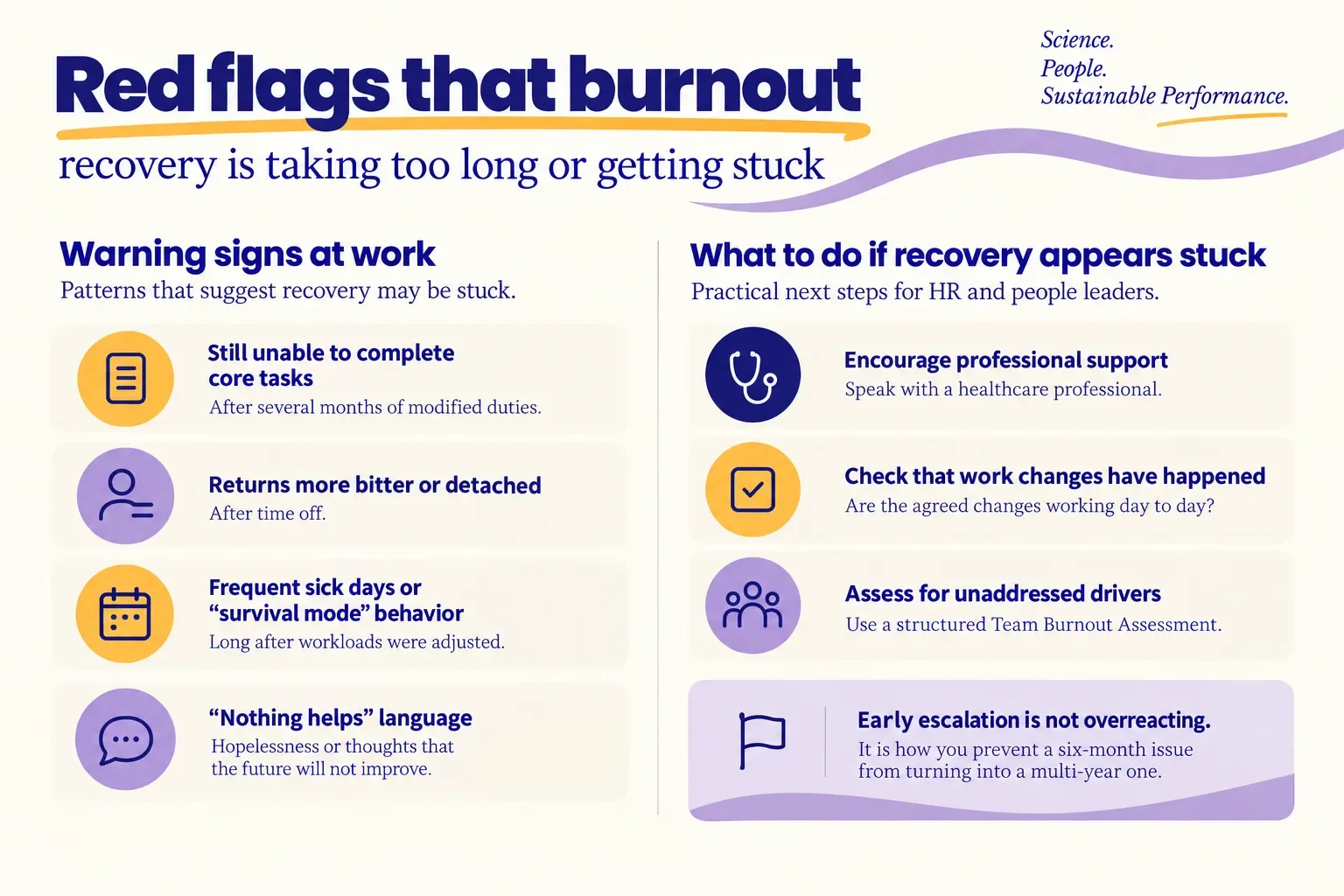
Some ups and downs are normal in recovery, especially around busy periods, personal stress or organizational change. What you are looking for as HR or a people leader are patterns that suggest the process has stalled.
Sustained or worsening exhaustion, cynicism and reduced performance over months are warning signs that recovery may be stuck and that additional conditions or diagnoses (such as depression or cardiovascular issues) might be emerging.
The biggest worry with persistent burnout is that burnout will eventually become other things like depression and even cardiac health issues (this is another reason that we do not have a lot of data on burnout; it is being recorded as something else when it persists clinically).
At work, red flags include:
an employee still unable to complete core tasks after several months of modified duties
a leader who has taken time off but returns even more bitter or detached
frequent sick days or “survival mode” behavior long after workloads were supposedly adjusted
“nothing helps” language, hopelessness or thoughts that the future will not improve
So when recovery appears stuck:
encourage the person to speak with a healthcare professional
check whether the “work changes” you agreed on have actually happened day to day
assess whether there are unaddressed drivers, using tools such as a structured Team Burnout Assessment
Early escalation is not overreacting. It is how you prevent a six-month issue from turning into a multi-year one.
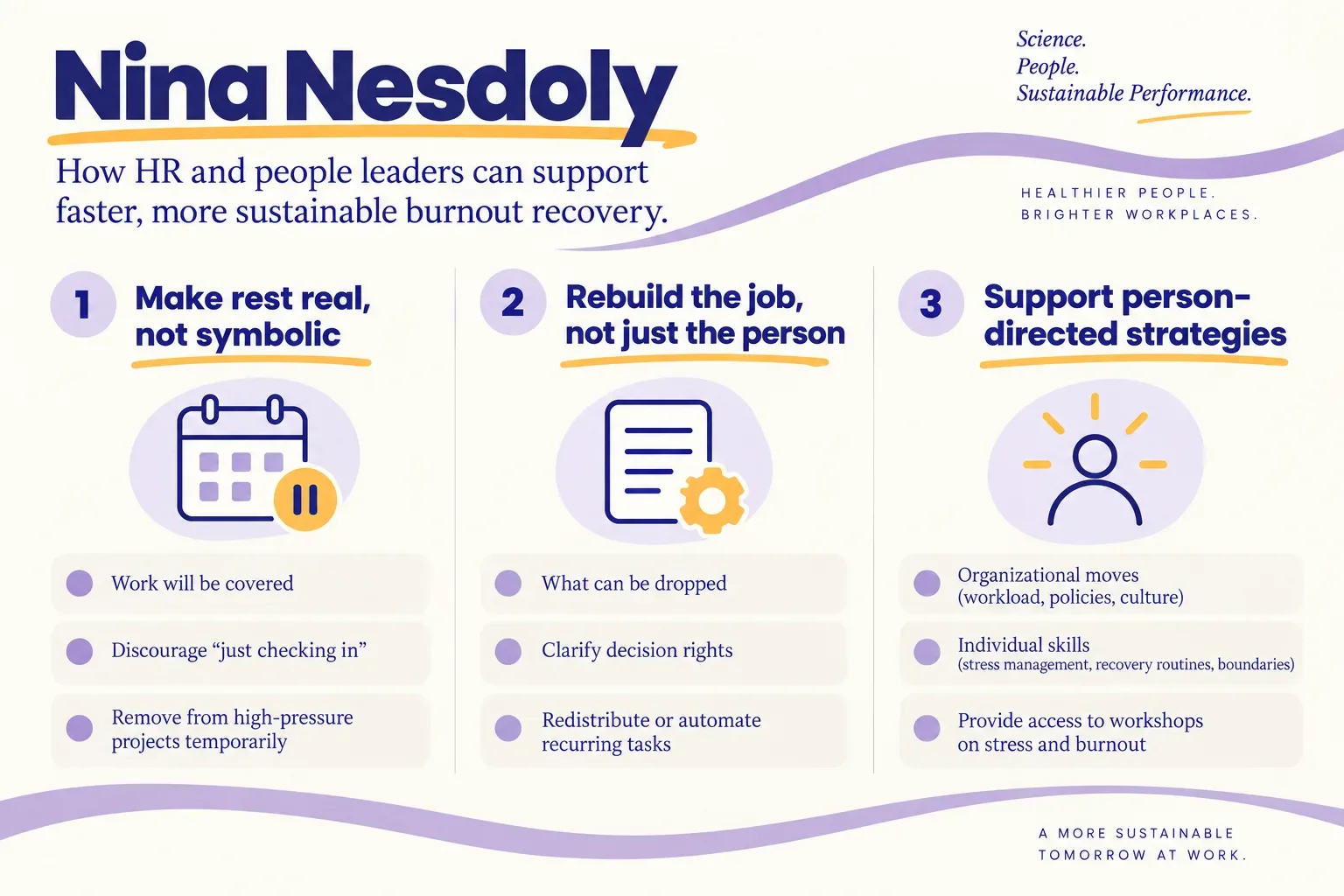
How HR and people leaders can support faster, more sustainable burnout recovery
You cannot control every dimension of burnout, but you have a lot more influence than telling people to “do more self-care.”
Adjusting workloads and deadlines during and after recovery is crucial for sustainable improvement. Without this, you are effectively asking employees to “recover” from burnout while running the same marathon pace.
Here are practical levers you can use.
Make rest real, not symbolic
Approve and protect time away when someone is in that acute phase. That means:
clear communication that work will be covered
discouraging colleagues from “just checking in” about tasks
removing the person from high-pressure projects temporarily
When someone returns from time off, your job is to make sure the return is not “straight back into the fire.” Plan for a gentle ramp-up, not an abrupt restart.
Rebuild the job, not just the person
Rest is necessary, but you also need to look honestly at role design, staffing and expectations.
Consider:
what can be dropped, not just deferred
where decision rights can be clarified to reduce chronic ambiguity
which recurring tasks could be redistributed or automated
You can support your managers by:
training them to identify signs of burnout early
setting expectations that capacity conversations are part of their job
giving them cover from senior leadership to slow or stop work when needed
Support person-directed strategies
This means it works best when you pair:
organizational moves (workload, policies, culture)
individual skills (stress management, recovery routines, boundaries)
As HR, you can:
provide access to workshops on stress and burnout
normalize mental health days and breaks
share vetted resources like the best books for burnout
“Nina’s teachings really resonated with our leadership team and inspired us to re-evaluate our work-life balance.” When leadership models these strategies, it creates permission for employees to use them too.
Consider broader culture interventions
Sometimes the volume of burnout signals is telling you the culture itself needs a reset.
This is where bringing in a Burnout & Corporate Stress Management Speaker to your leadership summit or all-hands can help set a shared language and urgency. “Engaging and relatable… a home run!” is how one organization described this kind of session when they used it to kick off deeper structural work.
If you want a sense of what a keynote covers, you can explore my burnout keynote speaking for conferences and company-wide events page.
Personal expectations: what to tell your team (and yourself) about burnout recovery timelines
As the person people come to for answers, you set the tone for how burnout is understood in your organization.
Being transparent that burnout recovery can take longer than a vacation normalizes the process and reduces shame. You can say things like:
“A week off is a start, but it is not realistic to expect you to feel 100% when you come back. We will support a gradual ramp-up.”
“Burnout builds over time, and it also heals over time. We are looking at the next several months, not just the next quarter.”
For individual conversations:
Avoid promising a specific timeline you cannot control. Instead, share ranges (weeks for initial relief, months for deeper changes).
Emphasize that relapses or bad weeks do not mean they have failed or will never recover.
Clarify what the organization is doing (for example, adjusting workload, hiring or shifting priorities) so it does not feel like it is all on them.
For yourself as a leader, you might need the same message. Your recovery from burnout will likely take longer than a long weekend or even a single holiday. It is okay to lower your own expectations and ask for support.
If you want ongoing, practical ideas you can share with your team, “Join Over 50,000+ Followers. Connect with Nina on Tik Tok, Instagram and LinkedIn.” You can also find me on Instagram for short, science-based videos you can pass along in team channels.
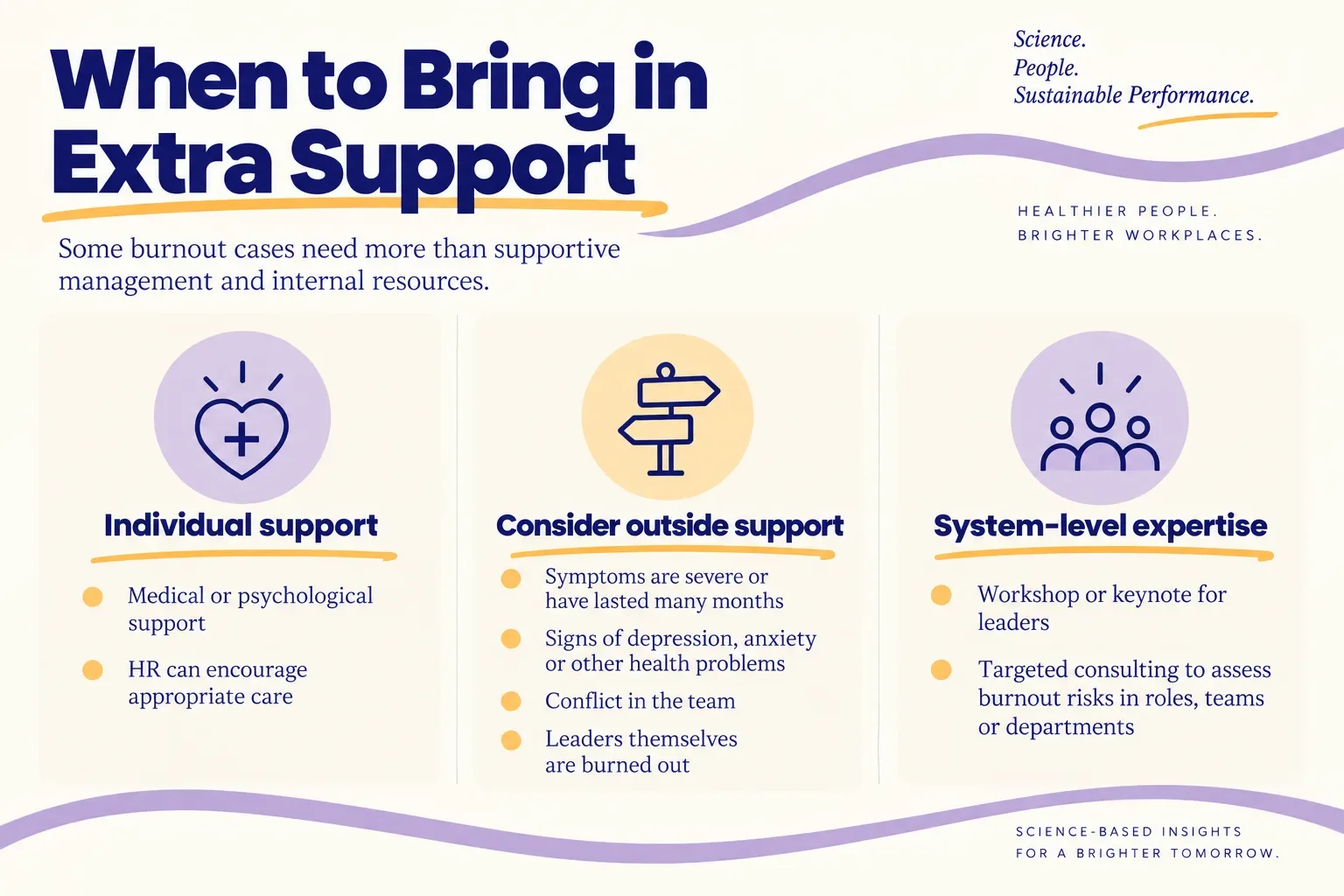
When individual support or outside expertise can change the recovery trajectory
Some burnout cases need more than supportive management and internal resources.
Some burnout cases need medical or psychological support; HR can encourage employees to seek appropriate care. You do not diagnose, but you can say:
“Your health comes first. It would be a good idea to talk with your doctor or a mental health professional about what you are experiencing.”
“We can provide documentation for your provider and explore accommodations based on their recommendations.”
You should consider outside support when:
symptoms are severe or have lasted many months despite reasonable work changes
there are signs of depression, anxiety or other health problems
conflict has developed in the team around the person’s performance or behavior
leaders themselves are burned out and struggling to support others
Beyond individual healthcare, it often helps to bring in expertise at the system level:
a workshop or keynote for leaders to understand burnout science and practical tools
targeted consulting to assess burnout risks in roles, teams or departments
As a Burnout & Corporate Stress Management Speaker, neuroscientist, PhD candidate · TEDx speaker · Bachelor's in Neuroscience and Master's in Management, I work with organizations across the United States and globally on these exact issues, in English and French. “We saw immediate improvements in how our employees approached stress management. Highly recommend!” is a common response when organizations decide to make burnout a strategic priority instead of a private struggle.
If you want help thinking through your specific situation or planning a leadership strategy, you can book a 1:1 consulting call.
FAQs
What affects how long burnout recovery takes?
Recovery time is influenced by how severe the burnout is, how long symptoms have been present, whether underlying work conditions and expectations change, and whether other health conditions are involved. Person-directed strategies can reduce emotional exhaustion more quickly, but sustainable recovery depends heavily on job demands, workload and organizational culture.
What are the phases of burnout recovery?
Typical phases include an acute rest and stabilization phase with very low capacity, an early re-engagement phase where energy starts to return, a consolidation and identity rebuilding phase where people regain a sense of effectiveness, and a long-term maintenance phase where new habits and organizational norms keep burnout from returning. People may move back and forth between phases, especially under new stress.
How can HR support burnout recovery at work?
HR can support recovery by making rest real (not just symbolic), adjusting workloads and deadlines during and after absences, redesigning roles to reduce chronic overload, and training managers to spot burnout early. Pairing these structural changes with person-directed supports, such as workshops, coaching and evidence-based resources, helps reduce emotional exhaustion and supports a sustainable return to work.
When should burnout recovery be escalated to outside support?
Escalation is appropriate when symptoms are severe, have persisted for months despite reasonable work changes, or there are warning signs of depression, anxiety or cardiovascular issues. It is also time to involve external help when there is significant conflict or performance impact at work, or when multiple leaders and teams are burned out and the organization needs strategic guidance and education at scale.
If you are looking at your calendar and your team and realizing that “pushing through” is not a strategy, this is the right time to get support. You can start by sharing this article internally, then, when you are ready to go deeper, Book a Consulting Call to talk through concrete next steps for your organization: Book a Consulting Call.
This article is educational and is not medical advice.