
Gender, Competence, and the Double Bind of Leadership
Why competence alone isn't always enough for women to be seen as legitimate leaders.
Two professors, identical reviews, identical teaching quality. The only thing I changed was the name at the top: Steve or Sarah.
We evaluate the people in charge of us constantly be it a boss, a doctor, a professor, or anyone else whose job is to know more than we do and lead us through something. Consciously or not, we're not just asking "are they good at this?" We're also asking "do they seem like the kind of person who should be in charge?"
My very first research project - my introduction to experimental design, before I started my Masters and specialized in work-related stress - was on the infamous “double-bind.” I've always been drawn to understanding not just what happens to people at work, but why it happens differently to some than others.
The “double bind” is a well-documented phenomenon where woman in positions of authority are caught between a rock and a hard place: be seen as competent or be seen as likeable, but rarely both.
My first research project, an undergraduate study at Carleton University, used fictional reviews as a controlled way to test how gender impacted students’ likelihood to take a course with a professor based on online evaluations.
This research was published in the Journal of Assessment and Evaluation in Higher Education.

Examples of the vignettes used in the experiment.
How I studied it
Working with Christine Tulk and my supervisor, Dr. Janet Mantler, I built an experiment using fictional professor reviews modeled on real RateMyProfessors.com posts. Over 500 undergraduate students each read one version of a review, randomly varied across three things: the professor's name (Steve or Sarah), their quality rating (a strong 5-star review or a mediocre 3-star review), and whether the review mentioned that the instructor "really cared about their students."
That gave us eight different versions of the same basic review, letting us isolate exactly how much gender and warmth mattered, and whether that changed depending on how strong the review already was.
What I found
Straightforward competence judgments were about the same across genders. Students didn't broadly rate "Sarah" as less capable than "Steve." This, at least, was good news. Women were not considered notably less competent than men by default.
But among male students specifically, the missing "caring" line mattered enormously for female professors and barely at for male ones. When a professor's review was already low-rated, male students' willingness to take her course dropped sharply if she wasn't described as caring. A male professor with the same low rating saw almost no change either way. He could be low-rated and businesslike without much extra penalty; she couldn't. Female students, however, gave any low-rated professor a boost for being described as caring. That boost wasn't gender-specific for them.
Separately, we found that individual differences in gender bias predicted a similar pattern more broadly. Using a validated gender-bias scale every participant completed, students who scored higher on it were less likely to want to take a course with a female professor, but their score had no relationship to likelihood of taking a course with a male professor.
When a woman's review was already lukewarm, needing to also prove warmth mattered in a way it simply didn't for a man in the same position, especially for male evaluators.
And students who scored higher on measured gender bias were less inclined to choose a female professor at all, regardless of the specific review.
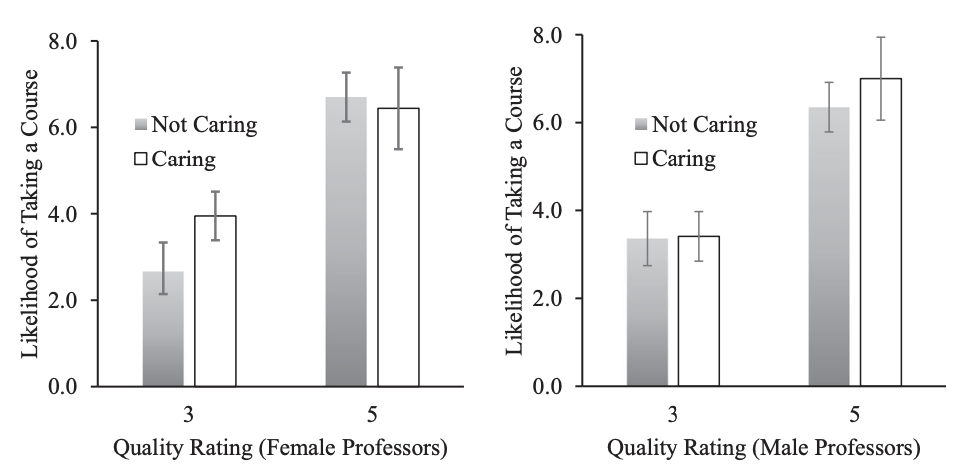
Interaction between professor quality rating and description of caring (not caring, caring) for likelihood of male students taking a course with female and male professors. The interaction was not significant for male professors.
What this means for how we evaluate leaders
The double bind isn’t contained to undergraduate students, it also shows up in performance reviews, hiring panels, and promotion decisions, where a woman's directness gets read as "abrasive" in a way a man's rarely does, and where "warmth," "likeability," or "executive presence" quietly function as additional hurdles to clear.
If you sit on hiring committees, write performance reviews, or make promotion calls: it's worth asking whether everyone in the room is being held to one standard and whether everyone making judgemental calls is doing so using the same parameteres.
How to cite:
Nesdoly, N., Tulk, C., & Mantler, J. (2020). The effects of perceived professor competence, warmth and gender on students' likelihood to register for a course. Assessment & Evaluation in Higher Education, 45(5), 666–679.
STUDY AT A GLANCE
Researcher: Nina Nesdoly (with Christine Tulk & Dr. Janet Mantler)
Who: 503 undergraduate students at a Canadian university
How: Randomized experimental vignette study varying professor name, quality rating, and mention of caring
When: Published 2020, in Assessment & Evaluation in Higher Education
Key result: Competence judgments didn't differ much by gender alone, but among male student a low-rated female professor paid a steep penalty for not being described as caring, while male professors saw little penalty. Students who scored higher on a gender-bias scale were less likely to choose a female professor overall.