
Burnout in Workplaces: Why It's Getting Worse and What Leaders Can Do
TL;DR
Burnout is getting worse because many workplaces combine high and constant demands, reduced recovery time and rising uncertainty, not because employees are less resilient.
As a leader you have real levers: workload and priorities, norms for availability, how you communicate during uncertainty, and how you equip people with stress skills without making burnout “their fault”.
You do not have to fix everything at once. Start by assessing burnout risks on your team, then choose one or two high-impact changes you can make this quarter.
You probably don’t need another article to tell you people are tired because you see it for yourself. People are quieter in meetings, more cynical in chat, slower to respond. Sick days and unexplained absences are creeping up. Your best performers look exhausted, not energized.
If you’re noticing this and wondering why burnout is getting worse even though you have policies, perks or wellness tools in place, you are not alone.
It is not that your people suddenly became less committed or less resilient. Burnout is rising because of how work is set up. Which is actually good news! That means leaders have a lot of power to change the trend.
As a PhD candidate in management with a Bachelor's in Neuroscience and Master's in Management, my research and work with organizations focuses on chronic stress and burnout in the workplace. What I see across industries is a pattern: intense cognitive demands, compressed timelines, stretched managers and constant uncertainty. Together, they create a perfect storm for burnout.
In this article, I will unpack why burnout is getting worse right now, and what you can actually do on your team starting now, based on data and the teams I work with.
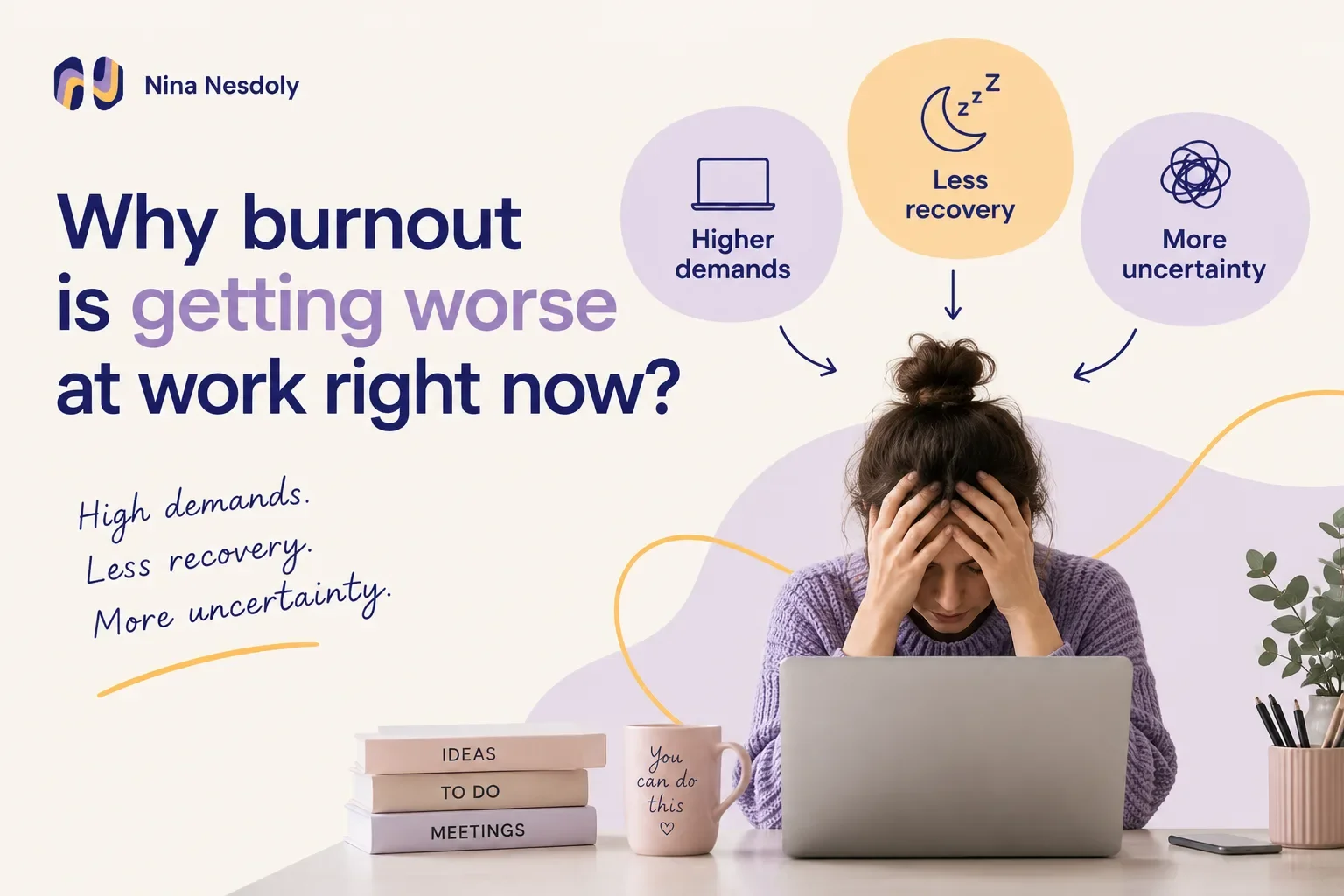
Why burnout is getting worse at work right now.
Why burnout is getting worse at work right now?
Despite all the time and attention allocated to dealing with burnout in the last decade, burnout is getting worse. Many workplaces combine ongoing high demands, reduced recovery and rising uncertainty, all in systems that were never redesigned for this level of pressure. The occasional break or wellness perk can’t offset the demands people are under. People are burning out in response to their environment, not because they lack grit.
Three big forces are driving this:
Chronic, high cognitive demands.
Technology has removed a lot of manual work, but it has not reduced the number of complex decisions, judgments and priorities people handle in a day. I recently finished the data analysis for my PhD dissertation in less than seven hours, work that previously would have taken close to 30 hours. This is fantastic, but it meant that the number of decisions I had to make in a two day window was dramatically higher than it would have been before, because I no longer had to do all of the tasks in between the decisions on my own. Many knowledge workers are living this pattern, every week.
Reduced time and space for recovery.
People work across time zones, juggle multiple platforms and feel pressure to be “always on”. Work that used to be spread across days is now compressed into hours, with few true breaks for the brain to switch off and reset. Over time, this chronic stress load is exactly what erodes energy and motivation. If you want a deeper dive into that process, I unpack it in more detail here: chronic stress and its role in burnout.
Uncertainty and instability in the background.
A majority of U.S. workers (54%) said job insecurity has had a significant impact on their stress levels at work (American Psychological Association press release). Around two-thirds of employed adults (65%) reported that their company or organization has been affected by recent government policy changes (American Psychological Association 2025 Work in America survey). Even when nothing is changing on your team, your people are processing this constant background threat and change.
On top of this, many managers are stretched thin. They have less time for mentorship and coaching, or they feel pressured to skip it to meet delivery demands. Ironically, this means more stressed teams that find it harder to deliver, because they were not given the training, coaching and support that make high performance sustainable.
For you as a leader or HR director, the key reframes are:
Burnout is a workplace design and leadership issue, not an individual weakness.
You cannot wellness-habit your way out of burnout while leaving workload, expectations and communication untouched.
You, and the leaders you support, are in a unique position to interrupt this cycle.
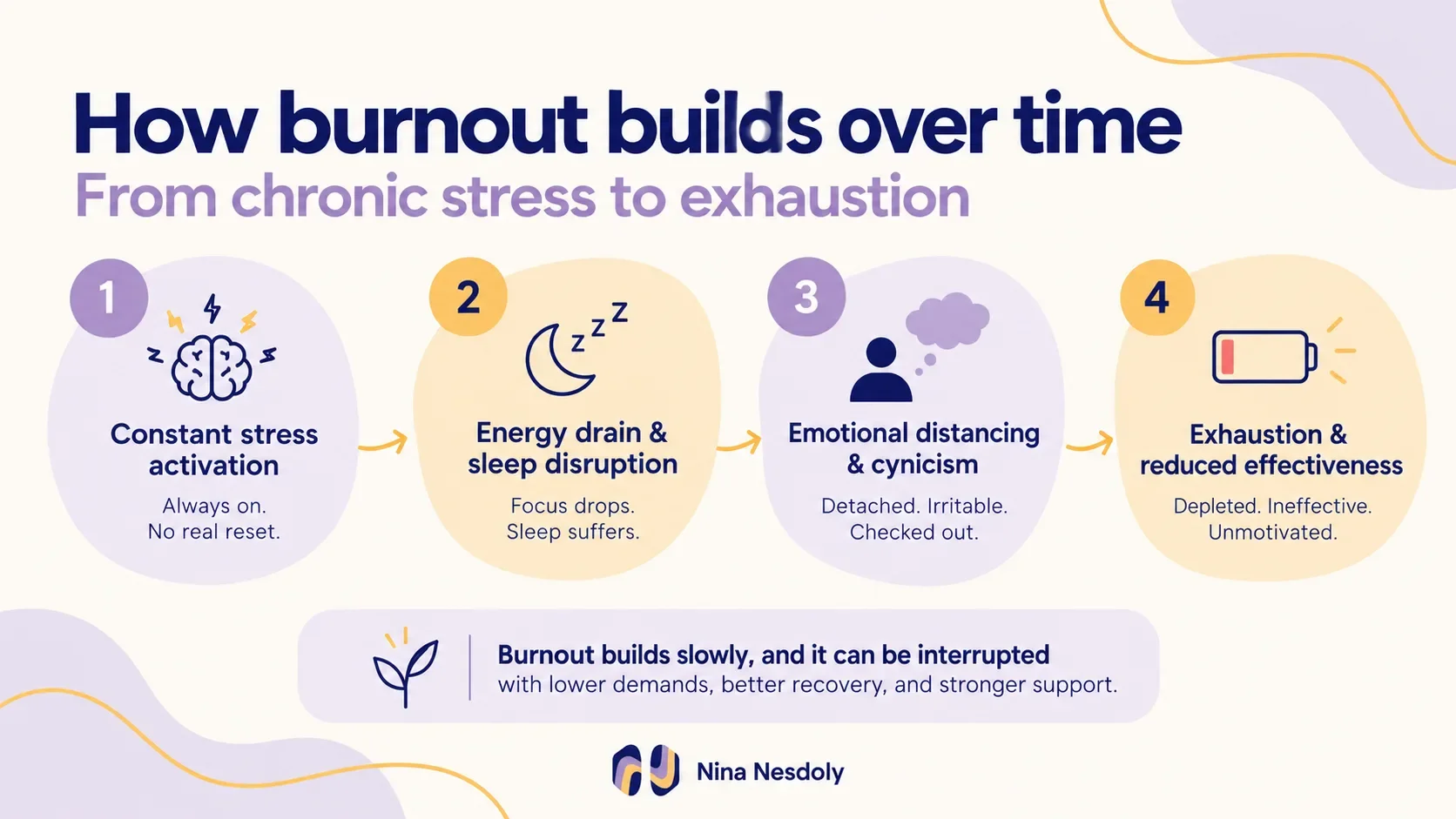
A simple visual of how burnout can progress from stress to exhaustion.
How burnout builds over time: from chronic stress to exhaustion?
Burnout rarely appears overnight. It builds gradually when workplace stressors continue for a long time without enough recovery.
Here is a simple way to understand the process, without clinical jargon.
1. Constant stress activation
Our stress response is designed for short bursts of demand with time to recover in between. In many modern workplaces, the brain never fully gets that “off” time:
Meetings back to back.
Notifications all day.
Decisions and problem solving right up to the end of the workday.
Work or rumination spilling into evenings and weekends.
At the brain level, this looks like your stress systems being activated again and again, without enough time to reset baseline. Over days and weeks this feels like “I am always on edge” or “I never fully relax, even when I am off”.
2. Energy drain and sleep disruption
Next, you start to see:
Trouble focusing.
More mistakes.
Difficulty switching between tasks.
Less restorative sleep, even if you are in bed for the same number of hours.
This is where chronic stress begins to affect the brain’s ability to regulate attention, emotion and energy. People often still “push through” here, so performance might not drop sharply yet, but the personal cost is rising.
3. Emotional distancing and cynicism
As the gap between demands and energy widens, the brain protects itself. Many people start to feel:
Detached from their work or colleagues.
Cynical about the organization or leadership.
Irritated by tasks or requests that never used to bother them.
This is an early sign of burnout, not an attitude problem. It is the brain’s way of conserving energy in an environment it perceives as unrelenting.
4. Exhaustion and reduced effectiveness
If nothing changes, this can progress to:
Deep physical and emotional exhaustion.
Feeling ineffective, incompetent or “like nothing I do makes a difference”.
Loss of motivation, creativity and problem solving.
At this stage, people are not just “stressed”. They are depleted. Simply telling them to “use the wellness app” will not work if the conditions that created the problem stay the same.
The important message for leaders: Burnout is a slow-building process that can be interrupted. Every reduction in chronic demand, every improvement in recovery time, and every increase in felt support helps pull people back from the edge.
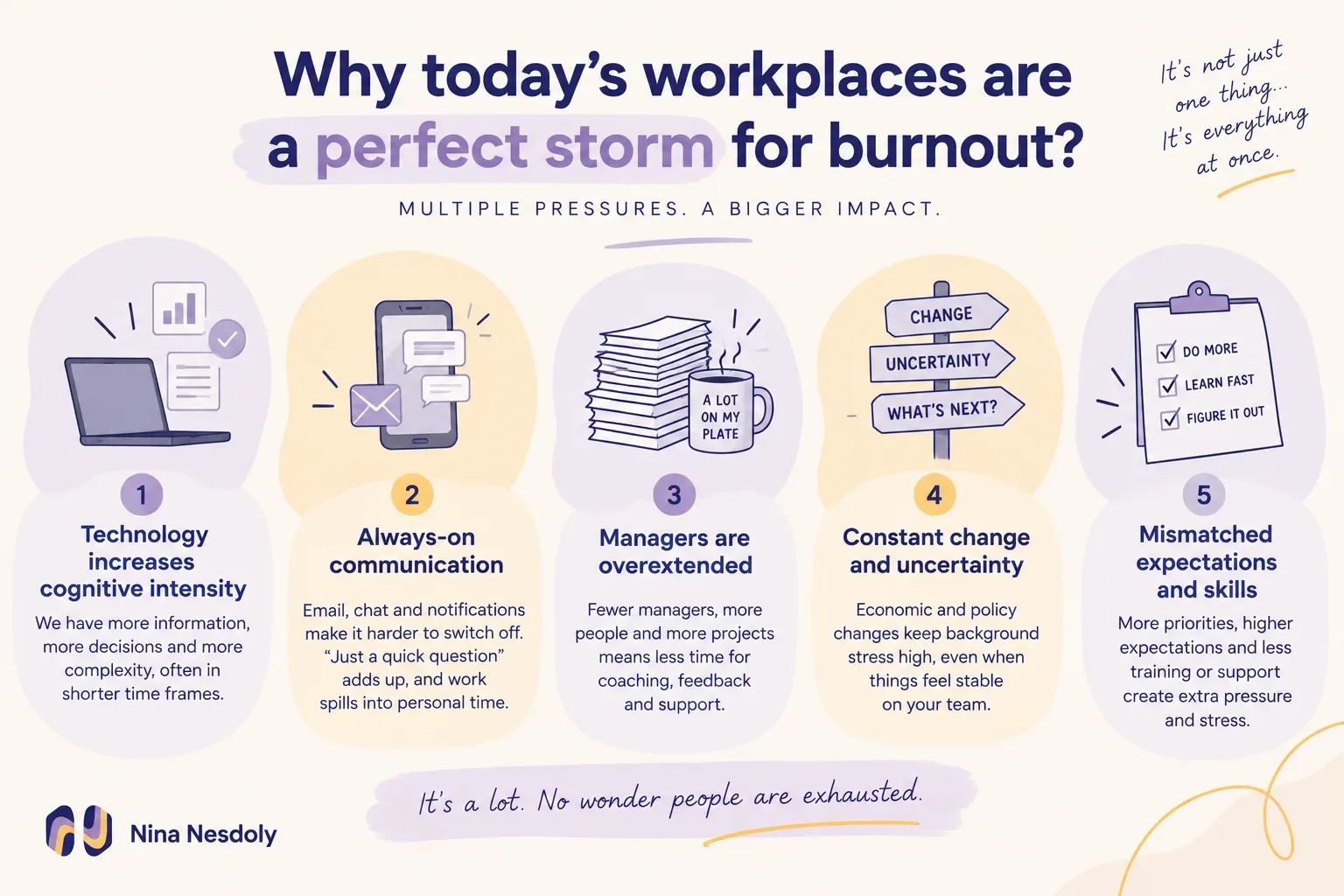
A quick overview of common workplace stressors linked to burnout.
Why today’s workplaces are a perfect storm for burnout?
Today’s workplaces combine several risk factors that would each be challenging on their own. Together, they create a perfect storm.
1. Technology has increased cognitive intensity, not just efficiency
We often think of technology as saving time. It does. But it also concentrates decision making into shorter windows.
In my dissertation analysis example, automation meant I could complete in hours what used to take days. The cost was that I made far more high-stakes decisions in a compressed time frame. Many of your employees are having similar days:
Automated reporting, but more meetings to interpret the data.
Faster customer communication, but more complex escalations.
Templates and tools, but more simultaneous projects.
This increases cognitive load, which is one of the most draining forms of work for the brain, especially when it is sustained with few real breaks.
2. Always-on communication and blurred boundaries
Email, chat tools and shared documents mean people can collaborate from anywhere. They also mean:
More channels to monitor.
More “just a quick question” pings.
The expectation of rapid response, even after hours.
Without explicit team norms, “flexible work” can become “work is always potentially happening”, which reduces recovery time. Chronic partial attention is exhausting.
3. Managers are overextended
Many organizations have flattened structures. Fewer managers, more direct reports, more projects.
When managers are stretched:
1:1s get shortened or rescheduled.
Coaching and feedback are rushed.
Onboarding and training are compressed.
Conversations about workload and wellbeing fall to the bottom of the list.
The very people who could help buffer stress for employees often feel they have no capacity to do that part of their job. This is not a character flaw, it is a capacity issue.
4. Constant change and uncertainty in the backdrop
Uncertainty and frequent change at the organizational and policy level keep background stress high for employees. The data reflect this:
A majority of U.S. workers (54%) said job insecurity has had a significant impact on their stress levels at work (American Psychological Association press release).
Around two-thirds of employed adults (65%) reported that their company or organization has been affected by recent government policy changes (American Psychological Association 2025 Work in America survey).
Even if you are not doing layoffs or restructures, your team is absorbing the stress of a volatile environment.
When leaders do not communicate clearly during change, people fill the gaps with worst-case scenarios. Their brains stay in a state of hypervigilance, which keeps stress high even when day-to-day tasks are manageable.
5. Mismatched expectations and skills
When work accelerates, organizations often respond by:
Adding more priorities without stopping others.
Expecting people to “figure it out” under pressure.
Skipping training, mentorship and capacity building.
As a result, employees face complex tasks and high expectations without the skills, tools or support to meet them. This mismatch is a recipe for chronic stress.
If you are wondering why burnout is getting worse on your team, it is likely some combination of these factors. The good news is that you control several of them at the team level.
For more on the organizational patterns behind burnout, you may also find this helpful: common causes of workplace burnout.
What leaders can actually change: five high-impact levers?
As an HR director or people leader, you cannot control the global economy. You might not control headcount or all company policies.
You do control how work is experienced on your team.
Here are five practical levers you can pull to reduce burnout risk.
1. Workload and priorities
Leaders can adjust workload and priorities so that demands match available capacity over time. This sounds simple and is hard in practice, especially when everything feels urgent.
High-impact moves:
Make trade-offs explicit. When a new project appears, ask “What comes off the plate?” in the same conversation.
Time-box recurring work. For example, limit meetings to certain hours to protect focus time.
Protect deep work windows. Schedule no-meeting blocks and model using them yourself.
2. Norms for availability and responsiveness
Your behavior sets the standard, even more than policies.
High-impact moves:
Clarify response expectations. For example, “Emails within 24 hours, chat messages within 2–3 hours, outside of emergencies.”
Name protected time. Encourage people to block focus time or personal commitments on their calendars without apology.
Model boundaries. If you send emails at night, clarify that you do not expect replies until working hours.
3. Clarity and communication during change
Uncertainty is stressful. Lack of information is worse.
High-impact moves:
Share what you know, and what you do not. You do not need all the answers to be transparent.
Explain the “why” behind changes. Context helps the brain feel more in control.
Create two-way channels. Q&A sessions, anonymous forms or office hours where people can ask questions about change.
We will go deeper on leading through uncertainty in a later section.
4. Coaching, mentorship and skill building
This is where many leaders feel the biggest squeeze, yet it has a strong protective effect against burnout.
High-impact moves:
Prioritize development conversations. Even short check-ins on growth and skills can increase people’s sense of progress and efficacy.
Coach on working smarter, not just harder. Help people refine workflows, set boundaries and make decisions on what to drop.
Pair people up. If you lack time, set up peer mentorship or buddy systems.
When leaders I work with put more intentional time into how their teams work, the impact is often immediate. One leadership team shared, “Nina’s teachings really resonated with our leadership team and inspired us to re-evaluate our work-life balance.” Another client reflected, “We saw immediate improvements in how our employees approached stress management. Highly recommend!”
5. Access to stress-management skills and resources
Stress-management tools cannot compensate for a toxic workload, but they can help people cope more effectively when paired with system changes.
High-impact moves:
Teach people how stress works. When people understand their own stress responses, they can use simple tools more effectively.
Normalize using resources. Talk about therapy, coaching, or internal supports as smart, not as a last resort.
Integrate micro-practices. Quick resets in meetings or between tasks so recovery is built into the workday.
If you want structured support on these levers, this is exactly the focus of my burnout workshops for teams and leaders and burnout keynotes for conferences and leadership events.
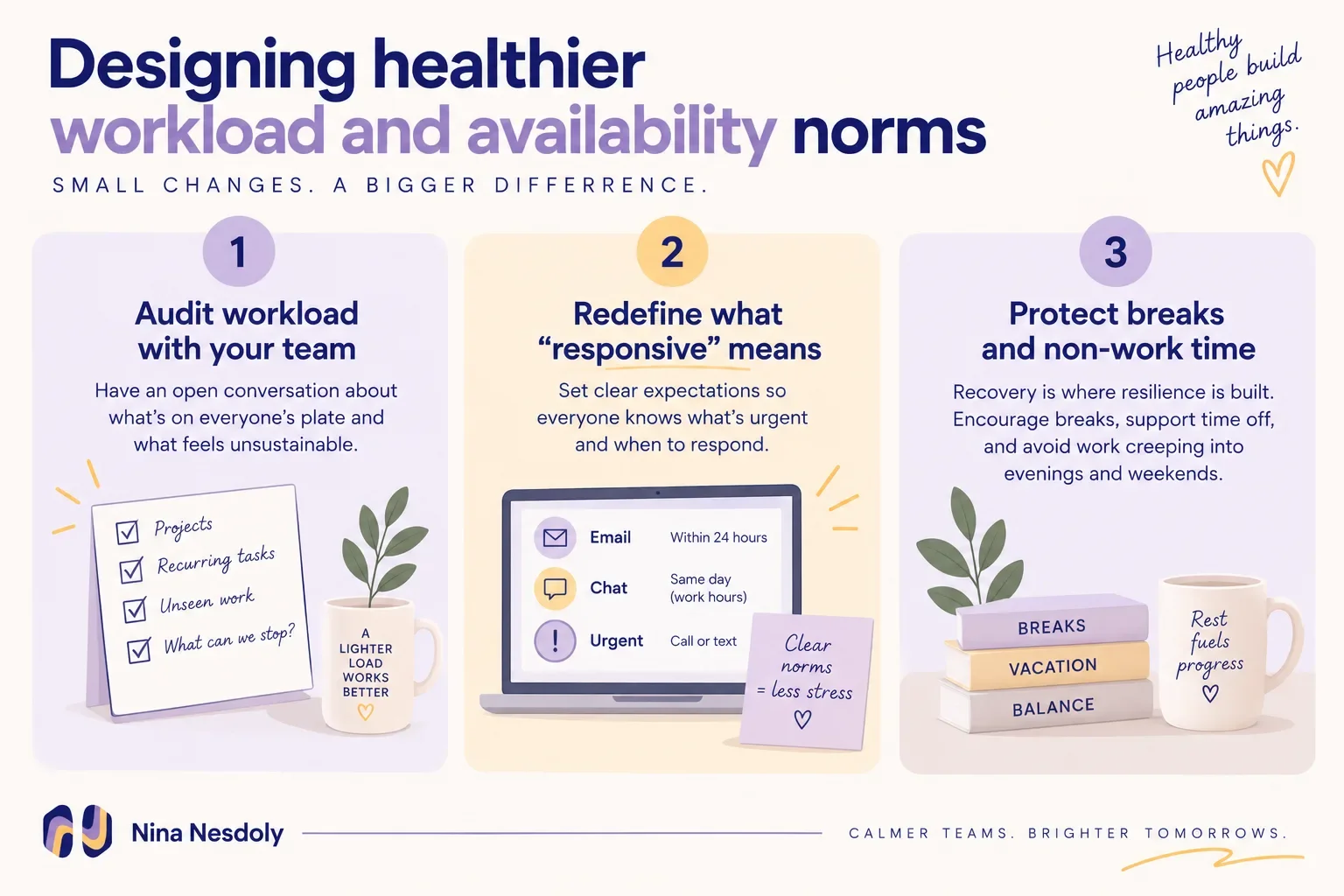
Three practical ways to support healthier team norms around workload, response times, and breaks.
Designing healthier workload and availability norms
This is one of the most direct ways you can affect burnout risk, and it sits squarely in your control.
1. Audit workload with your team, not for your team
Leaders should regularly audit workload and priorities with their team, rather than assuming people will speak up when overloaded.
Most people do not want to appear like they cannot handle pressure. They often stay quiet until they are far past capacity.
Try this:
Run a quarterly “work inventory” session. Ask everyone to list their recurring tasks, projects and “unseen” work such as mentoring or internal committees.
Estimate time and energy cost. Not all tasks are equal. Mark which ones are high cognitive load.
Ask explicitly: “What feels unsustainable?” Look for themes rather than focusing on individual complaints.
Then adjust:
Stop or pause lower-impact work.
Escalate to your leaders when demands cannot be met with current resources.
Redistribute tasks to better match strengths and capacity.
2. Redefine what “responsive” means
Your team’s default expectations about responsiveness drive a lot of chronic stress.
Steps you can take:
Set channel norms. For each channel (email, chat, project tools), decide what “timely” means.
Clarify true emergencies. Define what qualifies as urgent and how people should reach out when something is urgent.
Agree on after-hours rules. For example, “We do not expect responses on evenings or weekends, unless you are on a clearly assigned on-call rotation.”
Write these down. Revisit them after a month to check if they are realistic.
3. Protect breaks and non-work time
Recovery is where resilience is actually built. Without it, even reasonable workloads can eventually feel unmanageable.
Practical actions:
Encourage micro-breaks between meetings. Even 2–3 minutes of standing up, breathing and looking away from the screen helps reset the brain.
Support people in using their vacation fully, without pressure to work during time off.
Watch for “work creep” into early mornings or late nights and address it in 1:1s.
Your team will not believe breaks are acceptable unless they see you taking them too.
Leading through uncertainty without burning people out
You cannot remove all uncertainty. You can significantly reduce how threatening it feels.
Transparent, frequent communication about change can reduce the anxiety that comes from uncertainty and rumors.
1. Communicate early and often
You might be tempted to wait until there is a full plan. The nervous system does better with partial information than with rumor and silence.
When something is changing:
Share what is confirmed.
Acknowledge what is still undecided.
Give a timeline for the next update, even if that update is “We still do not know”.
This keeps people from filling the gaps with worst-case scenarios.
2. Explain the impact at the team level
Big organizational announcements can feel abstract. Your team cares about:
“What does this mean for my role?”
“Will my priorities change?”
“How will success be measured?”
Translate company-level change into concrete implications for your group. If you do not know yet, say so and commit to updating them.
3. Make space for emotion and questions
Change is not just a project plan, it is an emotional process.
You can:
Host Q&A sessions.
Invite anonymous questions.
Validate that feeling anxious or frustrated is normal.
This does not mean you must fix every concern. It means you are creating psychological safety, which is protective against burnout.
4. Anchor people in what is stable
During uncertainty, the brain looks for any source of predictability.
Highlight:
What is staying the same about your mission or values.
Routines or rituals that are not changing.
Clear short-term goals people can focus on.
This gives the nervous system something solid to hold on to while larger pieces are in motion.
Equipping your team with stress-management skills (without making burnout “their fault”)
You want to support individuals without implying that if they were just better at self-care, they would not be burning out. This balance is crucial.
Stress-management tools are valuable, but they must sit alongside real changes to workload, boundaries and culture.
1. Frame stress skills as performance tools, not fixes for weakness
How you introduce stress-management matters. For example:
Instead of: “We are offering resilience training because people are struggling.”
Try: “We are all working in a high-demand environment. These tools can help your brain stay sharp and recover faster.”
This positions stress skills as part of professional development, not as a personal flaw.
2. Pair every “individual” initiative with a systems question
When you bring in stress or burnout training, also ask:
“What is one workload or process change we can make to support this?”
“How will we adjust expectations so these tools are actually usable in the workday?”
Otherwise, people hear, “Do this meditation, but still answer emails at 11 pm.”
3. Make stress skills practical and integrated
Short, realistic practices are more sustainable than long, ideal ones.
Examples you can encourage:
60–90 seconds of slow, nasal breathing between meetings to calm the nervous system.
One “transition ritual” at the end of the workday to signal the brain that work is complete.
Quick grounding exercises before high-stakes conversations.
When I teach these tools in organizations, feedback is often along the lines of, “Engaging and relatable… a home run!” because the focus is on what people can actually do during a busy workday, not on adding an hour of wellness homework at night.
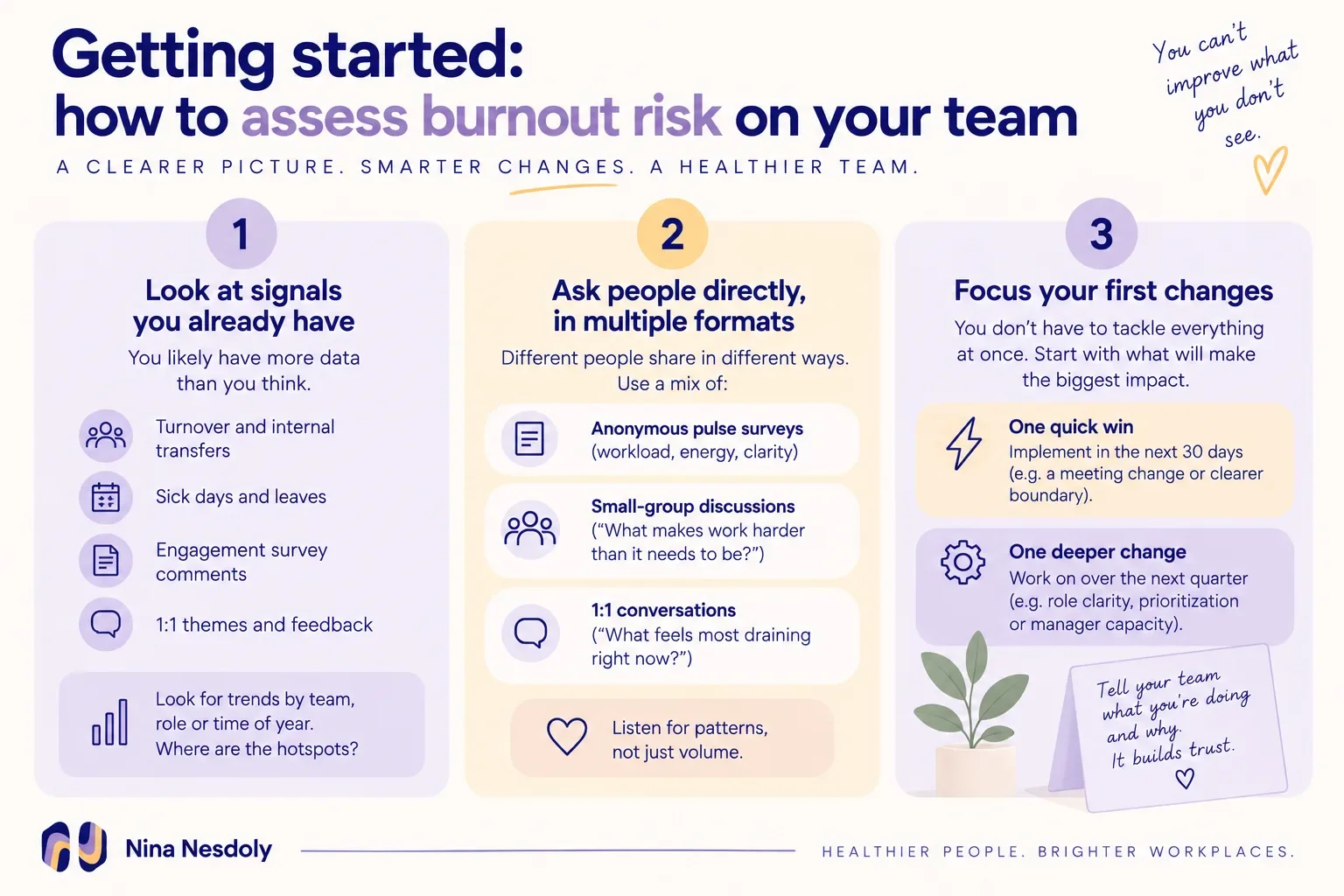
A simple framework for spotting burnout risk and choosing first steps.
Getting started: how to assess burnout risk on your team
Before you redesign anything, you need a clear picture of what is happening now.
Leaders should start by getting a clear picture of current burnout risk and stressors on their team, rather than guessing.
1. Look at signals you already have
You likely have more data than you think:
Turnover and internal transfer patterns.
Sick days and short-term leaves.
Engagement survey comments.
1:1 themes and complaints.
Look for trends by team, role or time of year. Where are the hotspots?
2. Ask people directly, in multiple formats
Not everyone is comfortable speaking up in the same way. Use a mix of:
Anonymous pulse surveys about workload, energy and clarity.
Small-group discussions focused on “what makes work harder than it needs to be?”
1:1 questions such as “What part of your job feels most draining right now?” and “What would make the biggest difference to your day-to-day stress?”
Listen for patterns, not just volume.
If you want a structured way to do this, you can use tools like my Team Burnout Assessment to identify specific risk factors and strengths on your team.
3. Focus your first changes
You do not have to tackle everything at once. In fact, you should not.
After you assess:
Choose one “quick win” you can implement in the next 30 days, such as a meeting change or a clarified boundary.
Choose one deeper structural change to work on over the next quarter, such as role clarity, prioritization or manager capacity.
Tell your team what you are doing and why. This builds trust and shows that you are taking their input seriously.
FAQ: Common questions leaders ask about worsening burnout
1. How is normal stress different from burnout?
Normal work stress:
Comes in waves.
Has clear endpoints.
Is followed by enough recovery that people return to their baseline.
Burnout is what happens when stressors are chronic and recovery is insufficient for a long time. It shows up as:
Persistent exhaustion that does not improve with a weekend off.
Emotional distancing or cynicism about work.
A sense of reduced effectiveness or “I cannot do this anymore”.
As a leader, you should be concerned when you see multiple people on your team expressing these signs over weeks or months, especially alongside high workloads and uncertainty.
2. Why do younger workers report higher burnout? Are they less resilient?
Younger workers often report higher burnout, and it is tempting to label this as a resilience issue. A more helpful lens is context.
Younger employees are more likely to be:
Early in their careers, still building skills and networks.
In roles with less control and autonomy.
Entering the workforce during a period of significant instability and change.
They may also be more willing to name and report burnout. None of this means they are inherently less resilient. It means they are experiencing work in a context of high demand, less control and rising uncertainty.
Your role is not to judge their resilience, but to design roles, workloads and support that allow early-career employees to grow without burning out.
3. Can individuals recover from burnout without workplace changes?
Individuals can recover from burnout. Rest, therapy, coaching and personal stress-management tools can all help people heal.
However, if they return to the exact same conditions that burned them out, they are at high risk of cycling straight back into it.
Sustainable recovery requires:
Individual healing and skills, and
Workplace changes to workload, control, support and clarity.
This is why your role as a leader is so important. You are a key part of whether recovery “sticks”.
For more on why this moment matters, you can read: why burnout prevention matters now more than ever.
Next steps for leaders who want support
Burnout getting worse is not inevitable. It is a signal that the way we are working is out of alignment with how human brains and bodies function best, and leaders are uniquely positioned to redesign that.
As a Burnout & Corporate Stress Management Speaker, PhD candidate and TEDx speaker with over 50,000+ followers (source: Nina's website (ninanesdoly.com)), I work with organizations that are ready to move beyond awareness into real, practical change through keynotes and workshops, in person and online, across the United States and globally.
If you want support rethinking how your team works, communicates and recovers, you can put a date on hold for a keynote or workshop conversation here: Put a Date on Hold →.
This article is educational and is not medical advice. If burnout is affecting you or your team, please talk to a qualified health professional.