
How to support an employee with burnout?

Relaxed outdoor portrait
TL;DR
Notice early. The top warning sign is a drop in work engagement compared with that person's own baseline. Look for patterns over weeks, not one bad day.
Talk about what you've seen, not what you think it is. Skip labels like "burned out" and open with specific, neutral observations ("three deadlines slipped this month"). Then ask open questions and listen.
Change the work. Co-create a short-term plan: focus on the one to three essentials, pause the rest, and say your reduced expectations out loud.
Don't spread the problem. If you hand tasks to teammates, trade rather than add, and model the boundaries you want to see.
Connect and learn. Point to your EAP and benefits, involve HR when needed, and afterward ask what workload patterns or norms contributed.
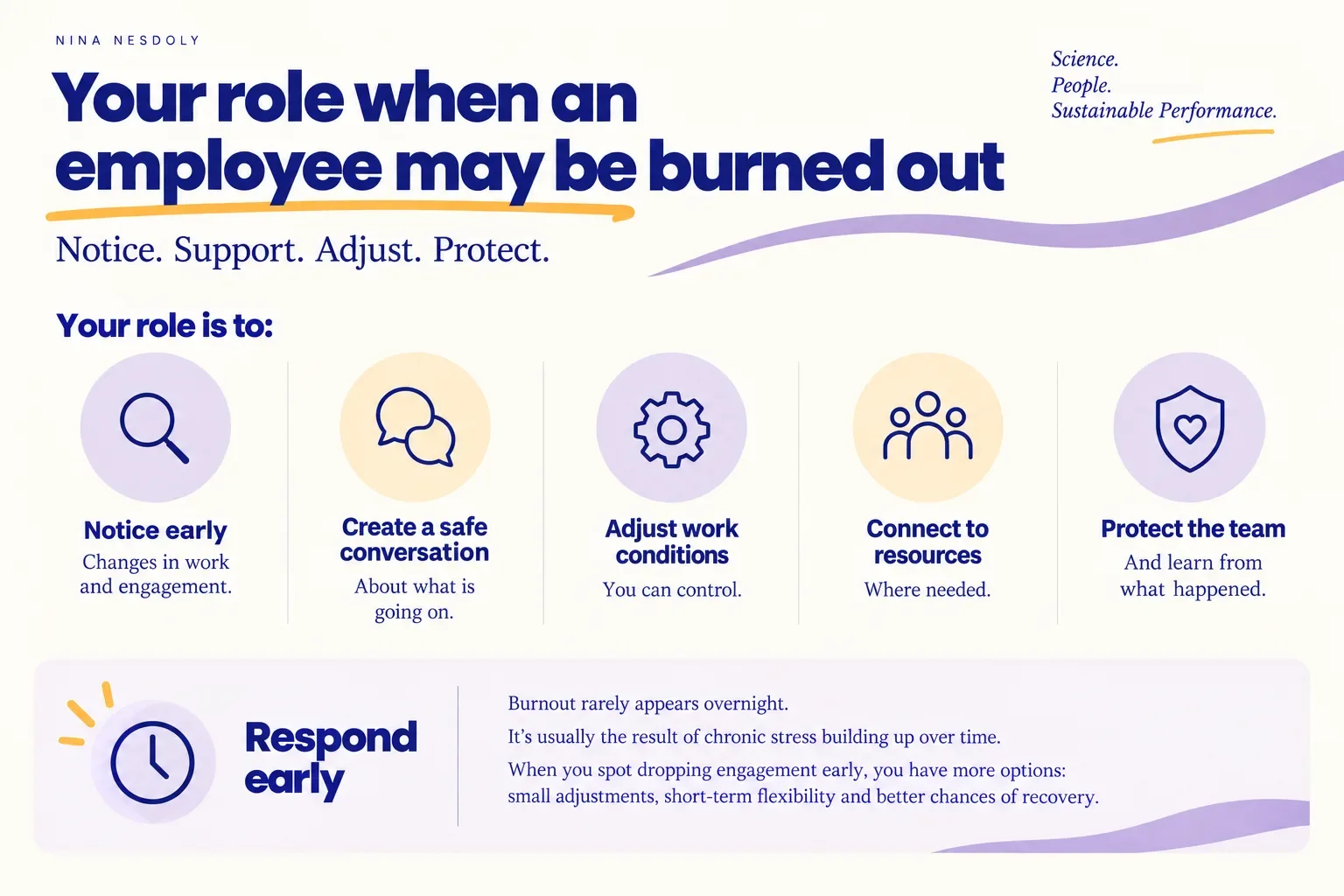
Start here: your role when an employee may be burned out
You’ve noticed a team member isn’t themselves lately. ou notice one person is not themself. Work that used to be easy seems heavy. They are quieter, missing more days, or making mistakes. You are worried and you do not want to say the wrong thing.
You are not a clinician, so you cannot and should not diagnose burnout. You are, however, one of the biggest influences on this person’s day-to-day stress: their workload, deadlines, priorities, meeting load, communication norms and what “good work” looks like on your team.
Your role is to:
Notice changes in work and engagement early.
Create a safe conversation about what is going on.
Adjust work conditions you can control.
Connect the employee with additional resources where needed.
Protect the rest of the team and learn from what happened.
Responding early matters because burnout rarely appears overnight. It is usually the result of chronic stress building up over time. If you catch it when you first see dropping engagement, you have more options: small adjustments, short-term flexibility and better chances of recovery without a full crisis. If you wait, you are more likely to face extended leaves, resignations or a whole team that is running on fumes.
So you do not need to have the perfect script. You do need to be present, concrete and willing to act.
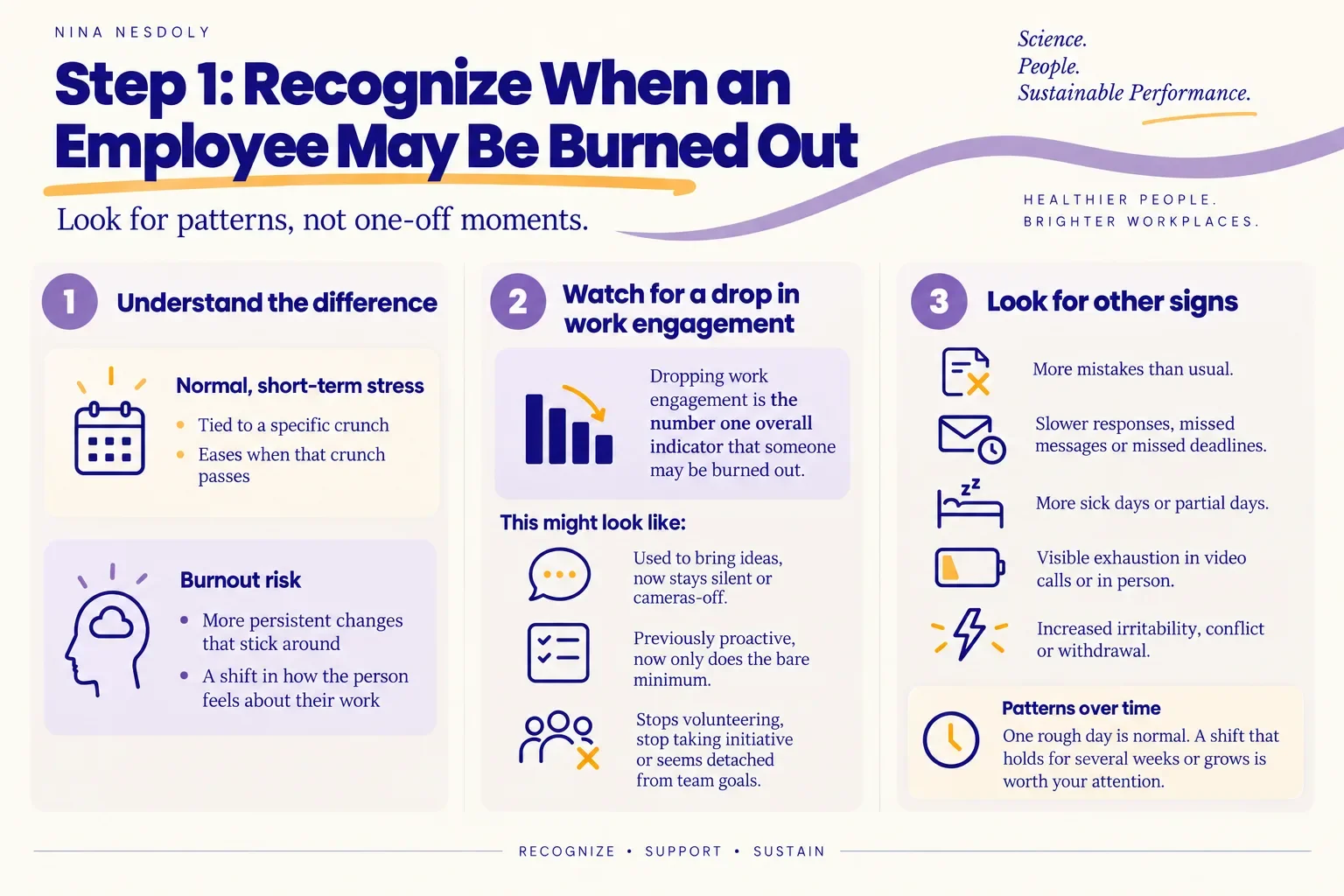
Step 1: Recognize when an employee may be burned out
You cannot support an employee with burnout if you are not sure what you are seeing. You also do not want to jump to conclusions every time someone has a bad week.
A useful way to think about this is:
Normal, short-term stress is tied to a specific crunch (end of quarter, a product launch) and eases when that crunch passes.
Burnout risk shows up as more persistent changes that stick around, and a shift in how the person feels about their work.
The number one early warning sign is a noticeable drop in work engagement.
The business states: Dropping work engagement is the number one overall indicator that someone may be burned out.
That might look like:
Someone who used to bring ideas to meetings now stays silent or cameras-off.
A previously proactive person now only does the bare minimum required.
They stop volunteering, stop taking initiative or seem detached from team goals.
The business states: If a person’s engagement is dropping, that is an important early warning sign of burnout, but what disengagement looks like will depend on the specific person and their role.
So you are looking for changes from this person’s own baseline, not a generic checklist.
Other work-related signs you might notice include:
More mistakes than usual in their work.
Slower responses, missed messages or missed deadlines.
More sick days or partial days.
Visible exhaustion in video calls or in person.
Increased irritability, conflict or withdrawal.
The key is patterns over time. One rough day is normal. A shift that holds for several weeks or grows is worth your attention.
If you want a deeper dive on behavior patterns, you can read more on signs of burnout in employees.
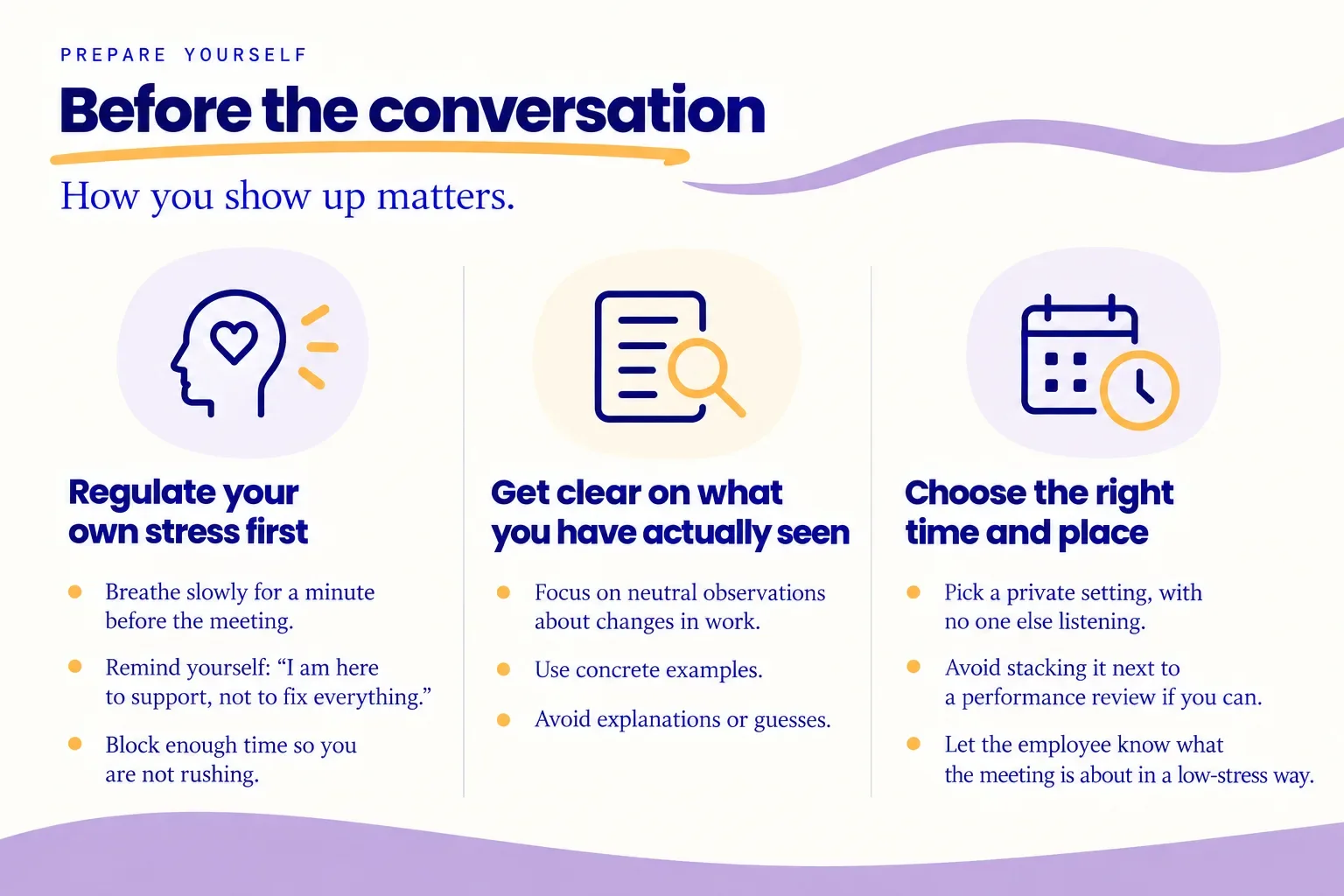
Step 2: Prepare yourself before you start the conversation
Once you have reasonable concern, do not rush straight into a heavy talk in the middle of a chaotic day. How you show up is as important as the words you choose.
Regulate your own stress first
If you feel anxious, guilty or frustrated, that will leak into the conversation. Take a moment to:
Breathe slowly for a minute before the meeting.
Remind yourself: “I am here to support, not to fix everything.”
Block enough time so you are not rushing.
You are aiming for calm, curious and open.
Get clear on what you have actually seen
The business states: When preparing for a conversation, managers should phrase their concerns as neutral observations about changes in work, and point to concrete examples.
Before you meet, jot down factual observations:
“In the last month, three deadlines were missed.”
“You have used six sick days in the last four weeks, which is more than your usual.”
“You have seemed quieter in meetings and have not been sharing ideas like you used to.”
Avoid writing down explanations, like “They are overwhelmed” or “They do not care anymore.” Those are guesses, not facts.
Then, practice turning one or two of these into neutral, supportive language.
For example:
“I have noticed you have been missing more days lately, and I wanted to check in about how you are doing and how I can support.”
“Over the past couple of weeks, I have seen a few deadlines slip, which is not like you. I wanted to understand what is going on on your side.”
The business states: Managers want to avoid accusatory language such as, “It’s horrible, you’ve been missing all these days,” and instead use wording that opens the door to an honest, supportive conversation.
You are describing patterns, not attacking character.
Choose the right time and place
Pick a private setting, with no one else listening.
Avoid stacking it next to a performance review if you can. This is a well-being conversation, not an evaluation.
Let the employee know what the meeting is about in a low-stress way, such as: “I would like to check in about how things are going for you and your workload. Can we book 30 minutes?”
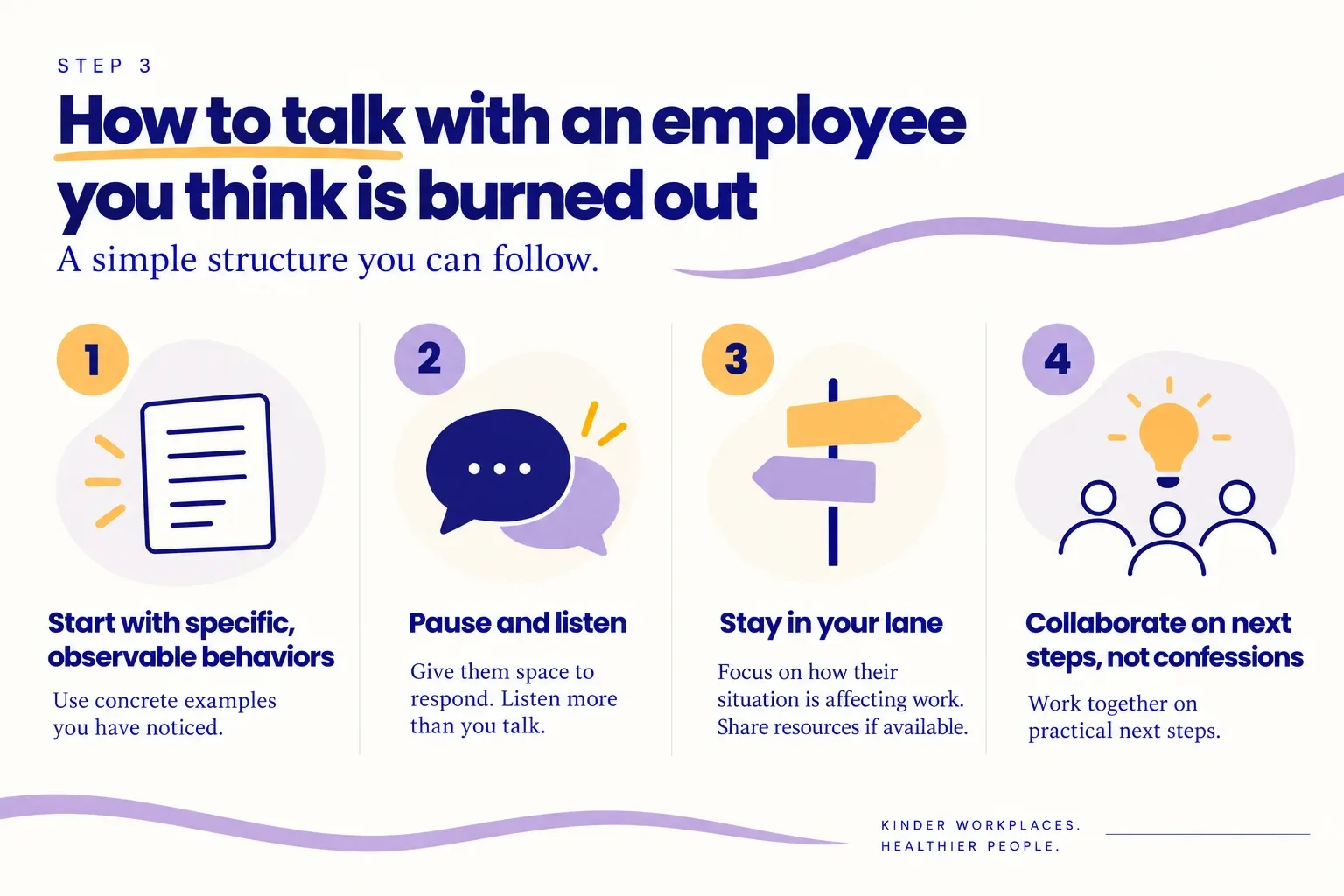
Step 3: How to talk with an employee you think is burned out
This conversation is where many managers freeze. You want to be kind, but you also need to talk about work. You do not want to pry, but you also do not want to ignore clear distress.
Here is a simple structure you can follow.
1. Start with specific, observable behaviors
The business states: Stress using specific observable behaviors as a starting point (e.g., missed deadlines, visible exhaustion) rather than labels or judgments.
Open with what you have noticed, using those neutral, concrete examples you prepared.
For example:
“I have noticed over the last few weeks that a couple of deadlines have slipped, and you have seemed really tired in our morning calls. This is different from how you usually are. I wanted to check in about how you are doing and what support might help.”
Avoid labels like “burned out,” “struggling,” or “not committed.” Also avoid medical language or trying to diagnose.
2. Pause and listen
Then stop talking. Give them space to respond.
You can encourage them with questions like:
“How have things been feeling for you at work lately?”
“Does what I am seeing match how you are feeling, or is there more I should know?”
“What feels hardest right now day to day?”
Listen more than you talk. Resist the urge to jump in with solutions before you understand their perspective.
If they get emotional, stay steady. You can say something like:
“Thank you for sharing that, I know it is not easy.”
“I appreciate you being open with me.”
3. Stay in your lane
There may be work factors, personal factors or both. If they share personal challenges, you can acknowledge them without trying to be a therapist.
Your lane as a manager or HR leader is:
Understanding how their current situation is affecting work.
Adjusting workload, priorities and expectations where you can.
Sharing information about resources, like an EAP or mental health benefits, if available.
Coordinating any necessary accommodations.
It is not your role to provide medical advice or push for personal details they do not want to share.
4. Collaborate on next steps, not confessions
If you hear signs of exhaustion, detachment or feeling ineffective, name your intention:
“My goal here is to figure out how we can make work more sustainable for you, and what adjustments we can make together.”
Then move into problem-solving together, which we will cover in the next step.
If you sense they are not ready to talk much yet, you might say:
“Thank you for letting me know that this is a lot right now. How about we each think about possible changes, and reconnect in a couple of days to talk through ideas?”
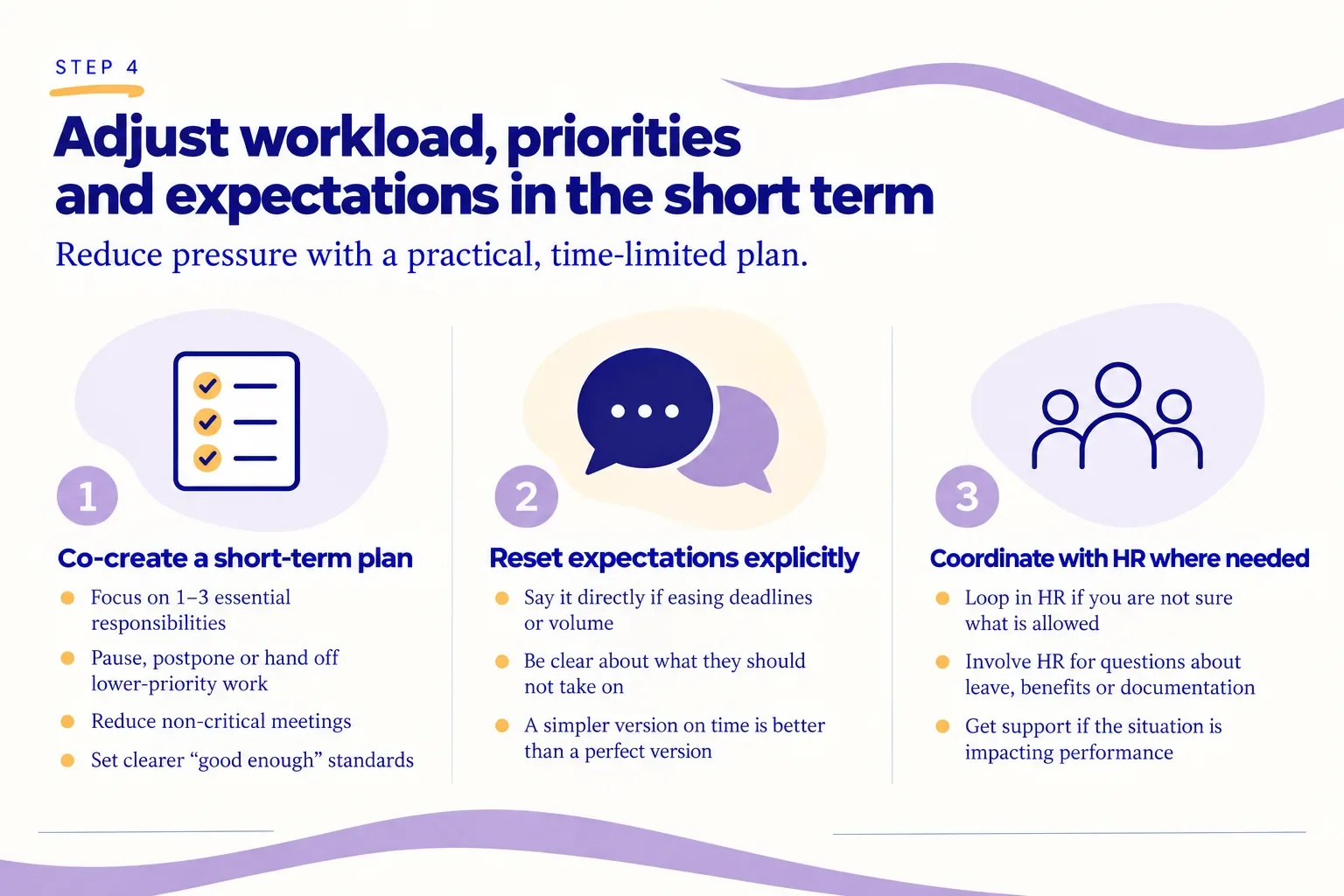
Step 4: Adjust workload, priorities and expectations in the short term
Talking without changing anything will only increase cynicism. Once you understand the broad picture, shift into “What can we change right now to reduce pressure?”
Co-create a short-term plan
The business states: Encourage co-creating a short-term plan with the employee that prioritizes essential tasks and pauses or postpones lower-priority work.
Look at:
Current projects and deadlines.
Meetings and recurring commitments.
The kinds of tasks that feel heaviest versus most manageable.
Together, you might:
Identify the 1–3 most essential responsibilities for the next few weeks.
Pause, postpone or hand off lower-priority work.
Reduce non-critical meetings.
Set clearer “good enough” standards so they are not over-perfecting everything.
Frame this as a time-limited adjustment that you will revisit:
“For the next four weeks, let us focus your time on projects A and B. I will move C to another timeline and see if we can get help with D. We will check in in two weeks and again at the end of the month and adjust from there.”
This shows you are serious about helping them, without locking anyone into a plan forever.
Reset expectations explicitly
If you are easing deadlines or volume, say it directly. Do not assume they will infer it.
“Given your current capacity, I am not expecting you to take on new cross-functional work this month.”
“For now, I would rather have a simpler version delivered on time than a perfect version that keeps you working late.”
The more explicit you are, the easier it is for them to stop pushing themselves to previous levels.
Coordinate with HR where needed
Some adjustments may touch on formal processes, like flexible working arrangements or medical accommodations. Loop in HR if:
You are not sure what is allowed.
The employee raises questions about leave, benefits or documentation.
The situation is impacting performance significantly.
HR can help you stay within policy while still being human.
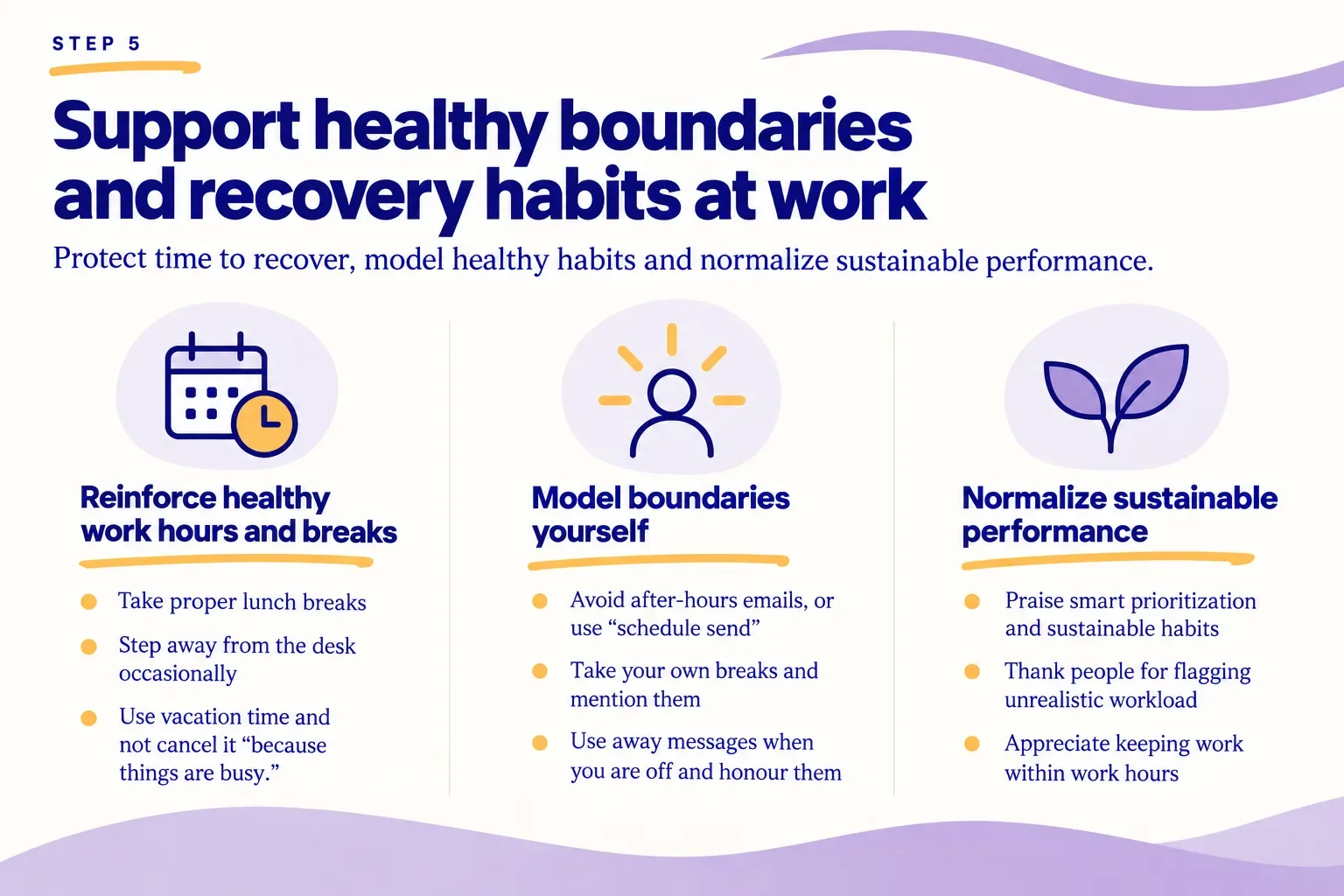
Step 5: Support healthy boundaries and recovery habits at work
Burnout is closely linked with chronic, unrecovered stress. So part of how you support an employee with burnout is by protecting their ability to recover while still employed.
Reinforce healthy work hours and breaks
Encourage:
Taking proper lunch breaks.
Stepping away from the desk occasionally.
Using vacation time and not canceling it “because things are busy.”
Make this explicit:
“I expect you to sign off by 5:30 unless there is a true emergency.”
“If you are feeling wiped out in the afternoon, take 10 minutes to reset. I would rather have you back focused than trying to power through.”
Model boundaries yourself
The business states: Encourage managers to model healthy boundaries themselves (e.g., not sending late-night emails as a norm).
If you send messages at 11 pm, your team will assume they should, too, even if you say you do not expect it.
You can:
Avoid after-hours emails, or use “schedule send” for the next morning.
Take your own breaks and mention them in a matter-of-fact way.
Use away messages when you are off and honor them.
Your behavior shows what is really acceptable more than any policy.
If you want ideas to share with your team on managing overwhelm and recovery, you can point them to my TEDx Talk.
Normalize sustainable performance
Praise smart prioritization and sustainable habits, not just heroic overwork.
Instead of only saying “Thank you for staying late,” also say:
“Thank you for flagging that this workload was too much for one person.”
“I appreciate you keeping this within work hours. That is the kind of sustainability we want.”
Over time, this shifts your culture from silent overwork to honest conversations about capacity.
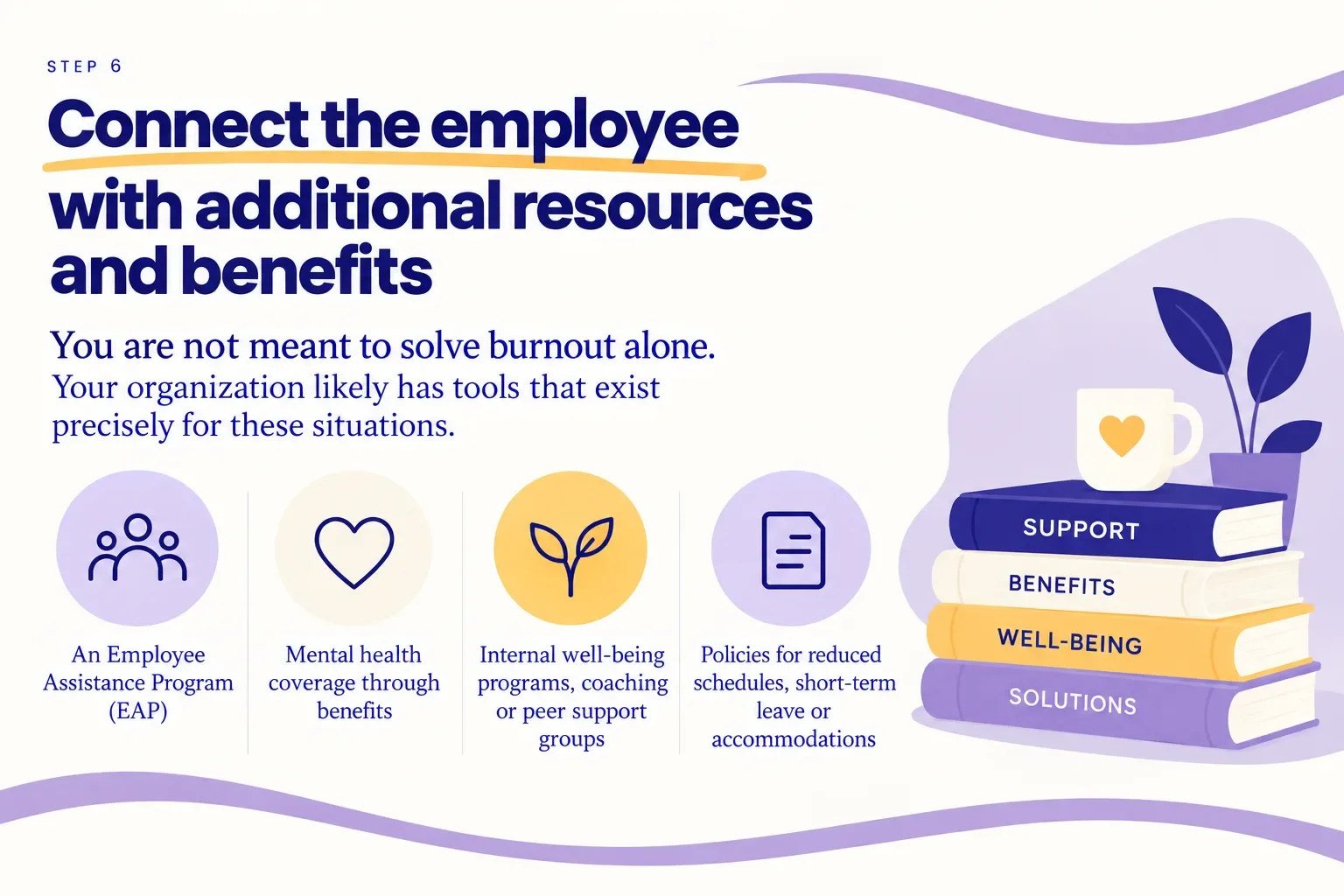
Step 6: Connect the employee with additional resources and benefits
You are not meant to solve burnout alone. Your organization likely has tools that exist precisely for these situations.
The business states: Encourage managers to know and proactively share information about internal resources like EAP or mental health benefits where applicable.
Depending on your company, that might include:
An Employee Assistance Program (EAP).
Mental health coverage through benefits.
Internal well-being programs, coaching or peer support groups.
Policies for reduced schedules, short-term leave or accommodations.
In the conversation, you might say:
“I am not a mental health professional, but we do have an EAP that offers confidential support. Would you like me to send you the details?”
“Our benefits include coverage for counselling. If that is something you are considering, HR can help you understand how it works.”
Ensure you actually know how to access these resources so you can give accurate, concrete information.
If your team or organization wants a shared foundation on what burnout is and how to work in a healthier way, structured learning, like burnout workshops for teams, can give everyone common language and tools, instead of leaving managers to figure it out one conversation at a time.
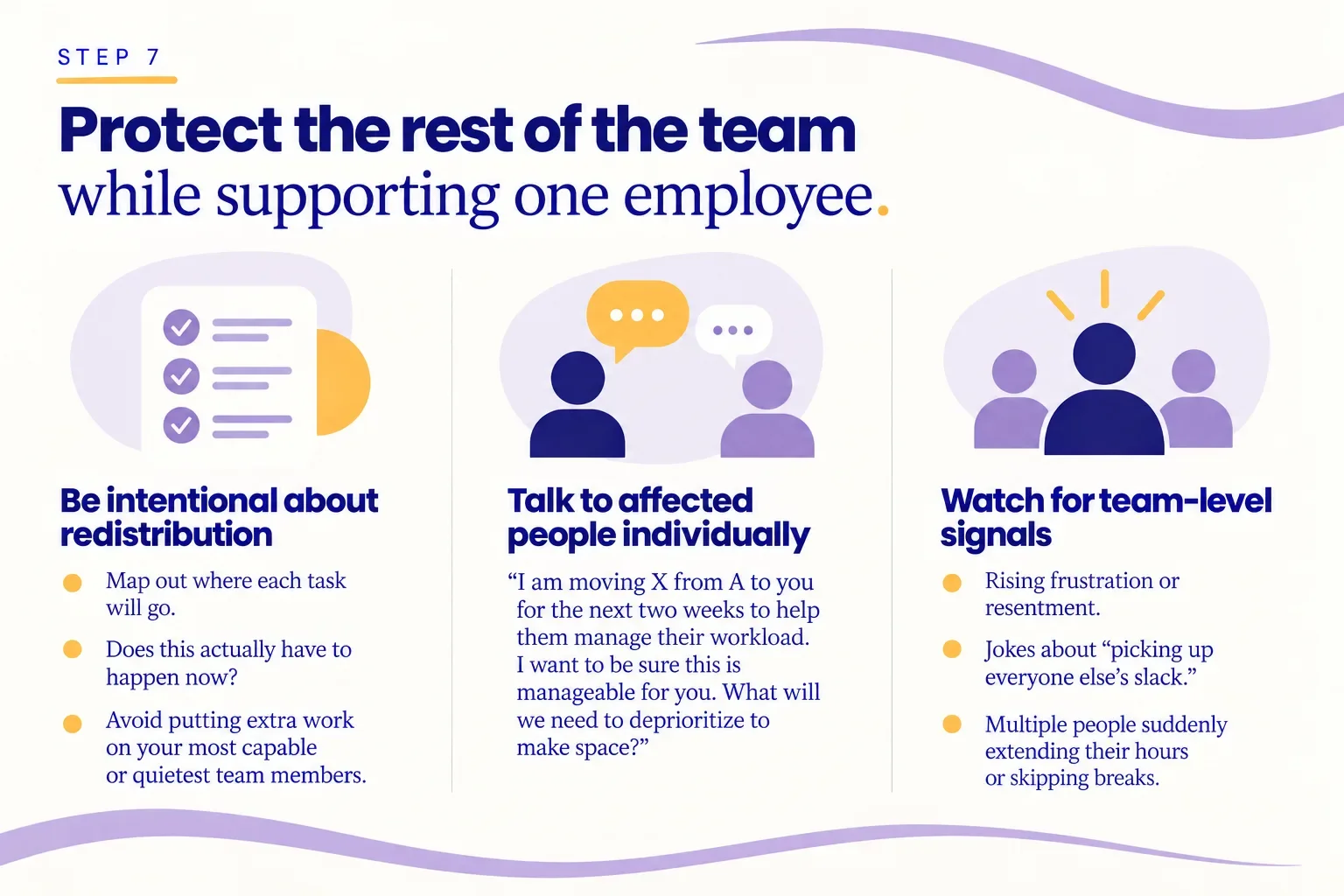
Step 7: Protect the rest of the team while supporting one employee
There is a real risk here. You reduce work for one struggling employee, and suddenly three others quietly pick up the slack and start moving toward burnout themselves.
The business states: Flag that simply shifting tasks from one struggling employee to others can spread burnout risk if done without care.
Be intentional about redistribution
When you adjust someone’s workload:
Map out where each task will go, if it needs to be done at all.
Ask honestly: “Does this actually have to happen now?”
Avoid automatically putting extra work on your most capable or quietest team members.
Where you must redistribute, talk to affected people individually:
“I am moving X from A to you for the next two weeks to help them manage their workload. I want to be sure this is manageable for you. What will we need to deprioritize to make space?”
Notice that last sentence. You are not just adding; you are trading.
Watch for team-level signals
Keep an eye on:
Rising frustration or resentment.
Jokes about “picking up everyone else’s slack,” which can be early warning signs.
Multiple people suddenly extending their hours or skipping breaks.
If you start hearing or seeing these, pause and reassess. You may need a broader reset of priorities and timelines, not just individual shuffling.
“We saw immediate improvements in how our employees approached stress management. Highly recommend!”
Feedback like this from organizations I have worked with reflects what happens when you treat burnout as a shared problem to solve thoughtfully, rather than just passing pressure around.
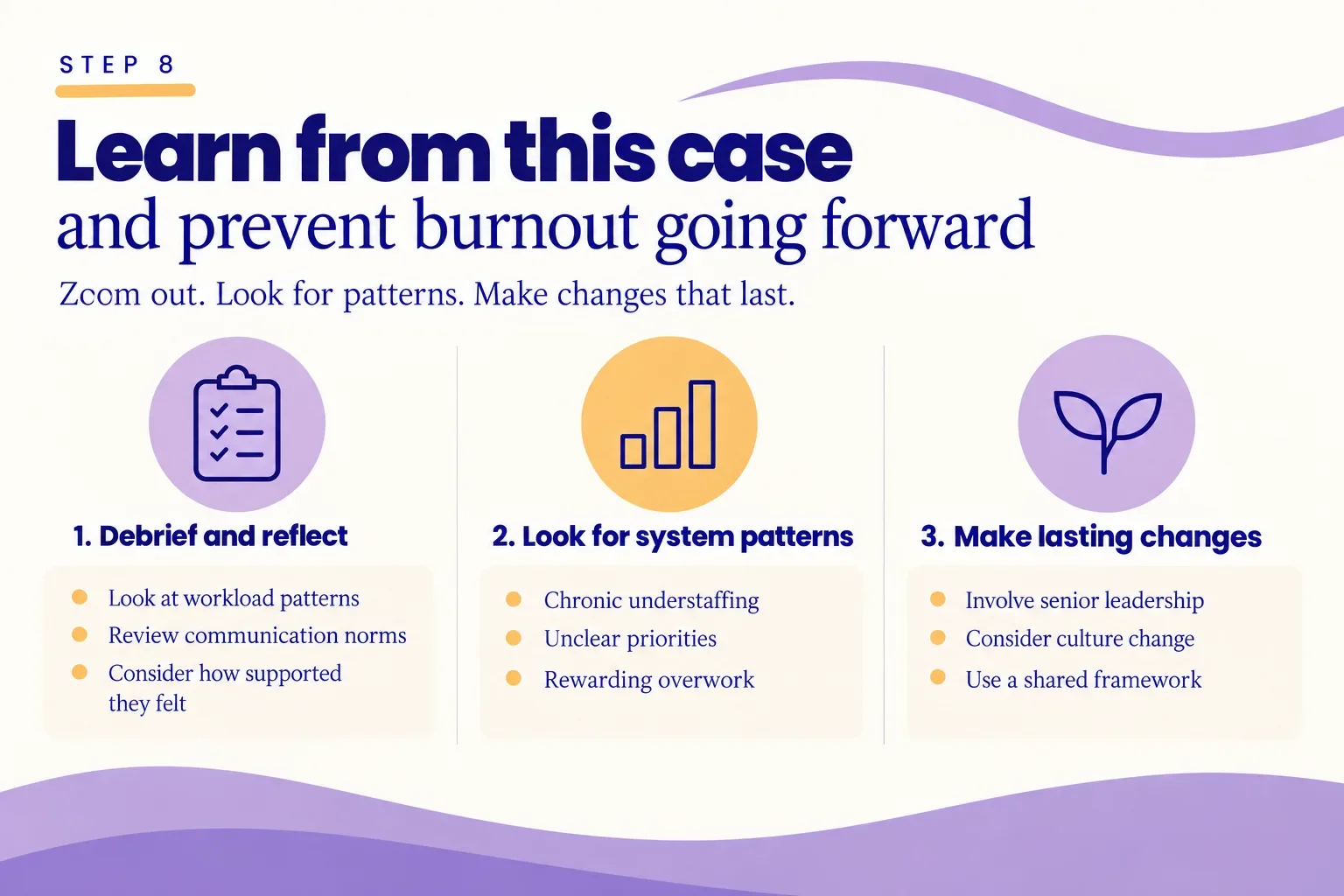
Step 8: Learn from this case and prevent burnout going forward
Once the immediate crisis is more stable, it is time to zoom out. This is not about blame. It is about pattern recognition.
The business states: Encourage a debrief: what workload patterns, expectations or cultural norms contributed to this employee’s burnout risk.
Debrief with yourself (and HR, if appropriate)
Ask:
Were there early drops in engagement we missed or minimized?
What workload or project patterns might have contributed?
Did our communication norms, meeting load or “always on” expectations play a role?
How supported did this person feel before it became serious?
You can also look at what helped:
Which adjustments were most effective?
Which conversations felt supportive and which felt clumsy or late?
This helps you refine how you support an employee with burnout next time, and ideally reduce the chances there will be a “next time” of the same kind.
If you want a structured way to spot risk earlier, you can use my tool to identify early signs of burnout across your team.
Shift from individual fixes to system changes
Over time, patterns you uncover might point to:
Chronic understaffing.
Unclear priorities that lead to constant fire drills.
Rewarding people who sacrifice their health, even unintentionally.
Limited psychological safety to say “This is too much.”
Addressing these requires senior leadership and sometimes culture change, not just one manager. This is where bringing in outside education and a shared framework can help.
“Nina’s teachings really resonated with our leadership team and inspired us to re-evaluate our work-life balance.”
That kind of shift happens when organizations treat burnout as a systemic issue instead of a personal weakness.
If you want more ongoing, research-based ideas in your feed, join over 50,000 followers. Connect with me on Tik Tok, Instagram and LinkedIn.

Quick reference: Do’s and don’ts when supporting an employee with burnout
Use this as a checklist before your next conversation.
Do
Notice early signs, especially drops in engagement relative to the person’s usual behavior.
Prepare neutral, specific observations about work changes before you meet.
Create a private, unhurried space for the conversation.
Start with what you see, then ask open questions and listen.
Focus on changing work conditions, not the employee’s personality.
Co-create a short-term plan, prioritizing essential tasks and pausing lower-priority work.
State your expectations clearly, including reduced workload or “good enough” standards.
Encourage healthy boundaries, like reasonable hours and real breaks.
Model those boundaries yourself.
Share information about resources, like EAPs or mental health benefits, where available.
Check in regularly and adjust the plan as needed.
Reflect on root causes, and feed what you learn into team or organizational improvements.
Don’t
Do not diagnose or use medical labels.
Do not blame or shame, for example, “It is horrible you have missed so much.”
Do not minimize their experience with “Everyone is stressed” or “It is just a busy season.”
Do not jump straight to performance warnings without exploring context.
Do not dig for personal details they are not offering.
Do not simply dump their work on other team members without considering capacity.
Do not reward overwork by only praising late nights and “heroic” efforts.
Do not treat this as a one-off if you are seeing similar issues across the team.
When to bring in outside burnout support for your team?
Sometimes, one employee’s burnout is exactly that: individual circumstances colliding with a demanding period at work. Other times, it is a red flag that something bigger is going on.
Consider bringing in outside burnout support, such as expert-led training, workshops or keynotes, when you see:
Multiple team members struggling, with similar signs of exhaustion or disengagement.
Repeated patterns after people return from leave, where they improve briefly, then end up overwhelmed again.
High turnover or quiet quitting, especially in roles with heavy workloads.
Managers feeling unsure and unsupported, guessing how to handle burnout conversations or workload changes.
Cultural norms that glorify overwork, like constant after-hours communication or “endless hustle” talk.
At that point, you are dealing with systemic burnout risk, not just one-off cases.
As a Burnout & Corporate Stress Management Speaker, neuroscientist, PhD candidate and TEDx speaker, I design burnout keynotes for conferences and company-wide sessions and Team workshops to give leaders and employees a shared, science-based toolkit. I love working with teams over multiple sessions to really change the culture and establish shared practices within the team.
“Engaging and relatable… a home run!”
That is the goal: to translate neuroscience and burnout research into practical, memorable tools your whole organization can use, so you are not handling burnout one painful case at a time.
FAQs
What should I say to an employee who may be burned out?
Start with what you have observed, in neutral, specific language, then invite their perspective.
For example:
“Over the last few weeks I have noticed you have been quieter in meetings and a couple of deadlines have slipped, which is unusual for you. I wanted to check in about how you are doing and see what support might help.”
Avoid accusatory phrasing like “It is horrible you have missed so many days.” Ask open questions such as “How have things been feeling for you at work lately?” and listen more than you talk.
What work changes can help an employee recover from burnout?
Helpful work changes usually reduce pressure and increase clarity in the short term. Co-create a plan that:
Prioritizes only the most essential tasks for the next few weeks.
Pauses or postpones lower-priority projects.
Reduces non-critical meetings.
Clarifies realistic standards, so they are not striving for perfection on everything.
Protects time for breaks and sustainable work hours.
Make these changes explicit, time-bound and subject to regular check-ins.
When should HR or outside support get involved with burnout?
Involve HR when:
You need to explore formal options like accommodations, flexible schedules or leave.
Performance has been significantly affected and you are unsure how to proceed fairly.
The employee has questions about benefits or resources you cannot answer.
Consider outside support, like burnout training or workshops, when:
Several employees are struggling with similar issues.
Burnout seems to recur after people return from leave.
You see cultural patterns, such as chronic overwork or unclear priorities, that go beyond one team.
How do I support one burned-out employee without overloading the rest of the team?
Be deliberate about any work you remove from the burned-out employee. Before redistributing:
Ask whether each task is truly essential right now.
If you must move it, talk to the receiving team member and ask what can be deprioritized to make space.
Avoid always giving extra work to the same “reliable” people.
Monitor the broader team for rising stress or resentment and adjust priorities or timelines if needed, rather than only shifting tasks from one person to another.
If you want a clear, research-informed snapshot of burnout risk on your team, you can use my free tool: Download Free Burnout Assessment.
This article is educational and is not medical advice.