Corporate burnout workshop or keynote?
TLDR
Choose a keynote when you want a high-energy, shared experience that raises awareness about burnout, introduces a clear framework and gives everyone practical strategies fast.
Choose a workshop when you want a smaller group to actively apply tools to their own roles, build skills and start changing day-to-day behavior.
For bigger events, a powerful option is a keynote in the morning and a workshop later in the day as a breakout or follow up.
You are trying to support your people with burnout and stress management, and you have a real constraint: you can only do so much with the time, budget and agenda you have.
Should you bring in a corporate wellbeing workshop or keynote? Which actually fits your event, your culture and your people, instead of just filling a slot?
This guide walks through the tradeoffs in practical terms, using how I structure my own burnout keynotes and workshops as examples, so you can choose the right format for what you care about most.
A simple guide to choosing between a keynote, a workshop, or both.
Corporate wellbeing workshop vs keynote: the short answer
If you only have time to skim, here is the practical distinction.
Choose a burnout keynote when you want to:
Reach a large audience at once (conference, corporate offsite, company-wide event).
Create a shared language and understanding around burnout and sustainable performance.
Inspire people with a clear, science-backed framework and concrete strategies they can start using right away.
Anchor a broader wellbeing initiative or “set the tone” for an event.
Choose a burnout workshop when you want to:
Focus on a specific group (a department, leadership team, high-stress function).
Give people time to apply tools to their actual workload, schedules and constraints.
Build skills through group activities and live practice, not only listening.
Kick off or continue a training program that runs over multiple sessions.
For many HR and people leaders, the most impactful option is a combination. For example:
A keynote in the morning that introduces a burnout framework plus practical strategies.
Followed by a smaller workshop later that day, or in the following weeks, where people explore their own burnout risks and build concrete plans.
A simple overview of keynote settings, goals, and interactive elements.
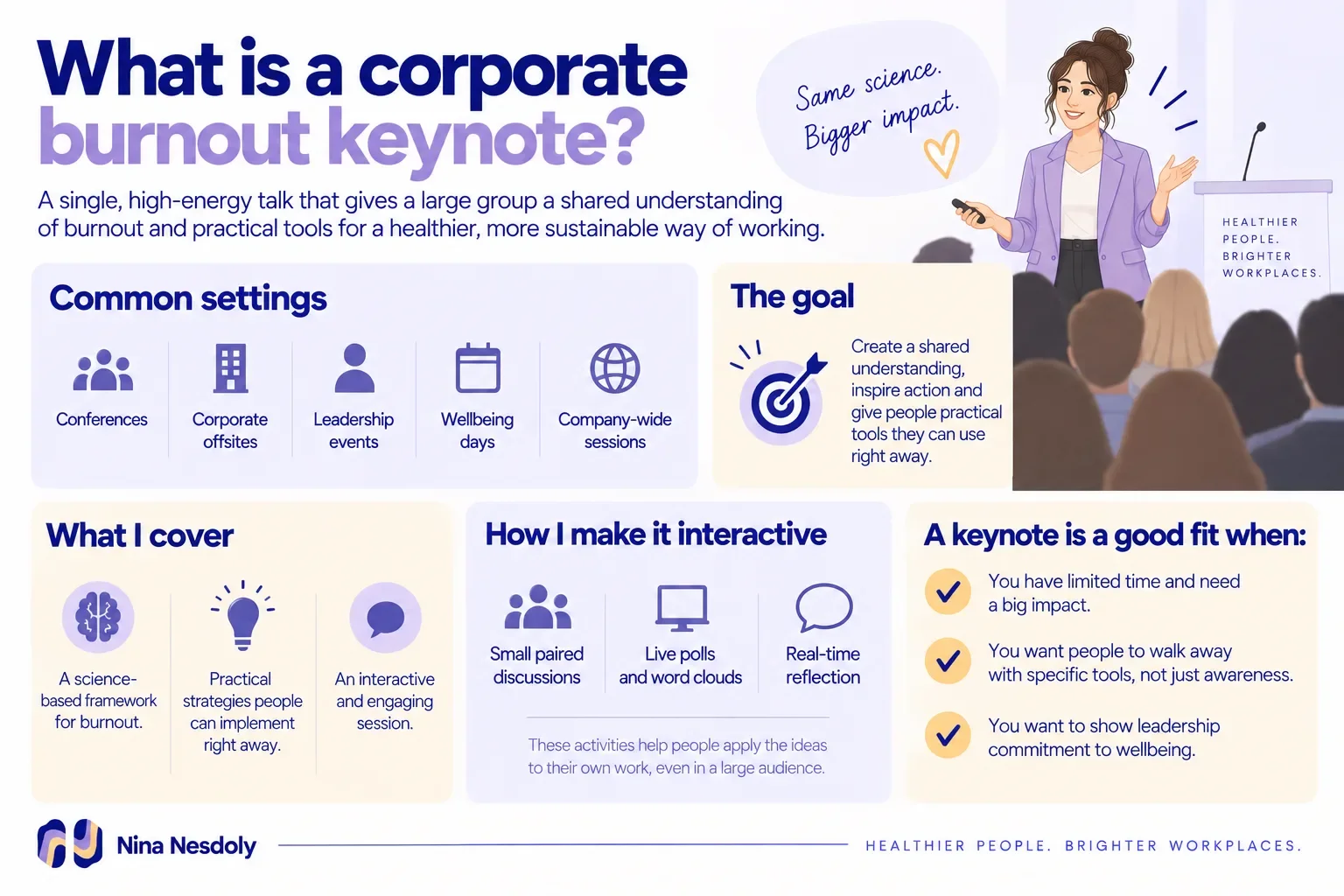
What is a corporate burnout keynote?
A burnout keynote is typically a single, high-energy talk delivered at:
Conferences
Corporate offsites
Leadership events
Employee wellbeing days
Company-wide sessions
The focus is to give a large group a shared understanding and clear framework for burnout and stress management, in a way that is engaging and memorable.
In my own burnout keynotes, I:
Share a science-based framework for understanding burnout and sustainable performance.
Offer practical strategies people can implement right away.
Keep the session interactive, even with a large audience.
Even though it is a keynote, it is not just a one-way lecture. I build in:
Small paired discussions, where attendees talk to each other about a concept and apply it to their own work.
Technology-mediated activities, such as:
Building a word cloud together.
Answering questions live.
Brainstorming around a specific topic.
These activities help people reflect and personalize the ideas, without needing flip charts or breakout rooms.
A keynote is a good fit when:
You have limited time and need a concentrated, impactful session.
You want people to walk away with specific tools, not just awareness.
You want to signal leadership commitment to burnout prevention and wellbeing.
If you are considering burnout keynotes for conferences and company-wide sessions, you can see how I structure these here: burnout keynotes for conferences and company-wide sessions.
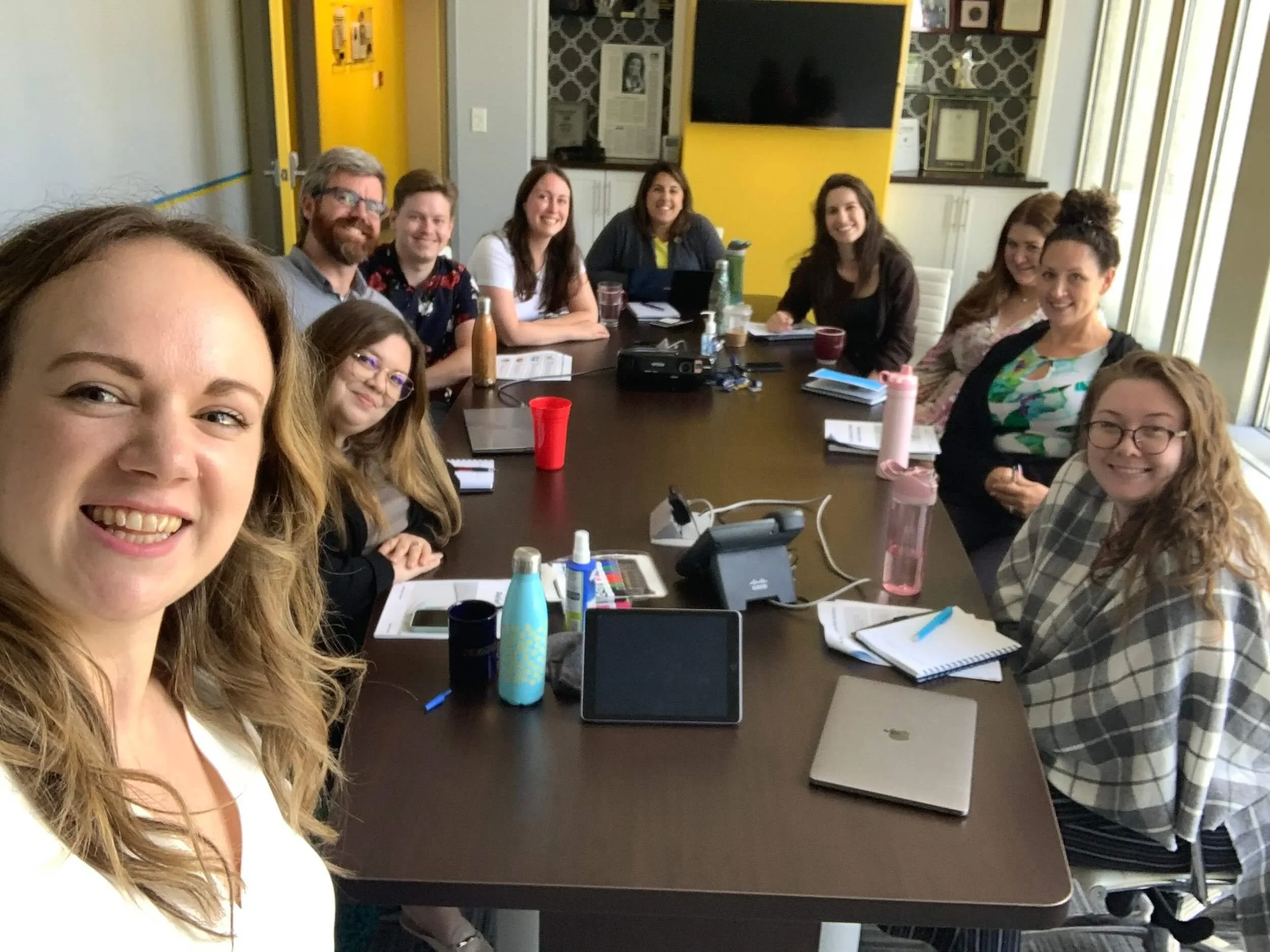
A collaborative workshop setting with team members gathered around the table.
What is a corporate burnout workshop?
A corporate burnout workshop is a facilitated, interactive session for a team, leaders or a specific group, where participants:
Explore what drives burnout in their real day-to-day work.
Practice tools and strategies in real time.
Work together in small groups to apply concepts and problem-solve.
Workshops are generally designed for smaller groups, so we can:
Create groups of about five or six people.
Run activities where they collaborate to:
Map out stressors.
Brainstorm healthier work practices.
Experiment with strategies for focus, recovery and boundaries.
The goal is not only to understand burnout, but to start changing how they work.
Workshops are typically the best option when:
You are running corporate training for teams or leaders.
You want a training program over multiple months, in person or virtual.
You want participants to leave with:
A shared understanding of burnout.
Concrete plans or commitments tailored to their roles.
From conversations with managers and event organizers, two requests come up again and again:
Practical takeaways people can use right away.
Interactive elements that keep people engaged.
I build both into my workshops extensively. You can see more about how I structure these sessions here: interactive burnout workshops for teams and leaders.
If you want a sense of specific exercises, this resource can help: burnout workshop activities ideas.
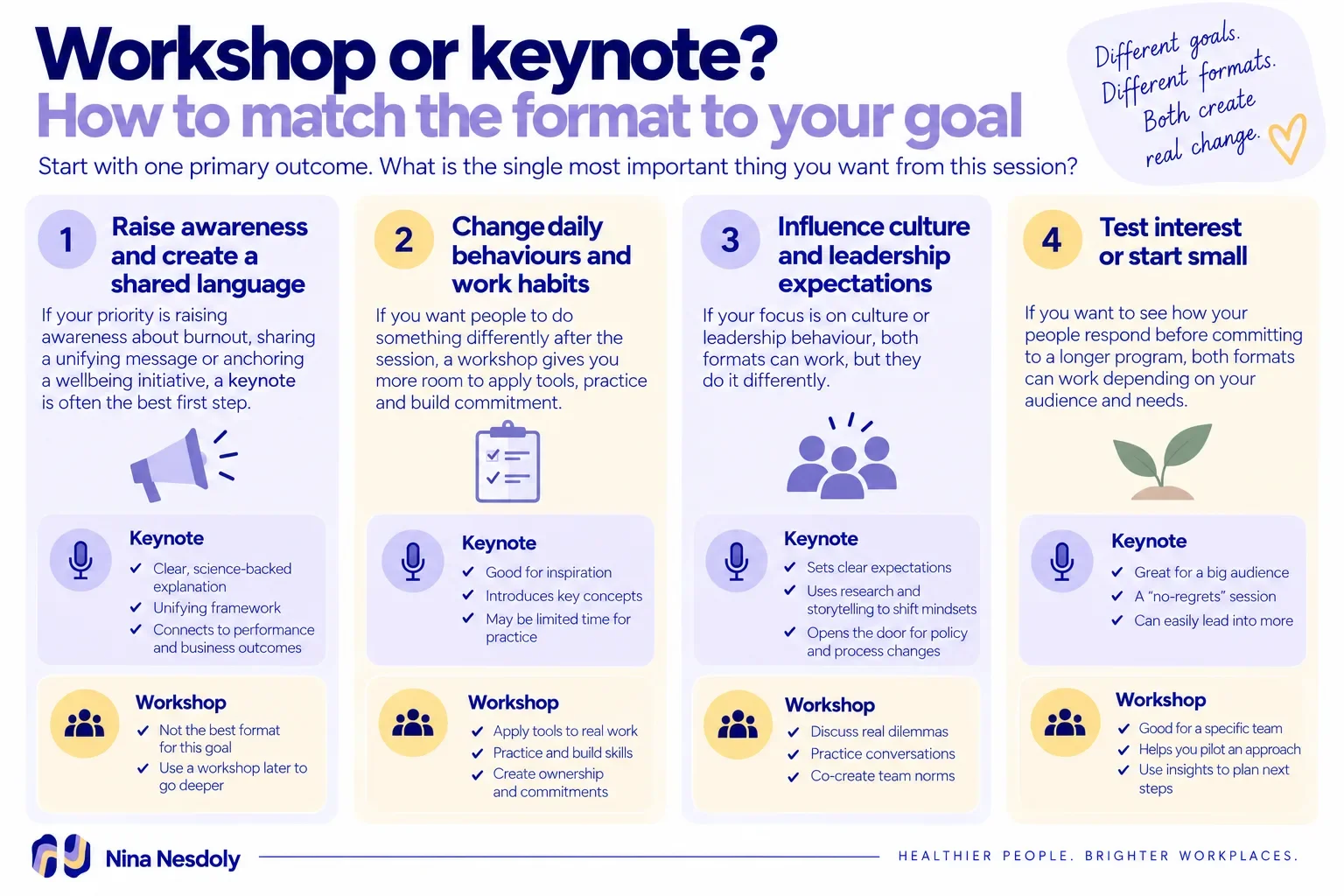
A simple guide to choosing the right format for your session.
Workshop or keynote? How to match the format to your goal
The most reliable way to decide is to start with one primary outcome. What is the single most important thing you want from this session?
Here is how keynotes and workshops line up against common goals.
Goal 1: Raise awareness and create a shared language
If your priority is raising awareness about burnout, sharing a unifying message or anchoring a wellbeing initiative, a keynote is often the best first step.
A keynote works well when you want:
A clear, science-backed explanation of burnout that everyone hears at once.
A unifying framework that people can reference in later conversations, policies or training.
To connect burnout prevention to performance and business outcomes, not just individual self-care.
You might use this to:
Launch or relaunch a wellbeing program.
Set the tone for a year where you want to prioritize sustainable performance.
Align leaders on what you mean by burnout and what you expect from them.
Goal 2: Change daily behaviors and work habits
If you want people to do something differently after the session, a workshop gives you more room to:
Look at actual schedules, workloads and constraints.
Practice tools, not only hear about them.
Build ownership and commitments through group activities.
Workshops are especially useful when you are targeting:
A team or function under sustained pressure.
Managers who need to support their teams more effectively.
A group you will work with again as part of a series or program.
Goal 3: Influence culture and leadership expectations
If your focus is on culture or leadership behavior, both formats can work, but they do it differently.
A leadership keynote can:
Set clear expectations for leaders’ role in burnout prevention.
Use research and storytelling to shift mindsets.
Open the door for later policy or process changes.
A leadership workshop can:
Allow leaders to discuss specific dilemmas.
Practice conversations about workload, boundaries and recovery.
Co-create norms that fit your organization.
Many organizations start with a keynote for all leaders or the whole company, then follow with workshops for managers or high-pressure teams.
Goal 4: Test interest or start small
Sometimes, you want to see how your people respond before committing to a longer program.
You might choose:
A keynote if you:
Have a big audience.
Want a “no-regrets” session that stands alone but can easily lead into more.
A single workshop if you:
Have a specific team that is clearly struggling.
Want to pilot an approach before offering it wider.
If you are still clarifying how urgent burnout is in your organization, this tool can help: free Team Burnout Assessment for HR and managers.
Other practical considerations: audience size, time, budget and logistics
Goals come first, but real constraints matter. Here is how format and logistics usually align.
Audience size
Keynote
Works well for larger audiences, such as:
Company-wide all-hands.
Conferences.
Cross-functional offsites.
The content and activities are designed to keep a large group engaged and interacting without breaking into many physical rooms.
Workshop
Better for smaller groups, where:
Everyone can participate.
Groups of five or six can work together.
There is time for questions and discussion that matter to that group.
Time available
Short time slot (45–60 minutes)
A keynote fits best. It delivers:
A clear narrative arc.
A defined framework.
Practical strategies, plus some interaction.
Longer time slot (90–120 minutes or more)
A workshop makes better use of this time, because:
Participants can move between content, reflection and activities.
They can produce concrete outputs, like team agreements or personal action plans.
Budget
In many organizations, one keynote can:
Reach a large number of people.
Serve as a visible commitment to wellbeing.
Be more budget-efficient on a per-person basis than multiple smaller sessions.
Workshops, especially in series, are typically:
More intensive per group.
Better suited when you have:
A targeted audience.
A need for clear behavior change.
If you are working with a limited budget, it can make sense to:
Use a keynote for broad impact.
Layer one or two targeted workshops for the highest-need groups.
Format and logistics
Both keynotes and workshops can run in person or online. When you are thinking about logistics:
Keynote
Fits easily into existing conference or offsite agendas.
Requires only one main room and standard AV.
Workshop
May need:
A room that supports group work.
Breakout spaces or virtual breakout rooms.
More scheduling flexibility if part of a multi-session program.
Scenarios: which should you choose for your event?
Here are common situations HR and people leaders describe, and which format usually fits best.
1. Annual company conference or corporate offsite
Best fit: Keynote, optionally plus a workshop breakout
For a company-wide wellbeing day, conference or corporate offsite, a keynote often works best to bring everyone together around a shared understanding of burnout and sustainable performance.
You might:
Open the day with a keynote that:
Explains burnout in clear, science-based language.
Normalizes the conversation.
Shares practical strategies people can start using immediately.
Then, for people who want to go deeper, offer a smaller workshop later in the day as a breakout or follow up.
2. Leadership retreat or manager summit
Best fit: Keynote for all leaders, then workshop for managers
At a leadership event, you often need to:
Align leaders on how you want them to think about burnout and wellbeing.
Help them understand their specific role.
A powerful structure is:
Leadership-focused keynote
Sets expectations and offers a framework for leading sustainably.
Follow-up workshop for people managers
Allows them to discuss real situations and build concrete practices.
This format respects time constraints while building real capability.
3. A specific team or department under strain
Best fit: Workshop
If one group is clearly burning out, they usually need more than awareness.
A workshop:
Makes space to talk about their actual constraints.
Lets them collaborate on practices that fit their real workload and client expectations.
Creates shared ownership over how they work.
You can also repeat the workshop for other high-pressure teams after you see how it lands.
4. New wellbeing initiative or mental health month
Best fit: Keynote, possibly with workshop series after
If you are launching a new wellbeing initiative or highlighting mental health:
A keynote gives you:
A visible “kick-off” moment.
A common language for later resources and programs.
Over the following months, you might add:
Workshops for teams and leaders.
Additional learning or discussions.
For more on why investing in burnout prevention is so important, this article may be helpful: Why Burnout Prevention Matters Now More Than Ever.
5. Talent development or leadership program
Best fit: Workshop series, possibly preceded by a keynote
If you are building burnout and stress management into a talent or leadership development program, you often want:
Deeper skill-building over time.
Opportunities for participants to apply tools between sessions.
Here, a short keynote-style session can introduce the concepts, with workshops used as the main learning vehicle over the length of the program.
How Nina Nesdoly supports both workshops and keynotes?
I work with organizations that want burnout support to be:
Science-backed and credible
High-energy and engaging
Practical and immediately useful to employees and leaders
I am a Burnout & Corporate Stress Management Speaker and neuroscientist. I am a PhD candidate and a TEDx speaker, and I hold a Bachelor's in Neuroscience and Master's in Management. My TEDx Talk "How to Relieve Stress When You're Overwhelmed" was selected as an Editor's Pick. I live in Canada and serve organizations in the United States and globally, in both French and English.
Here is how my offerings line up with the formats in this guide.
Burnout keynotes
I offer burnout keynotes for:
Conferences
Corporate offsites
Leadership events
Employee wellbeing days
Company-wide sessions
In a keynote, you can expect a session that is:
High-energy and interactive, with paired discussions and technology-mediated activities
Built around a clear framework from neuroscience and management research
Focused on practical strategies people can put into practice right away, either:
Learned directly from the content
Or brainstormed by participants themselves during interactive segments
You can explore these sessions here: Burnout keynotes.
Team workshops
I also host business workshops in person and online, helping prevent burnout in the business setting.
In workshops, we slow down a bit more. Sessions are:
Designed for groups small enough to work in teams of five or six
Built around activities where participants:
Apply concepts to their real workload and context
Build out new practices together
Often used as:
Standalone training for a team or function
A multi-month program, in the office or virtually
You can see more details here: Team workshops.
Using both together
Many organizations like to combine both formats so they get reach and depth.
A structure that works well is:
Keynote in the morning to present the framework and share strategies
Workshop later in the day (or as a follow-up) so people can:
Dig into their own realities
Build concrete action plans
This setup tends to deliver the two things managers and event planners ask for most often: practical takeaways and interactive elements, no matter which format you choose.
If you want an extra sense of my speaking and teaching style, you can find me featured in lists like Best Ted Talks Burnout.
And if you prefer to get to know me through ongoing content and ideas:
Join Over 50,000+ Followers. Connect with Nina on Tik Tok, Instagram, and LinkedIn.
Next steps: clarify your goals and explore options
At this point, you likely have a gut sense of which format fits your event. To make the decision concrete, you can:
Name your core goal.
Clarifying your core goal (awareness, behavior change, culture shift or early exploration) makes the workshop vs keynote decision much easier.
Define your audience and constraints.
Who exactly do you want in the room?
How many people?
How much time do you realistically have?
Decide on format, or a combination.
Keynote only, if you need broad reach and inspiration.
Workshop only, if you are focused on one group and behavior change.
Keynote plus workshop, if you want both alignment and application.
If you want to talk through which option makes sense for your event and your people, you can Put a Date on Hold so we can look at your goals and constraints together: Put a Date on Hold.
Here is how some organizations describe the impact:
“Nina’s teachings really resonated with our leadership team and inspired us to re-evaluate our work-life balance.”
“We saw immediate improvements in how our employees approached stress management. Highly recommend!”
For more help assessing where your teams stand with burnout right now, this tool is available: free Team Burnout Assessment for HR and managers.
FAQs
When should we choose a corporate wellbeing workshop instead of a keynote?
Choose a workshop when you:
Are working with a specific group, such as a team, department or leadership cohort.
Want people to actively practice tools and apply concepts to their own roles.
Have enough time for group activities and discussion.
Are building a training program over multiple sessions.
Workshops are ideal when your goal is to change how people work day to day, not only how they think about burnout.
When is a keynote the better choice for burnout and stress management?
A keynote is typically the better choice when you:
Have a large audience, such as a company-wide event, conference or offsite.
Want to raise awareness and create a shared language quickly.
Need a high-energy, engaging session that fits into a limited time slot.
Are launching or anchoring a broader wellbeing initiative.
The keynote format lets you deliver a clear framework and practical strategies in a way that is impactful, even when people’s schedules are tight.
Can a workshop and keynote be used together at the same event?
Yes. In fact, using both together is often one of the most effective approaches.
A common structure is:
Keynote in the morning to:
Introduce the burnout framework.
Energize the group.
Share practical strategies widely.
Workshop later in the day or as a follow up to:
Help a subset of participants apply the content.
Build specific action plans or team agreements.
This combination gives you both reach and depth: everyone hears the same core message, and key groups also get hands-on support translating it into their day-to-day work.
This article is educational and is not medical advice. If burnout is affecting you or your team, please talk to a qualified health professional.