
How to Spot Employee Burnout: 7 Warning Signs Every HR Professional Should Know
TL;DR
Burnout usually starts with persistent exhaustion, then grows into cynicism and reduced effectiveness over time.
HR can spot burnout early by watching for patterns in energy, behaviour, communication, performance and health, not just “bad attitudes”.
When you see several of these warning signs together and persisting, it is time to talk with the employee, review demands versus available resources, and make systemic changes, not only offer a day off.
If you work in HR, you probably have a “gut feeling” when someone is not okay. Maybe an employee who is usually really engaged starts turning cameras off, missing small details or making comments about how tired they are. You notice it, but it can be hard to know if you are seeing normal stress or the beginnings of burnout.
Burnout isn’t just a bad week, it’s a chronic, occupational phenomenon that quietly erodes energy, motivation, and performance, often long before anyone uses the word “burnout.” As a society, we have gotten really good at overriding the initial warning signs of burnout. It might seem more productive at first, but the worse burnout gets the harder it is to recover.
By the time someone is in crisis, options narrow; people go on extended leave, teams scramble to cover, trust in leadership drops off. This is why spotting burnout is a core HR responsibility, not just a managerial soft skill.
Rather than a gut-feeling or best-guess, a research-based lens for how to spot employee burnout goes a long way. As a burnout and stress management speaker and neuroscientist, I use the three dimensions of burnout described by Maslach, Schaufeli and Leiter (emotional exhaustion, cynicism and reduced professional efficacy) as the backbone for how I teach HR teams to spot warning signs.
The list below turns those dimensions into specific, observable warning signs, with specific examples from teams I’ve worked with and concrete next steps you can take.
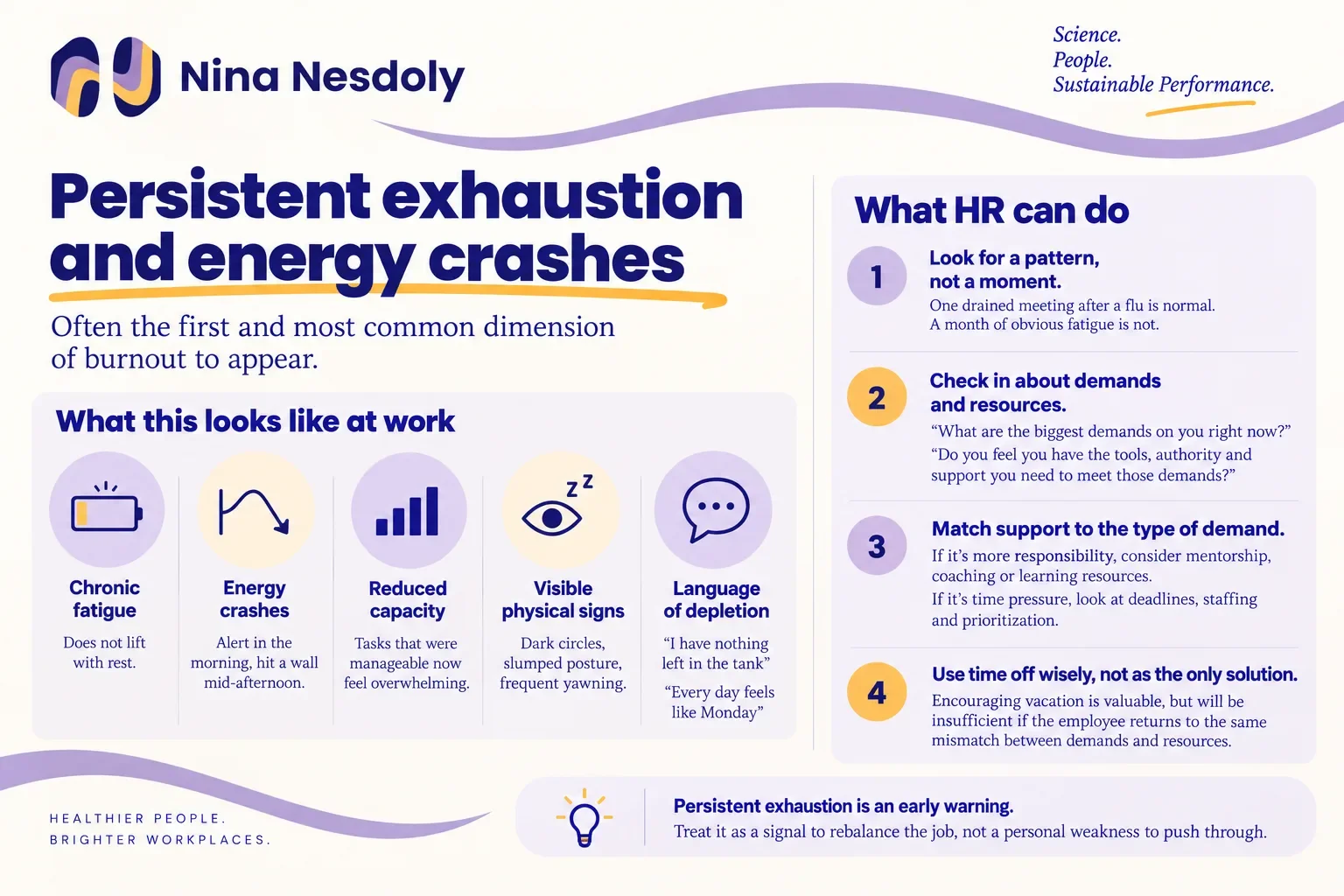
1. Persistent exhaustion and energy crashes
Emotional exhaustion is the most common dimension of burnout and usually the first to appear. It’s so common that popular media will often conflate the two; you may have seen burnout statistics that actually only cover exhaustion. Exhaustion is more than “a bit tired” after a busy week.
What this looks like at work?
Watch for patterns like:
Chronic fatigue that does not lift with rest. The employee comes back from a weekend or short vacation still wiped out, saying things like “I am tired all the time” or “I just cannot recharge”.
Energy crashes during the day. They seem reasonably alert in the morning, but hit a wall later on, even after a good lunch break. They may stare at the screen, struggle to get started on tasks or say they feel “fried” or “foggy”.
Reduced capacity. Workloads that were manageable a few months ago now feel overwhelming. They need more time, more reminders or more breaks to get through similar tasks. Worth nothing, that probably means the workload wasn’t actually sustainable in the first place. The occasional sprint or heightened workload is okay, but people cannot work at the top end forever.
Language of depletion. Phrases like “I have nothing left in the tank”, “I am just trying to survive this week” or “I just need to make it until this project is done.”
These are all manifestations of emotional exhaustion that show up in day‑to‑day work.
From a neuroscience perspective, chronic stress keeps us in a state of heightened alert. Over time, this depletes the systems that support sustained attention, self‑control and emotional regulation. That’s why exhausted employees often become more reactive and less consistent, even if they are trying just as hard. Minor inconveniences feel massive when your brain is in a high-alert state.
What HR can do when you see exhaustion?
Look for a pattern, not a moment. One drained meeting after a flu is normal. A month of obvious fatigue is not.
Check in about demands and resources, not just workload. Ask:
“What are the biggest demands on you right now?”
“Do you feel you have the tools, authority and support you need to meet those demands?”
Match support to the type of demand. Research on stressors and resources at work (for example, de Jonge & Dormann’s work on the “triple‑match principle”) highlights that resources are most effective when they fit the specific demands.
If someone has more responsibility and feels overwhelmed, the answer may not be to remove responsibility. It might be to give mentorship, coaching or learning resources that help them succeed at that level.
If the demand is time pressure, look at deadlines, staffing and prioritization.
Use time off wisely, not as the only solution. Encouraging vacation is valuable, but will be insufficient if the employee returns to the same mismatch between demands and resources.
Persistent exhaustion is an early warning. Treat it as a signal to rebalance the job, not a personal weakness to push through.
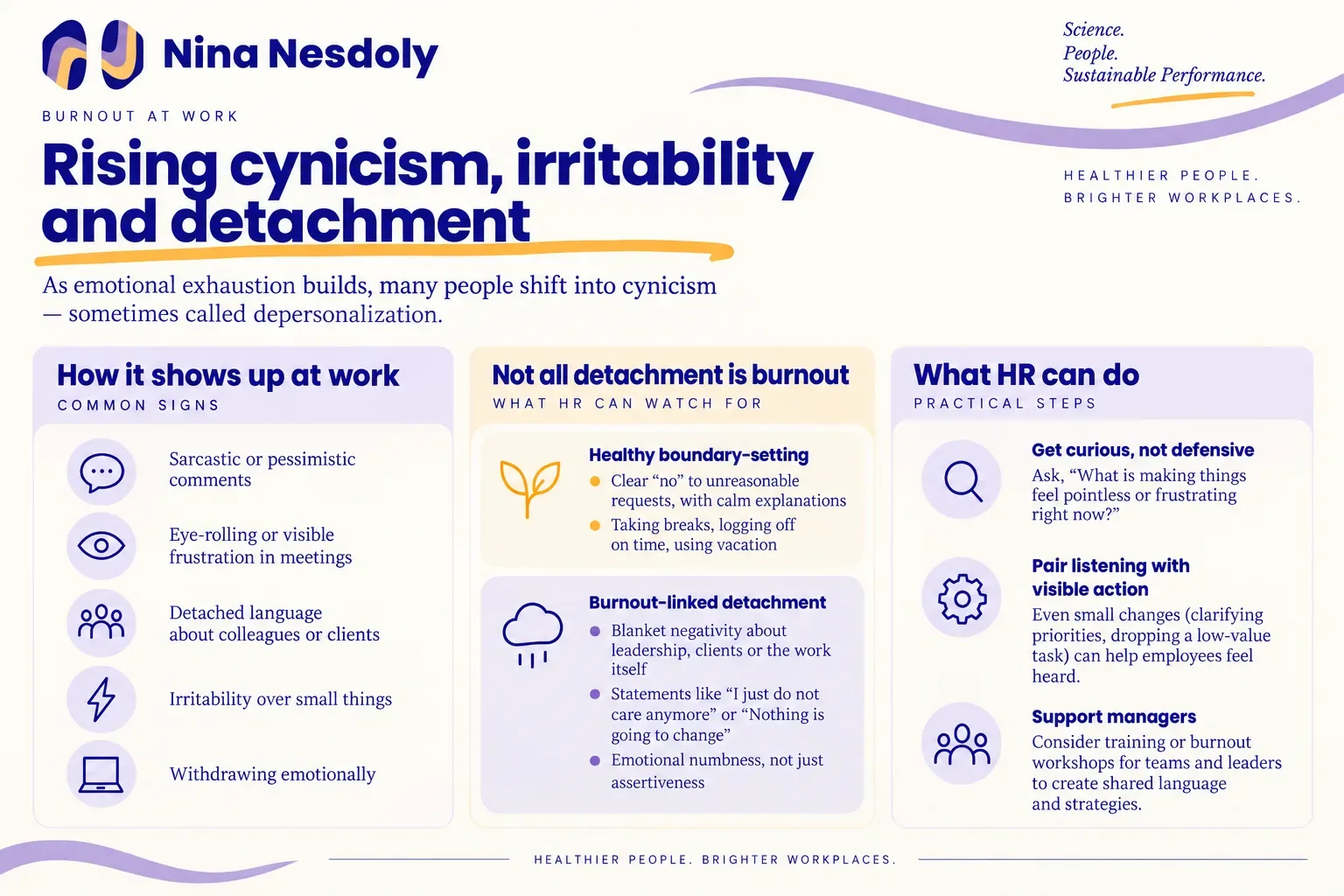
2. Rising cynicism, irritability and detachment
As emotional exhaustion builds, many people shift into the second dimension of burnout: cynicism. This is sometimes called depersonalization, and it often shows up as irritability and emotional distance. People who once enjoyed interacting with customers, clients, or peers will appear disinterested and even frustrated.
How cynicism shows up at work?
You might notice:
Sarcastic or pessimistic comments. Jokes with an edge, like “Why bother? It will get changed again anyway” or “Management will not listen, they never do”.
Eye‑rolling or visible frustration in meetings. Sighs, sharp tone, or closed body language when new initiatives or client needs are discussed.
Detached language about colleagues or clients. Talking about people as “cases”, “tickets” or “problems”, rather than as individuals. Less warmth or empathy in conversations.
Irritability over small things. Short fuse about minor delays or requests that they previously handled calmly.
Withdrawing emotionally. Doing the bare minimum in interactions, avoiding informal chats, keeping cameras off and microphones muted unless directly asked a question.
These behaviors can easily be misread as “bad attitude”. In burnout, they are often protective. When the brain is overloaded and exhausted, pulling away emotionally can feel like the only way to cope.
Distinguishing burnout from healthy boundaries
Not all cynicism or detachment is unhealthy. HR can watch for:
Healthy boundary-setting:
Clear “no” to unreasonable requests, with calm explanations.
Taking breaks, logging off on time, using vacation.
Burnout‑linked detachment:
Blanket negativity about leadership, clients or the work itself.
Statements like “I just do not care anymore” or “Nothing is going to change”.
Emotional numbness, not just assertiveness.
Healthy boundaries reduce stress. Burnout‑driven cynicism shows up as ongoing bitterness, hopelessness or contempt.
What HR can do when you see it?
Get curious, not defensive. If cynicism is aimed at leadership or policies, it might highlight real issues. Ask, “What is making things feel pointless or frustrating right now?”
Pair listening with visible action. Even small changes (clarifying priorities, dropping a low‑value task) can reduce learned helplessness and help employees feel heard.
Support managers. Leaders often become the target of cynicism while they are burned out themselves. Consider training or burnout workshops for teams and leaders to create shared language and strategies.
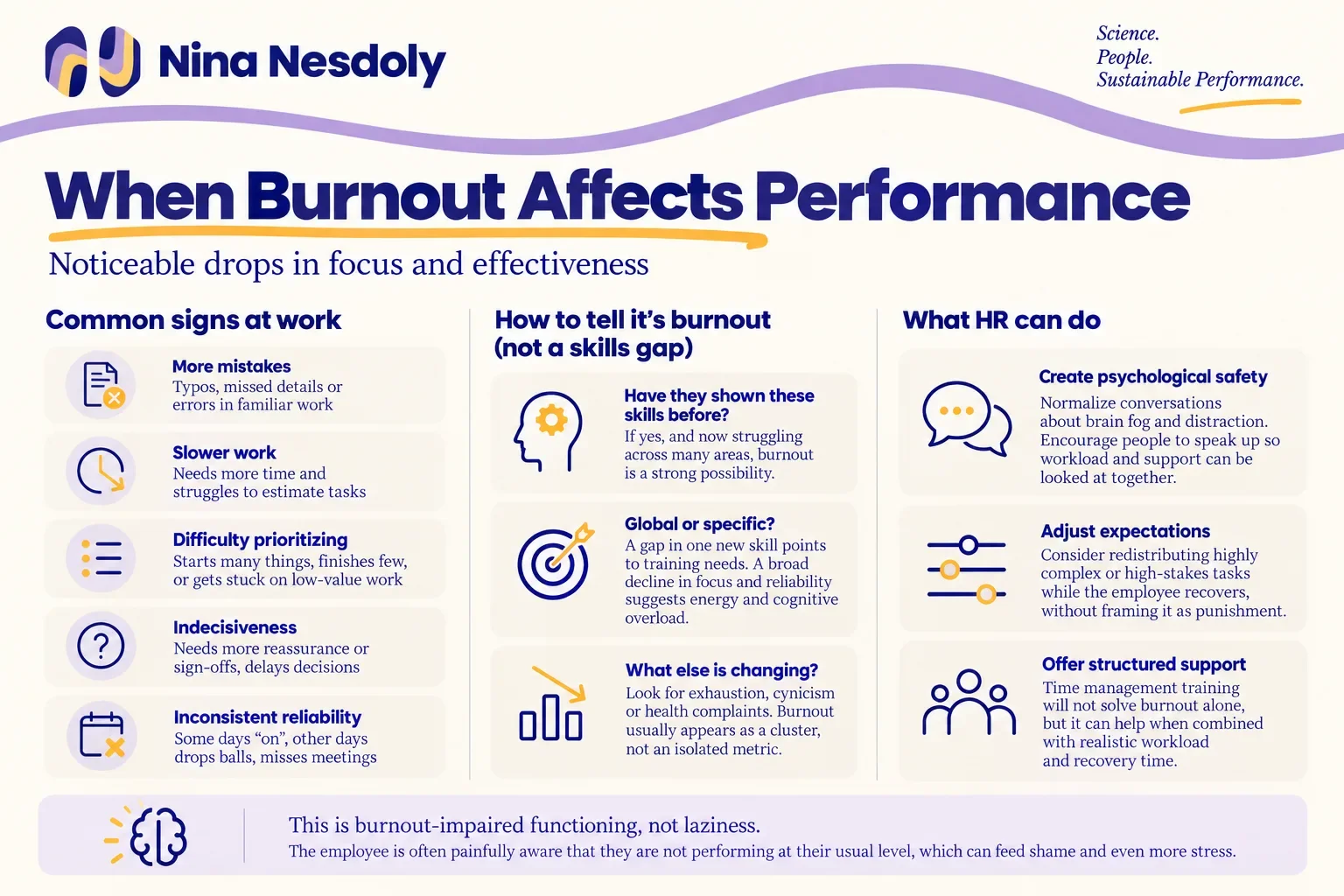
3. Noticeable drops in performance and focus
The third dimension of burnout, reduced professional efficacy, often appears as cognitive and performance changes. This matters for HR because it is where burnout is most likely to be misclassified as a skill issue or disengagement. Chronic stress decreases activity in prefrontal cortex, which is central to focus, planning and decision making.
What this looks like in day‑to‑day work?
Look for shifts relative to the employee’s own baseline:
More mistakes and missed details. Typos, missed steps in routine processes or errors in work they usually handle well.
Slower work on familiar tasks. They need more time than usual and may struggle to estimate how long tasks will take.
Difficulty prioritizing. They bounce between tasks, start many things and finish few, or get stuck on low‑value work while important work waits.
Indecisiveness. Needing more reassurance or sign‑offs, second‑guessing themselves or delaying decisions they used to make quickly.
Inconsistent reliability. Some days they are “on”, other days they drop balls, miss meetings or forget commitments.
This is burnout‑impaired functioning, not laziness. The employee is often painfully aware that they are not performing at their usual level, which can feed shame and even more stress.
Differentiating burnout from a skills gap
Ask yourself:
Has this person demonstrated these skills before? If yes, and they are now struggling across many areas, burnout is a strong possibility.
Is the pattern global or specific? A gap in one new skill points to training needs. A broad decline in focus and reliability suggests energy and cognitive overload.
What else is changing? Are there concurrent signs of exhaustion, cynicism, or health complaints? Burnout usually appears as a cluster, not an isolated performance metric.
What HR can do when you see drops in performance?
Create psychological safety to talk about cognitive strain. Normalize statements like, “A lot of us are noticing more brain fog and distraction this quarter. If that is you, please speak up so we can look at workload and support together.”
Adjust expectations temporarily. Consider redistributing highly complex or high‑stakes tasks while the employee recovers, without framing it as punishment.
Offer structured support. Time management training will not solve burnout alone, but it can help when combined with realistic workload and recovery time.
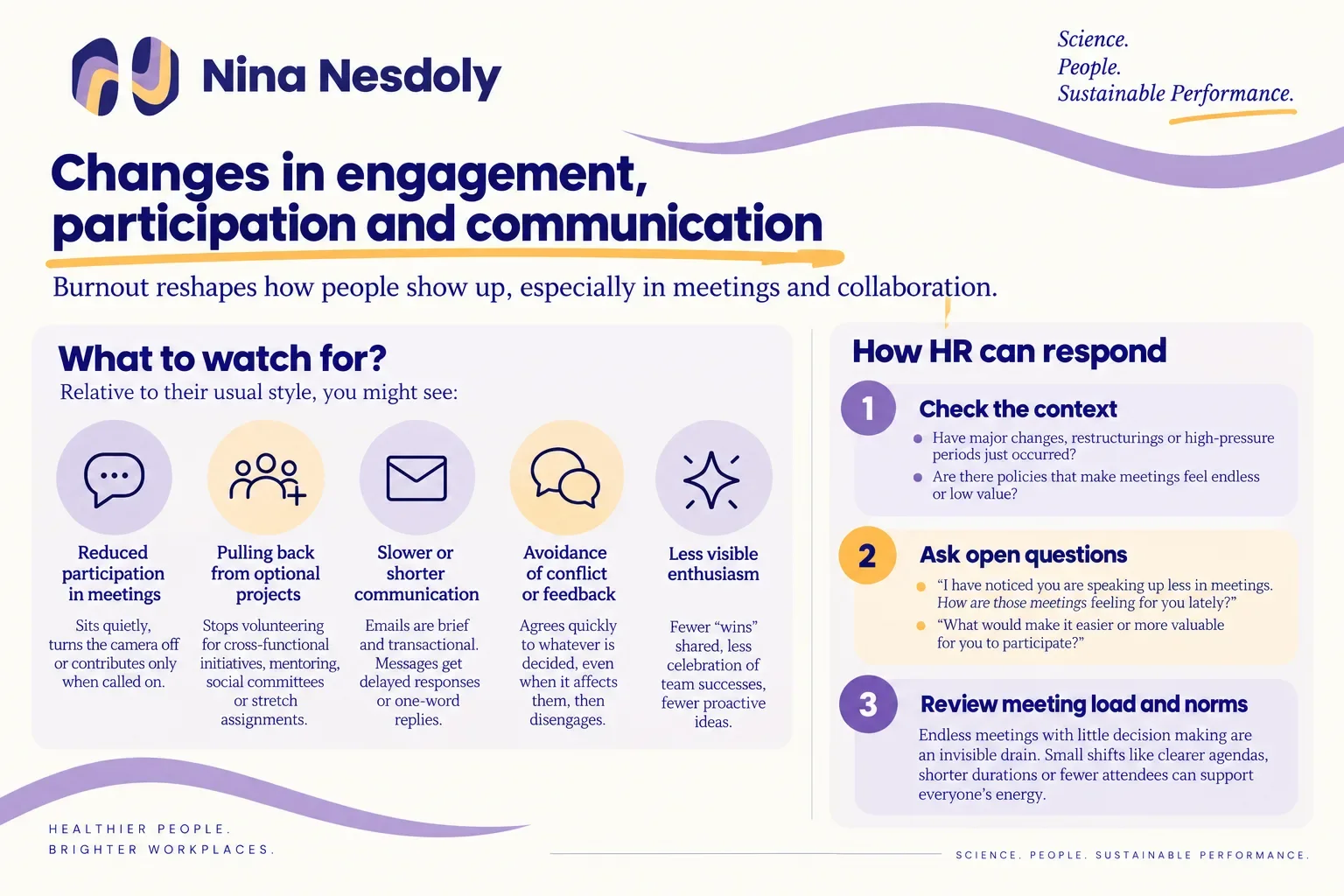
4. Changes in engagement, participation and communication
Burnout does not only live in individual performance metrics. It reshapes how people show up socially, especially in meetings and collaboration.
What to watch for?
Relative to their usual style, you might see:
Reduced participation in meetings. Someone who used to ask questions, brainstorm or drive discussions now sits quietly, turns the camera off, or contributes only when called on.
Pulling back from optional projects. They stop volunteering for cross‑functional initiatives, mentoring, social committees or stretch assignments.
Slower or shorter communication. Emails become brief and transactional. Slack or Teams messages get delayed responses or one‑word replies.
Avoidance of conflict or feedback. They agree quickly to whatever is decided, even when it affects them, then disengage.
Less visible enthusiasm. Fewer “wins” shared, less celebration of team successes, fewer proactive ideas.
Burned out employees may be conserving energy. Participating actively in discussions, turning cameras on or engaging socially all require cognitive and emotional resources that they may not feel they have.
How HR can respond?
Check the context before labelling it disengagement.
Have major changes, restructurings or high‑pressure periods just occurred?
Are there policies that make meetings feel endless or low value?
Ask open questions. For example:
“I have noticed you are speaking up less in meetings. How are those meetings feeling for you lately?”
“What would make it easier or more valuable for you to participate?”
Review meeting load and norms. Endless meetings with little decision making are an invisible drain. Small shifts like clearer agendas, shorter durations or fewer attendees can support everyone’s energy.
One client shared that “We saw immediate improvements in how our employees approached stress management. Highly recommend!” after incorporating leadership‑focused teachings on healthier work habits. When teams have shared tools for managing stress and energy, participation and communication often improve.
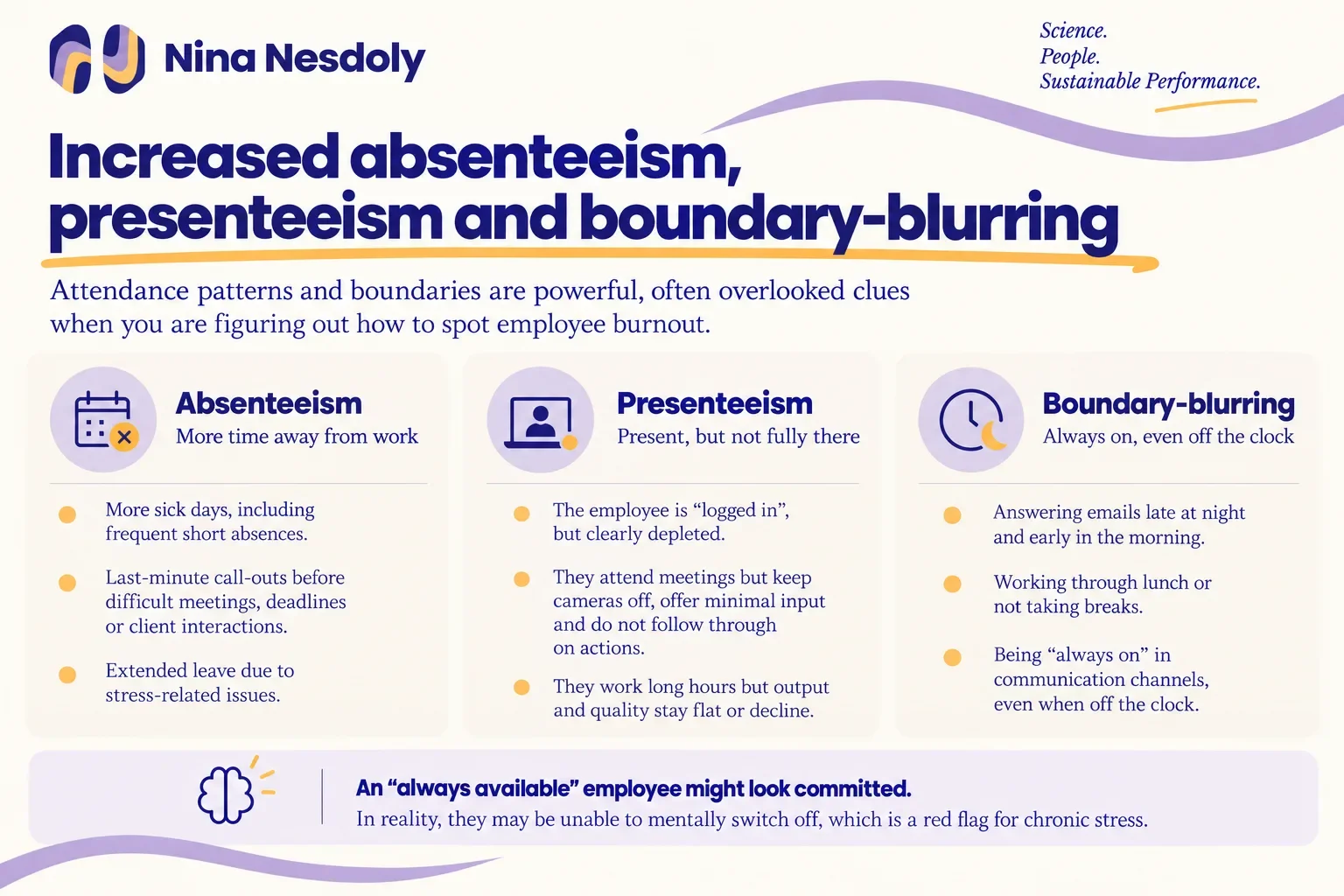
5. Increased absenteeism, presenteeism and boundary-blurring
Attendance patterns and boundaries are powerful, often overlooked clues when you are figuring out how to spot employee burnout.
Two sides of the same burnout coin
Burnout can show up as:
Absenteeism
More sick days, including frequent short absences.
Last‑minute call‑outs before difficult meetings, deadlines or client interactions.
Extended leave due to stress‑related issues.
Presenteeism
The employee is “logged in”, but clearly depleted.
They attend meetings but keep cameras off, offer minimal input and do not follow through on actions.
They work long hours but output and quality stay flat or decline.
You may also see boundary‑blurring:
Answering emails late at night and early in the morning.
Working through lunch or not taking breaks.
Being “always on” in communication channels, even when off the clock.
From the outside, an “always available” employee might look committed. In reality, they may be unable to mentally switch off, which is a red flag for chronic stress.
What HR can do when you see absenteeism?
Look at patterns over time. A spike in sick days during flu season is normal. A steady climb, especially tied to specific stressors, deserves attention.
Address culture, not just the individual. Ask:
“Do our norms reward overwork and constant responsiveness?”
“Do leaders model healthy boundaries themselves?”
Normalize boundaries. Encourage and model:
Using out‑of‑office replies.
Not expecting responses outside of working hours.
Taking breaks and encouraging others to do the same.
Talk about presenteeism explicitly. Make it clear that being online but non‑functional is a sign to reach out for support, not a performance strategy.
Nina helps teams build healthier, more sustainable ways of working through burnout workshops and keynotes. Shifting norms around availability and recovery is often a team‑level project, not something an individual employee can fix alone.
6. Physical and health-related red flags
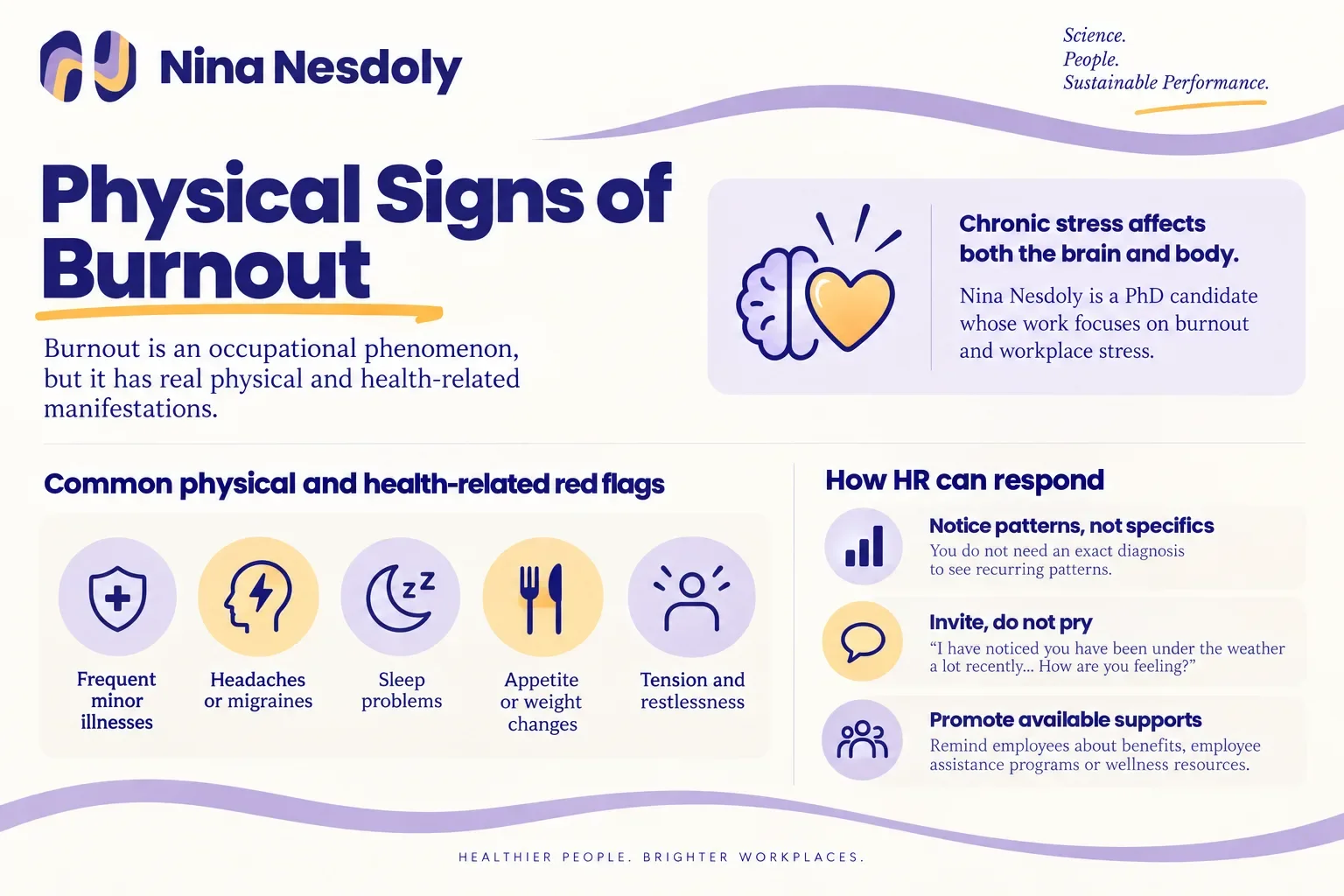
Burnout is an occupational phenomenon, but it has real physical and health‑related manifestations that HR can ethically notice through patterns in attendance, self‑reports and observed behavior.
Nina Nesdoly is a PhD candidate whose work focuses on burnout and workplace stress. Her research and speaking often connect how chronic stress affects both the brain and body.
What this can look like?
You might observe or hear about:
Frequent minor illnesses. Colds, stomach issues or “bugs” that seem to come one after another.
Headaches or migraines. Employees mention recurring headaches, especially later in the day or week.
Sleep problems. Comments like “I cannot shut my brain off at night” or “I wake up at 3 am thinking about work”.
Appetite or weight changes. Skipping meals because they are “too busy”, or relying heavily on caffeine and sugar to get through the day.
Tension and restlessness. Fidgeting, jaw clenching, rubbing temples or neck, or difficulty sitting still in long meetings.
Chronic stress can contribute to these symptoms and erode recovery. Over time, this feeds a vicious cycle: poor sleep and health issues reduce energy and focus, which increase stress, which then worsens health further. I cover more of this connection in detail in my article on chronic stress and its role in burnout.
Staying within professional boundaries
HR is not a medical provider, and you should not diagnose or demand private health information. Instead:
Notice patterns, not specifics. You do not need to know an exact diagnosis to see that someone is frequently unwell or complaining of stress‑related symptoms.
Invite, do not pry. You might say, “I have noticed you have been under the weather a lot recently and still working long hours. How are you feeling about your workload and stress levels?”
Promote available supports. Remind employees about benefits, employee assistance programs or wellness resources without pressuring them to disclose details.
The key is to treat physical red flags as another piece of the burnout puzzle, not as proof or as something to ignore because it feels “personal”.
7. Loss of meaning, motivation and growth
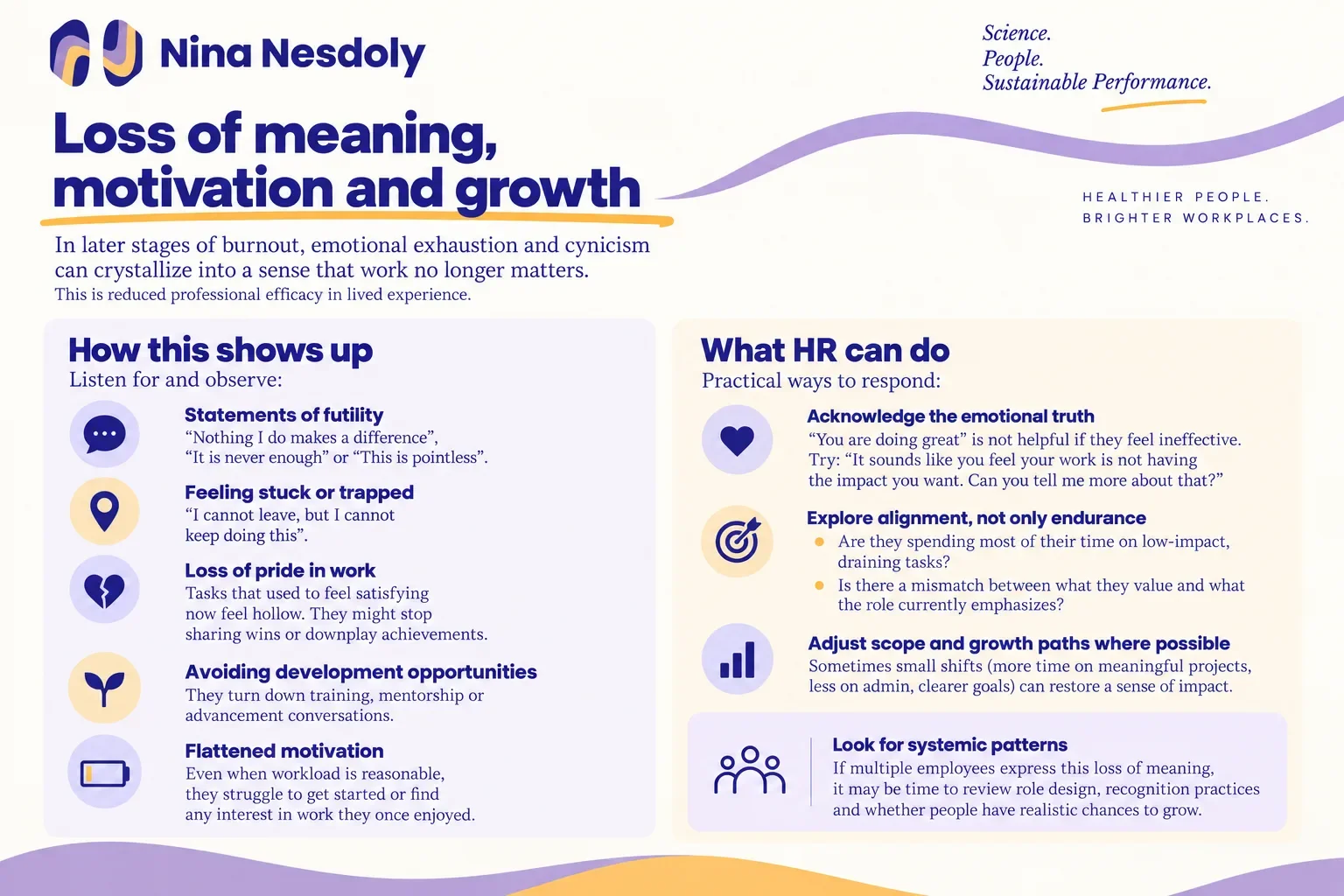
In later stages of burnout, emotional exhaustion and cynicism can crystallize into a sense that work no longer matters. This is reduced professional efficacy in lived experience.
How this shows up in language and behavior?
Listen for and observe:
Statements of futility. “Nothing I do makes a difference”, “It is never enough” or “This is pointless”.
Feeling stuck or trapped. Not “I am ready for a new challenge”, but “I cannot leave, but I cannot keep doing this”.
Loss of pride in work. Tasks that used to feel satisfying now feel hollow. They might stop sharing wins or downplay achievements.
Avoiding development opportunities. They turn down training, mentorship or advancement conversations, not because they lack ambition, but because they feel too depleted to imagine growth.
Flattened motivation. Even when workload is reasonable, they struggle to get started or find any interest in work they once enjoyed.
This is different from a normal desire for change. Healthy career exploration sounds like curiosity: “I think I am ready to try X” or “I want to build Y skill”. Burnout‑related loss of meaning sounds more like resignation or despair.
One client shared that “Nina’s teachings really resonated with our leadership team and inspired us to re-evaluate our work-life balance.” When leaders themselves reconnect with meaning and sustainable ways of working, it gives employees permission to do the same.
What HR can do when you see it?
Acknowledge the emotional truth. Saying “You are doing great” is not helpful if the employee feels ineffective. Try: “It sounds like you feel your work is not having the impact you want. Can you tell me more about that?”
Explore alignment, not only endurance.
Are they spending most of their time on low‑impact, draining tasks?
Is there a mismatch between what they value and what the role currently emphasizes?
Adjust scope and growth paths where possible. Sometimes small shifts (more time on meaningful projects, less on admin, clearer goals) can restore a sense of impact.
If multiple employees in a team express this loss of meaning, that is a systemic flag. It may be time to review role design, recognition practices and whether people have realistic chances to grow.
What HR can do next: from spotting signs to taking action?
Spotting burnout is only useful if it leads to timely, compassionate action at both individual and systemic levels.
Here is a simple path from observation to action:
1. Look for patterns across the three dimensions
Use the warning signs above to look for clusters of:
Emotional exhaustion (persistent fatigue, energy crashes, health complaints).
Cynicism (negativity, irritability, detachment).
Reduced professional efficacy (drops in performance, loss of meaning and motivation).
One sign alone might be a rough week. Several signs, persisting for weeks or months, point toward burnout.
If you want structure, tools like the Team Burnout Assessment for HR professionals and managers can help you systematically measure these dimensions across a group or organization.
2. Have a supportive, specific conversation
When you have concerns:
Prepare concrete observations. “I have noticed you are taking more sick days and seem really tired in our Monday calls” is more helpful than “You seem off”.
Lead with care, not performance. Open with impact on their wellbeing first, then on work: “I am concerned about how hard you are pushing yourself, and I also see the work feels harder than it used to.”
Ask about demands and resources.
“What are the biggest pressures on you right now?”
“What feels like it is missing to help you handle those pressures?”
Listen more than you talk. Resist the urge to jump immediately to fixes.
3. Adjust demands and add resources, not just days off
One of the big mistakes HR managers make is focusing only on obvious levers like reducing workload or encouraging employees to take time off. These are valuable and often necessary, but they will be insufficient if the employee does not have the resources they need to meet the actual demands of their job.
If an employee has just been given more responsibility and is showing signs of irritation and overwhelm, the answer might not be to remove that responsibility. It might be to provide:
Mentorship or coaching.
Training or learning resources.
Clearer expectations and decision rights.
Think in terms of demand–resource fit:
Task demands (volume, complexity) need time, tools and clear priorities.
Emotional demands (client distress, conflict) need supportive supervision, debriefing, peer support.
Cognitive demands (constant switching, problem‑solving) need focus time, reduced interruptions, realistic deadlines.
Research on stressors, resources and strain at work supports this “matching” approach. The right resource for the right demand is more effective than generic support.
4. Take systemic action, not only individual accommodations
Burnout is often a rational response to chronic conditions, not individual fragility. Look for patterns across teams:
Are multiple people showing the same signs after a particular change?
Do some roles or managers have consistently higher burnout signals?
Are there common themes in exit interviews or engagement surveys?
Systemic responses can include:
Revisiting role design and workload distribution.
Training managers in sustainable performance and stress management.
Bringing in external support, such as burnout keynotes for conferences and company-wide sessions or targeted Team workshops.
One client shared, “Nina’s teachings really resonated with our leadership team and inspired us to re-evaluate our work-life balance.” Another reported, “We saw immediate improvements in how our employees approached stress management. Highly recommend!” When leaders and teams have shared language and practical tools, it becomes much easier to intervene early and sustainably.
5. Escalate when needed
Some situations require more urgent or formal action:
The employee mentions thoughts of self‑harm or severe distress.
Functioning has dropped so much that safety or major obligations are at risk.
You see signs of discrimination, harassment or other violations contributing to stress.
In these cases, follow your organization’s policies. Encourage and facilitate access to medical or psychological support, and involve appropriate internal partners (for example, health and safety, legal, senior leadership) as needed.
FAQs
How can HR tell burnout apart from a short-term rough patch?
Look for duration, breadth and clustering. A rough patch is usually time‑limited and tied to a specific event (a big deadline, a reorganization). Burnout builds over weeks or months, affects many areas at once (energy, mood, performance, health) and rarely resolves with a single weekend off or short vacation. When you see multiple signs across exhaustion, cynicism and reduced effectiveness, persisting despite normal rest, burnout is more likely.
What are the most observable signs of employee burnout in the workplace?
Some of the most observable signs include:
Persistent exhaustion that does not lift with rest.
Increased cynicism, irritability or detachment from work, clients or colleagues.
Noticeable drops in focus, reliability and quality of work.
Pulling back from meetings, collaboration and communication.
Changes in attendance patterns, including more sick days or presenteeism.
Recurring stress‑related complaints like headaches, sleep issues or frequent minor illnesses.
Language that suggests loss of meaning, impact or motivation.
The key is to compare these behaviors with the employee’s usual baseline and look for consistent change over time.
When should HR escalate possible burnout concerns?
Escalate when:
The employee’s wellbeing appears significantly at risk, for example they mention feeling hopeless or unable to cope.
Performance or safety is seriously compromised and cannot be stabilized with simple adjustments.
There are signs that workplace factors such as harassment, discrimination or policy violations are contributing.
Multiple team members are showing similar severe signs, suggesting a systemic issue.
In these cases, involve appropriate internal stakeholders, follow your organization’s procedures and support the employee in accessing professional help where appropriate.
What can HR do after noticing burnout warning signs?
Once you notice warning signs:
Document specific observations and look for patterns across exhaustion, cynicism and reduced effectiveness.
Have a supportive, confidential conversation with the employee focused on demands, resources and how they are feeling, not just on performance metrics.
Adjust workloads and expectations where possible, and add targeted resources such as mentorship, training, better tools or clearer priorities.
Review team and organizational factors, addressing unrealistic norms or systemic stressors.
Use structured tools like the Team Burnout Assessment for HR professionals and managers if you need a more formal picture.
Escalate according to policy if you see severe distress or risk.
If you want a ready‑made, science‑backed way to start these conversations and assess your team, you can share my free assessment link with managers or use it yourself: Download Free Burnout Assessment → https://www.ninanesdoly.com/burnout-assessment.
This article is educational and is not medical advice. If burnout is affecting you or your team, please talk to a qualified health professional.