
How to Run a Burnout Prevention Workshop at Work
TL;DR
A good burnout prevention workshop is not a cure, it is a catalyst. It builds shared language, awareness and specific team commitments that make work more sustainable.
Start by defining 1–3 clear goals, design a simple agenda with short teaching plus lots of discussion, keep it psychologically safe and always finish with concrete next steps.
Use this guide to run a solid internal session, and bring in an external expert when you want deeper impact, impartial facilitation or more advanced content.
You have been asked to “run something on burnout” for your team. You care about your people, you know burnout is real, and you also know this cannot be a one-off magic fix.
What you can do is run a focused, science-informed burnout prevention workshop that opens up honest conversation, teaches useful concepts and helps your team agree on specific changes to how they work.
This guide walks you through exactly how to run a burnout session at work, from clarifying your goals to facilitating the room, to deciding when it is worth bringing in an external burnout workshop facilitator like Nina Nesdoly.
A collaborative workshop setting with team members gathered around the table.

1. Start with why: what a burnout prevention workshop can (and can’t) do
A burnout prevention workshop is a starting point, not a solution to every problem.
A well-designed session can:
Build a shared language about stress and burnout, so people can talk about it earlier and more clearly.
Increase awareness of what burnout is, what it is not, and common causes at work.
Help people recognize early signs of burnout in themselves and colleagues.
Introduce practical tools for managing stress and energy in a work context.
Create space for the team to identify small, concrete, collective changes that support healthier ways of working.
It cannot:
Fix chronic under-staffing in 90 minutes.
Replace fair workload distribution, proper resourcing or psychologically safe leadership.
“Treat” individual burnout like a clinical intervention.
Where workshops become powerful is in the mix of insight and co-creation. In Nina’s workshops, time for team discussion is crucial. When teams have space to brainstorm, reflect and decide together, new norms often emerge that they then keep “forever after”.
For example, some teams:
Decide meetings will be 50 minutes, with 10 minutes left for a break, so everyone has breathing room between calls.
Set one Friday afternoon each month for learning whatever they want, which a tech team used to reclaim time to play, explore and stay sharp for future challenges.
Block a no-meeting period in the morning so people can do deep work.
Agree to protect a short block at lunch for a walk, stretch or personal wellness time.
The details vary by team. The pattern is the same: the facilitator offers recommendations, then creates space for the team to select and shape what will work for them. Teams that do this report immediate changes even from one small shift, because everyone is pulling in the same direction and prioritizing well-being together.
Your role, whether you are the facilitator or you bring someone in, is to create that container: clear information, honest discussion and support for deciding on next steps.
Clarify your goals before the session to keep the discussion focused and useful.
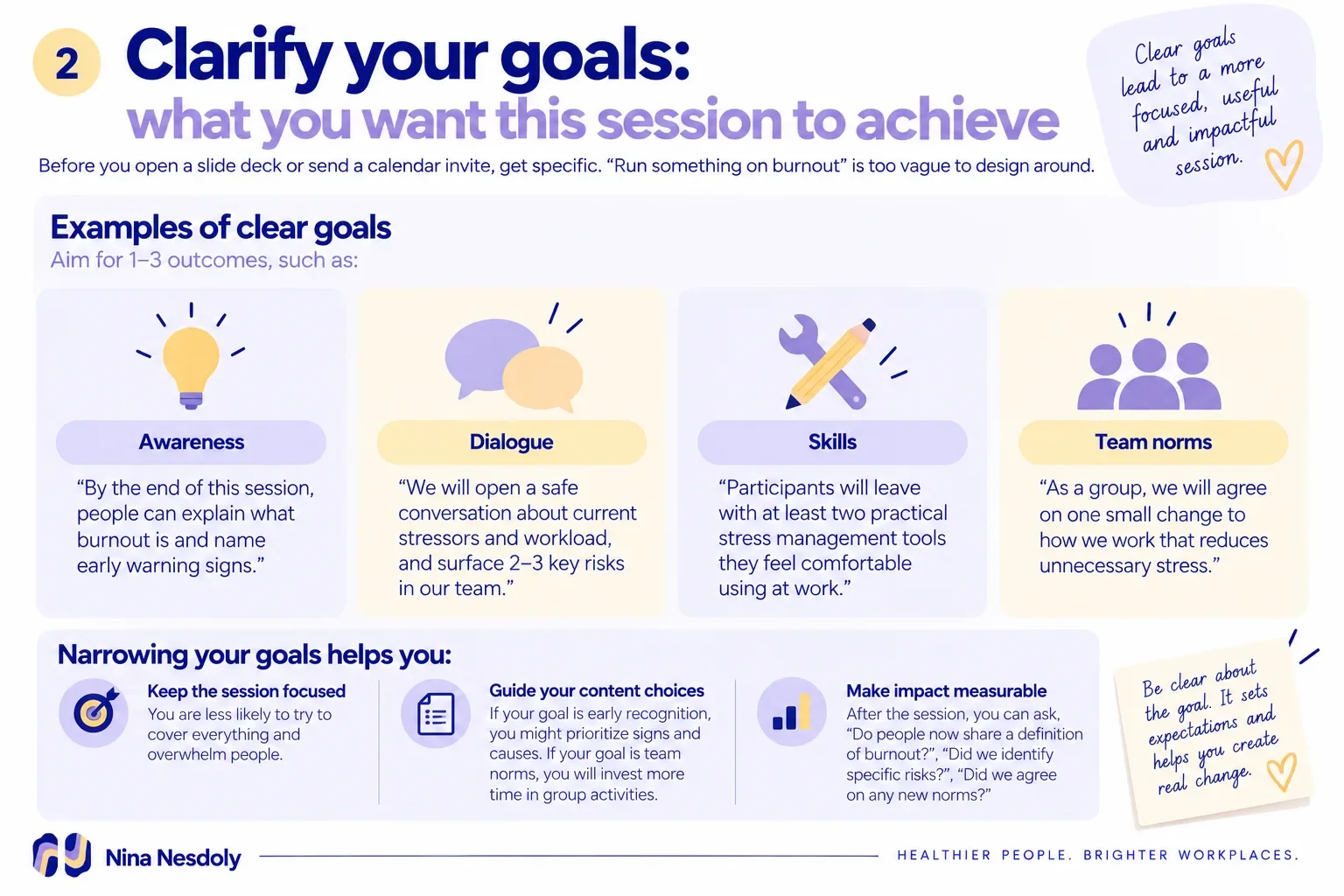
2. Clarify your goals: what you want this burnout session at work to achieve
Before you open a slide deck or send a calendar invite, get specific. “Run something on burnout” is too vague to design around.
Aim for 1–3 clear outcomes, such as:
Awareness: “By the end of this session, people can explain what burnout is and name early warning signs.”
Dialogue: “We will open a safe conversation about current stressors and workload, and surface 2–3 key risks in our team.”
Skills: “Participants will leave with at least two practical stress management tools they feel comfortable using at work.”
Team norms: “As a group, we will agree on one small change to how we work that reduces unnecessary stress.”
Narrowing your goals:
Keeps the session focused. You are less likely to try to cover everything about burnout and overwhelm people.
Guides your content choices. If your goal is early recognition, you might prioritize signs and causes. If your goal is team norms, you will invest more time in group activities.
Makes impact measurable. After the session, you can ask, “Do people now share a definition of burnout?”, “Did we identify specific risks?”, “Did we agree on any new norms?”
Share these goals with leaders and with participants. This sets expectations and helps you avoid overpromising, especially around what a single workshop can change.
3. Know your audience and constraints
Your workshop design lives or dies on practical constraints. Before you commit to an agenda, answer:
Group size:
Fewer than 12 people supports deeper discussion in one group.
12–30 works well with small-group breakouts plus whole-room debriefs.
Larger than that, consider webinar-style with polls and chat, or bring in additional facilitators.
Time available:
60 minutes is enough for a light but meaningful intro session.
90 minutes lets you go deeper into activities and team commitments.
Shorter than 60 minutes, keep expectations low and focus on one core goal (for example, shared language).
Format and location:
In-person allows for easier small-group tables and body-based practices like stretch breaks.
Hybrid needs clear tech (breakout rooms, microphones) and explicit turn-taking, so remote people are not sidelined.
Fully remote requires more structure and intentional engagement (polls, chat prompts, breakout discussions).
Voluntary or mandatory:
Voluntary sessions often attract people already interested in the topic. You may get more vulnerable discussion.
Mandatory sessions send a signal that leadership takes burnout seriously, but you may need extra care around psychological safety and expectations (“This is not a performance conversation”).
Your role and relationship:
Are you HR, a direct manager or a peer?
If you hold power over performance reviews or promotions, people may be more guarded. You might opt to focus on education and team-level norms, not individual disclosures.
Gather this information upfront. It will help you right-size the content and choose activities that are realistic in your context.
A simple flow for structuring an effective burnout prevention workshop.
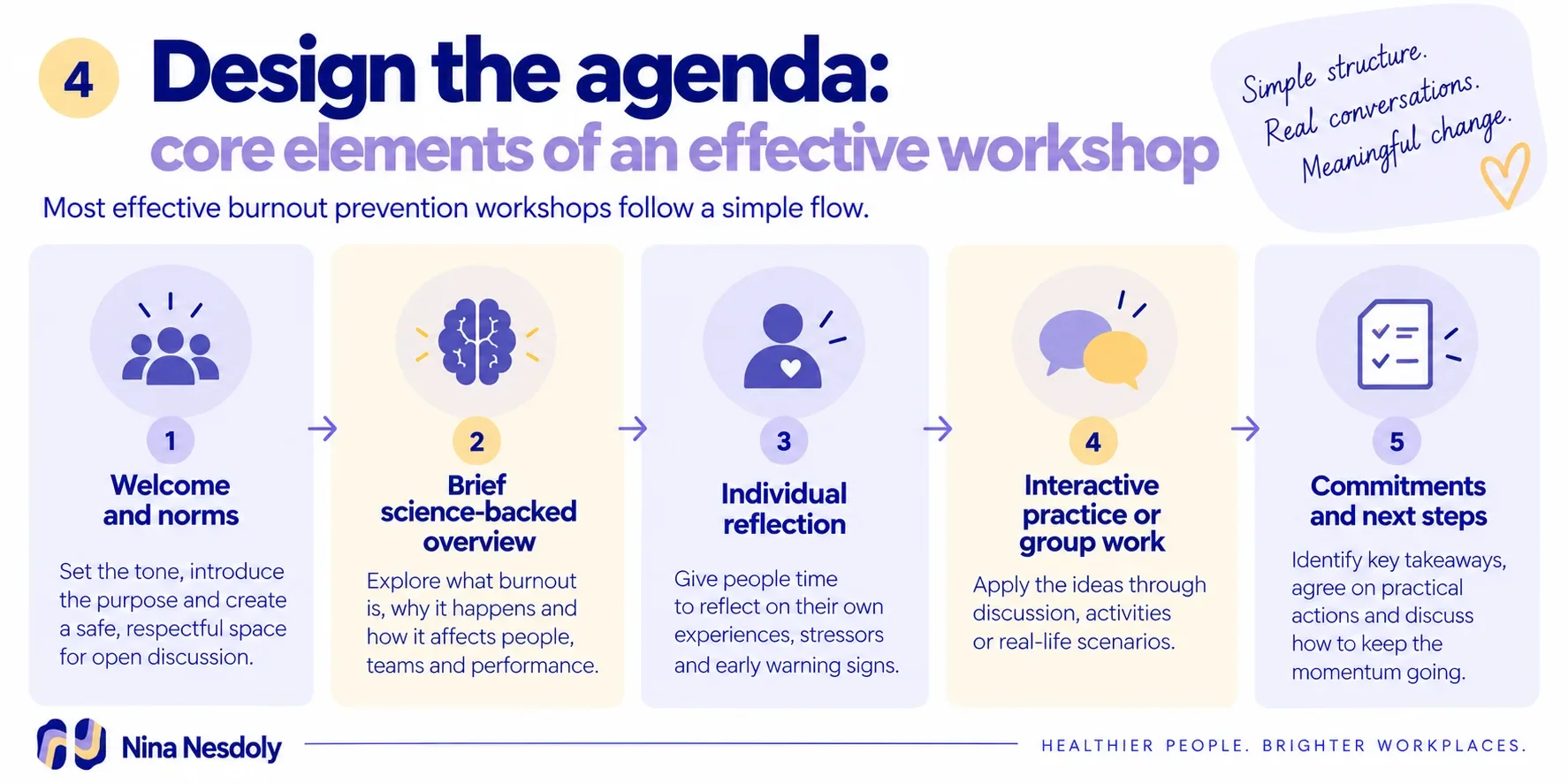
4. Design the agenda: core elements of an effective burnout prevention workshop
Most effective burnout prevention workshops follow a simple flow:
Welcome and norms
Brief science-backed overview
Individual reflection
Interactive practice or group work
Commitments and next steps
Below is how each part works in practice.
1. Welcome and norms (5–10 minutes)
Set the tone early.
Share the purpose of the session in clear, human language.
Acknowledge that burnout is a serious topic and people may have lived experience.
Establish 3–5 simple ground rules, like:
Confidentiality (stories stay, learnings leave).
Share at your own comfort level.
Listen to understand, not to fix.
No blaming individuals for systemic issues.
This is where psychological safety starts. You will reinforce it later.
2. Brief science-backed overview (10–20 minutes)
Offer a concise, research-informed overview:
What burnout is.
Common workplace causes.
Early signs to watch for.
Why prevention matters for both well-being and performance.
You do not need to be a neuroscientist yourself. Keep it clear and jargon-free. If you want to ground yourself beforehand, you can review an explanation of what burnout is, how chronic stress relates to burnout, and the signs of burnout.
Nina Nesdoly is a high-energy burnout and stress management speaker who blends neuroscience, academic research and storytelling to help teams work in a healthier, more sustainable way. Her TEDx Talk "How to Relieve Stress When You're Overwhelmed" selected as an Editor's Pick, is an example of how complex science can be made engaging and practical for everyday work challenges.
If you are facilitating internally, you can borrow this spirit: short teaching segments, grounded in research, with everyday language and relatable examples.
3. Individual reflection (5–10 minutes)
Give people quiet time to think. For example:
“On a scale from 1 to 10, how stretched do you feel at work right now? What is driving that number up or down?”
“What are 2–3 things that currently drain your energy at work?”
“What helps you recover during or after the workday?”
You can collect responses anonymously with sticky notes, a shared document or a polling tool. Or you can keep it private and use it just as a warm-up for later discussion.
4. Interactive practice and group work (20–40 minutes)
This is where you turn awareness into application.
Options include:
Pairs or trios: Share one current stressor and explore what is in their control, what is not, and one small step they could take.
Small groups: Map common team stressors and connect them to specific causes of burnout, then brainstorm possible adjustments.
Live practice: Try a brief stress management technique together, such as a short breathing exercise or a structured pause between meetings.
Mix listening, thinking and talking. People learn more when they are active, not just receiving information.
For ideas and structures, you can draw from this guide to burnout workshop activities.
5. Commitments and next steps (10–20 minutes)
Close by moving from ideas to action.
Ask participants what stood out and what they want to remember.
Facilitate a group conversation to identify 1–3 specific changes the team wants to pilot. Examples from Nina’s workshops include:
50-minute meetings with 10-minute buffers.
A protected learning afternoon once a month.
A morning no-meeting block.
A short daily or weekly check-in on capacity.
Clarify:
Who will own each change.
How you will test it.
When you will revisit it.
This is the bridge between “nice workshop” and real impact.
5. Choose evidence-based content: what to cover about burnout (and what to skip)
You do not need an exhaustive lecture on burnout. Aim for a few high-impact, research-backed topics that fit your goals and time.
At minimum, people should leave understanding:
What burnout is:
A clear, shared concept of burnout helps distinguish it from “just a busy week” or normal ups and downs. If you want a foundation for yourself before teaching, this what is burnout guide is written for workplace audiences.
Common causes at work:
Focus on work factors that contribute to burnout. For example, you can review common causes of workplace burnout as a prep resource, then pick the ones that feel most relevant to your organization.
Early signs to watch for:
Early recognition is prevention. People often find it helpful to know the signs of burnout in concrete language.
The role of chronic stress:
Burnout is usually linked to prolonged, unmanaged stress. If you want to deepen the science, you can draw from the explanation of chronic stress and its role in burnout.
What to skip in a short workplace workshop:
Detailed diagnostic criteria.
Graphic or fear-based content that could overwhelm or shame people.
Overly personal probing that could feel like therapy without proper support.
Keep it practical. Focus on giving people language, models and examples that help them understand their own experience and workplace realities.
A simple structure for planning engaging burnout workshop activities.
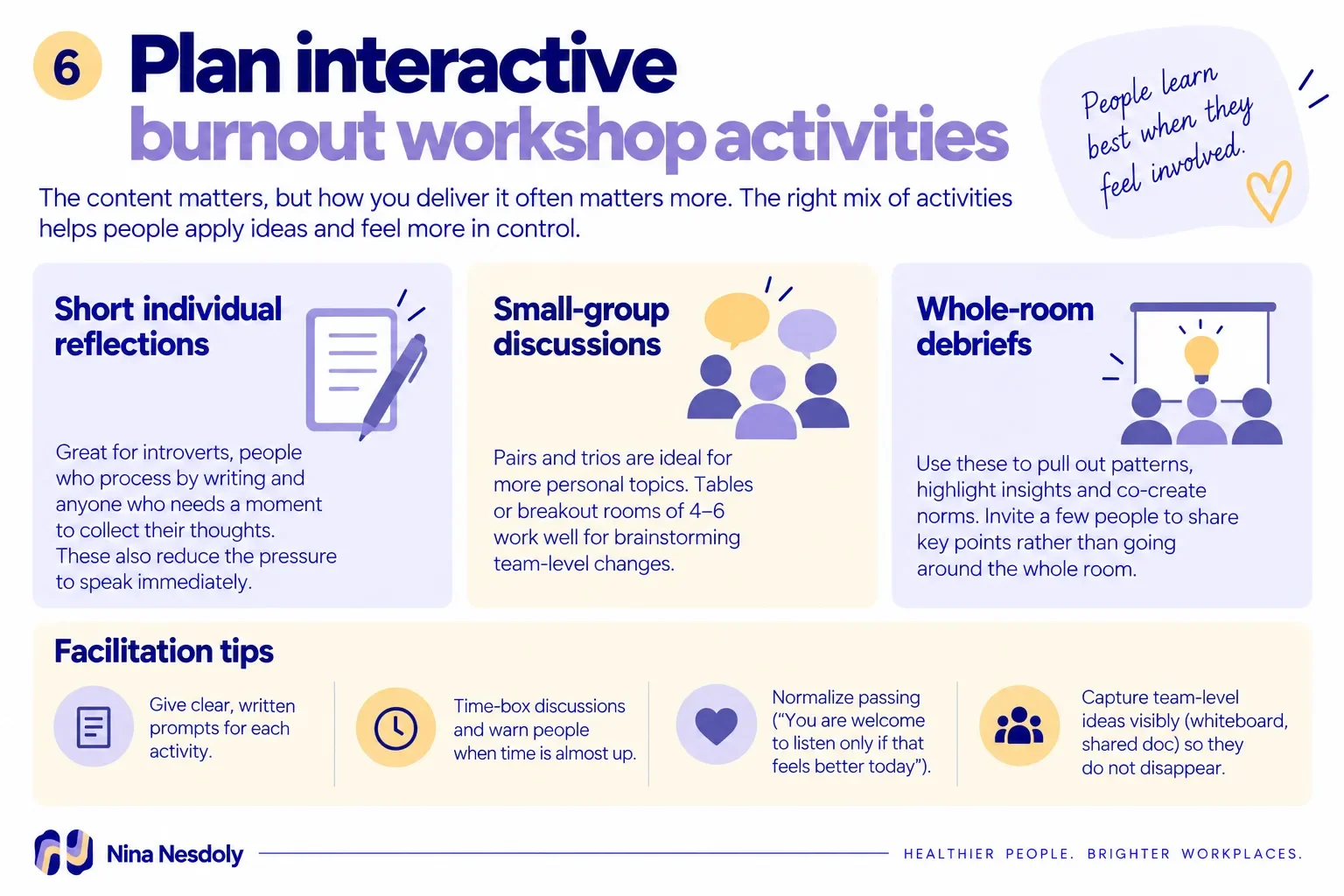
6. Plan interactive burnout workshop activities
The content matters, but how you deliver it often matters more.
A session with no interaction can feel like another presentation. A session with the right mix of activities helps people apply ideas and feel more in control.
Mix:
Short individual reflections
Great for introverts, people who process by writing and anyone who needs a moment to collect their thoughts. These also reduce the pressure to speak immediately.
Small-group discussions
Pairs and trios are ideal for more personal topics. Tables or breakout rooms of 4–6 work well for brainstorming team-level changes.
Whole-room debriefs
Use these to pull out patterns, highlight insights and co-create norms. Invite a few people to share key points rather than going around the whole room.
Facilitation tips:
Give clear, written prompts for each activity.
Time-box discussions and warn people when time is almost up.
Normalize passing (“You are welcome to listen only if that feels better today”).
Capture team-level ideas visibly (whiteboard, shared doc) so they do not disappear.
If you want ready-made structures and prompts, Nina has shared specific burnout workshop activities you can adapt to your context.
7. Create psychological safety and set expectations
Burnout is a sensitive topic. Some people in your session may be close to burnout or already beyond it.
To keep the workshop psychologically safe:
Open with explicit ground rules
As mentioned earlier, include confidentiality, voluntary sharing, non-judgment and respect for different experiences.
Acknowledge limits
Be clear that:
This is an educational and discussion session, not therapy.
You are not asking anyone to disclose personal health information.
People should share only what they are comfortable sharing.
Model vulnerability with boundaries
As a facilitator or leader, you can briefly share a time when work felt unsustainable for you and what helped, without turning the session into your story.
Offer options for support
Remind people of internal or external support channels if they find the topic activating.
Nina’s background as a Former Junior National Team cyclist and pro-elite athlete gives her a personal understanding of high performance and the pressures that come with it. In her corporate work, she combines that perspective with neuroscience and management research to create environments where high performers can talk honestly about limits and sustainability. You can mirror this by honoring both your team’s ambition and their humanity.
8. Link the workshop to your organization’s reality
The most common complaint about workplace wellness sessions is that they feel disconnected from real work. To avoid that:
Name the context
Briefly acknowledge high-level realities, such as growth targets, seasonal crunch periods or recent reorganizations, without blaming or overexplaining.
Invite participants to identify burnout risks
Ask questions like:
“What about our current workload, processes or culture might increase burnout risk?”
“Where do we see misalignment between expectations and capacity?”
“Which parts of our work feel most draining or unsustainable right now?”
You can connect this to the common causes of workplace burnout you reviewed in your prep, without turning it into a lecture.
Move from venting to problem-solving
Allow some space to name frustrations, then gently guide the group toward what is in their sphere of influence. For example:
Clarifying priorities.
Adjusting meeting practices.
Improving how you hand off work or communicate changes.
One organization that worked with Nina shared, “Nina’s teachings really resonated with our leadership team and inspired us to re-evaluate our work-life balance.” When you link workshop discussions directly to how your team sets deadlines, runs meetings or handles urgent requests, you make it easier for leaders and employees to see that re-evaluation path.

9. Build in follow-up and measurement
A single burnout prevention workshop has more impact when it is treated as the start of an ongoing conversation.
Simple follow-up ideas:
Short check-in surveys
A week or two after the session, ask:
What is one thing you tried?
What is working?
What do you still need?
Manager team huddles
Encourage managers to spend 10–15 minutes in team meetings revisiting agreed norms or pilot changes and adjusting them.
Resource round-up
Share slides, internal policies and links to relevant articles so people can revisit concepts. For example, you might include links to resources on what burnout is, signs to watch for and chronic stress.
Series format
If possible, run a short series of sessions. For example:
Session 1: Awareness and language.
Session 2: Team norms and processes.
Session 3: Individual strategies and boundaries.
Measurement does not need to be complex:
Baseline and follow-up pulses on perceived workload, stress levels, sense of control or clarity of expectations.
Tracking adoption of specific team norms (for example, percentage of meetings that honor the new 50-minute structure).
Organizations that implement even small changes sometimes see shifts quickly. As one team put it after working with Nina, “We saw immediate improvements in how our employees approached stress management. Highly recommend!” Your follow-up process helps you notice and reinforce those improvements.
A relaxed outdoor setting for a speaking or workshop introduction.
10. Decide: run it yourself or bring in an external burnout workshop facilitator
You can absolutely run a solid introductory burnout prevention workshop internally. In other situations, partnering with an external expert can unlock deeper impact.
Here is a simple way to think about the decision.
When an internal facilitator works well?
Consider running it yourself (or with another internal facilitator) when:
The group is small and trust is already high.
Your primary goal is awareness and shared language.
The content will be relatively light and non-personal.
You have some comfort facilitating group discussions.
You want to pilot a session quickly or with limited budget.
Internal facilitation can feel more informal and integrated into your culture, especially if HR and managers are already seen as supportive.
When an external expert adds value?
Consider bringing in a specialist like Nina when:
You want deeper, science-based content.
Nina is a Burnout & Corporate Stress Management Speaker and neuroscientist. She is a PhD candidate, a TEDx speaker, and holds a Bachelor's in Neuroscience and Master's in Management. This combination means she can speak with credibility to both brain science and organizational realities.
You need high-impact delivery.
She is known as a high-energy burnout and stress management speaker who blends neuroscience, academic research and storytelling, which can help engage teams that are skeptical or tired.
You want neutrality.
An external facilitator is not embedded in internal politics or performance evaluations. People may feel safer speaking honestly.
You are working with senior leadership.
Leaders may respond differently to an external expert, especially when invited to reflect on their own role in burnout prevention.
You are rolling out larger-scale, global or recurring sessions.
With over 50,000+ followers (source: Nina's website (ninanesdoly.com)), Nina’s work already reaches broad business audiences, and she serves organizations globally.
You do not have to choose one path forever. Many organizations start with an external workshop, then use internal facilitators to reinforce and extend the work.
Sample burnout prevention workshop agenda (60–90 minutes)
Use this as a plug-and-play template and adapt it to your context.
60-minute agenda
0–5 minutes: Welcome and purpose
Why we are here.
What this workshop will and will not do.
5–10 minutes: Ground rules and psychological safety
Confidentiality.
Voluntary sharing.
Respectful listening.
10–25 minutes: Burnout 101
What burnout is (and is not).
Common workplace causes.
Early signs to watch for.
25–35 minutes: Individual reflection
Quiet journaling on current stressors and supports.
Optional anonymous collection of themes.
35–50 minutes: Small-group activity
In groups of 3–5, map current team stressors to burnout risks.
Brainstorm possible changes within your control.
50–60 minutes: Whole-room commitments
Surface 1–2 small, specific changes the team wants to try.
Agree who will own each and how you will check in.
90-minute agenda
With 90 minutes, you can deepen each part:
0–10 minutes: Welcome, purpose and norms
10–30 minutes: Science-backed overview
Add a brief explanation of chronic stress and its role in burnout.
Include one short, guided stress management exercise.
30–40 minutes: Individual reflection
40–65 minutes: Interactive practice
Small groups work through a structured activity (for example, designing “our ideal week” within realistic constraints).
Each group identifies 1–2 potential team norms.
65–80 minutes: Team discussion
Compare proposed norms.
Discuss feasibility and potential barriers.
80–90 minutes: Commitments and closing
Finalize 1–3 norms to pilot.
Clarify next check-in date.
Invite feedback on the session.
This structure keeps a balance between content, reflection and co-creation, which is key to making the time feel worthwhile.
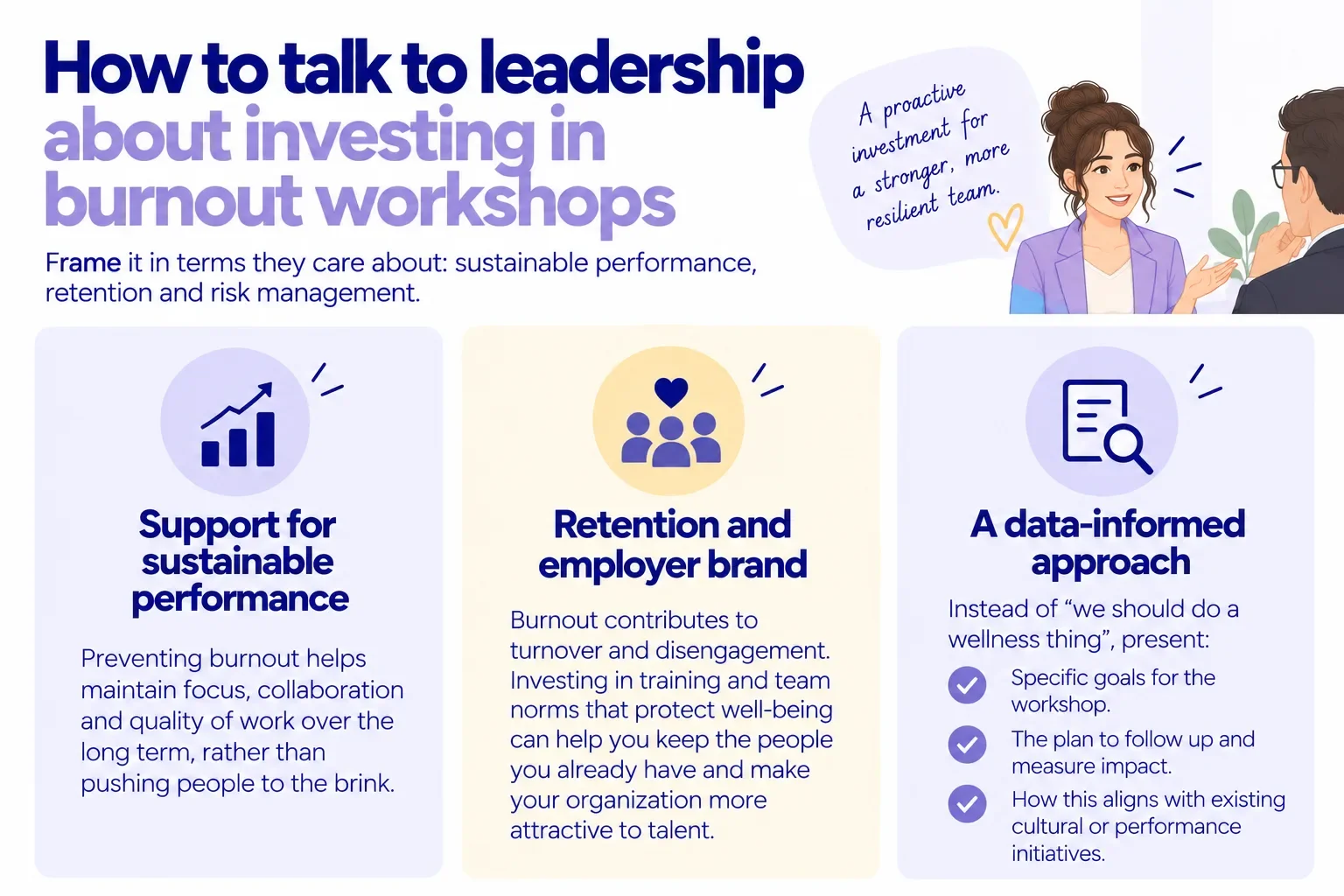
A simple framework for framing burnout workshops in leadership terms.
11. How to talk to leadership about investing in burnout workshops?
When you take this idea to leaders, frame it in terms they care about: sustainable performance, retention and risk management.
Ways to position burnout prevention:
Support for sustainable performance
Emphasize that preventing burnout helps maintain focus, collaboration and quality of work over the long term, rather than pushing people to the brink.
Retention and employer brand
Burnout contributes to turnover and disengagement. Showing that you invest in training and team norms that protect well-being can make your organization more attractive and help you keep the people you already have.
Data-informed approach
Instead of “we should do a wellness thing”, present:
Specific goals for the workshop.
The plan to follow up and measure impact.
How this aligns with existing cultural or performance initiatives.
You can also help leaders see that burnout is not only an individual resilience problem. A workshop is a tool for examining workload, processes and expectations together.
If you are proposing bringing in an external expert, share why that matters:
You want a neuroscientist and Burnout & Corporate Stress Management Speaker who can translate complex research into actionable steps.
You want someone with experience hosting corporate workshops, in person and online, for business settings.
You want a credible voice who can speak both to front-line employees and leadership.
Nina fits that profile. Her business-focused keynotes and team workshops are built for organizations that care about both well-being and performance.
Next steps: get support for your burnout prevention efforts
You now have a clear, science-informed structure for how to run a burnout session at work: set realistic goals, design a simple agenda, build in interaction and psychological safety, link the discussion to real work and follow up on concrete commitments.
A practical way to start is to pilot a 60- or 90-minute session with one team, using the sample agenda above. Gather feedback, refine your approach and then decide whether to expand, repeat or partner with an external specialist.
If you want expert support designing or delivering impactful burnout prevention workshops for your organization, you can book a Team Workshop with Nina here: Book a Team Workshop.
FAQs
How long should a burnout prevention workshop be?
For most workplaces, 60–90 minutes is ideal. Sixty minutes allows for a brief overview, one interactive activity and simple commitments. Ninety minutes gives you space for deeper discussion and more robust team norms without overwhelming people.
What should I include in a burnout workshop?
Include a clear purpose, ground rules for psychological safety, a short science-backed overview of what burnout is and common causes, time for individual reflection, at least one interactive activity that connects concepts to your team’s real work and a closing segment where the team agrees on specific next steps.
Can I run a burnout session without an external facilitator?
Yes. Many HR professionals and managers successfully run internal burnout prevention sessions, especially for awareness-building and early conversations. Use a clear agenda, keep content grounded in research and invest extra care in psychological safety. Consider bringing in an external expert for more advanced content, leadership-focused work or when team dynamics are complex.
How do I keep a burnout workshop psychologically safe?
Set expectations at the start, with clear ground rules about confidentiality, voluntary sharing and non-judgment. Avoid pressuring anyone to disclose personal experiences. Acknowledge that burnout is serious and can be painful to talk about, and point people to appropriate support if needed. Throughout the session, model respectful listening, normalize a range of experiences and keep the focus on learning and constructive change rather than blame.
This article is educational and is not medical advice. If burnout is affecting you or your team, please talk to a qualified health professional.